 Back
Biomolecules: Carbohydrates and Functional Groups
Study Guide - Smart Notes
 Tailored notes based on your materials, expanded with key definitions, examples, and context.
Carbohydrates
Monomers: Monosaccharides
Carbohydrates are organic molecules composed of carbon, hydrogen, and oxygen, and are essential for energy storage and structural functions in living organisms. The simplest carbohydrates are monosaccharides, also known as simple sugars.
Examples:
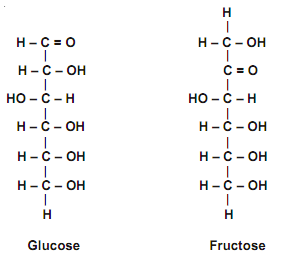
Glucose (C6H12O6)
Fructose (C6H12O6)
Isomers: Molecules with the same chemical formula but different structural arrangements.
Example: Glucose and fructose are isomers, both with the formula C6H12O6, but with different atomic arrangements.
Linear and Ring Structures
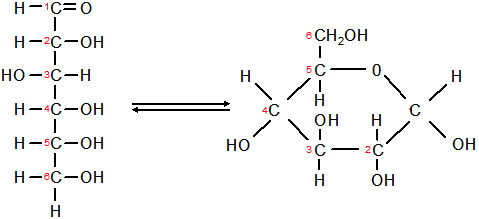
Monosaccharides can exist in both linear and ring forms, especially in aqueous solutions. The ring structure is more common in biological systems.
Disaccharides
When two monosaccharides join together via a dehydration reaction, they form a disaccharide.
Examples:
Glucose + Fructose = Sucrose (table sugar)
Glucose + Galactose = Lactose (milk sugar)
Polysaccharides
Polysaccharides are long chains of monosaccharide units and serve as storage or structural molecules.
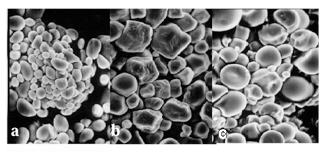
Starch: Storage polysaccharide in plants.
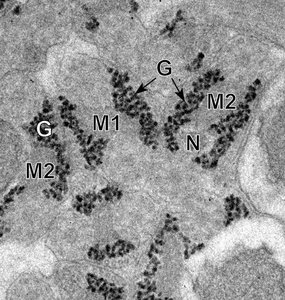
Glycogen: Storage polysaccharide in animals, mainly in the liver; provides glucose on demand.
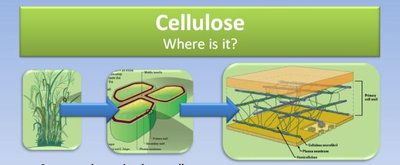
Cellulose: Structural polysaccharide in plants; major component of wood and plant cell walls.
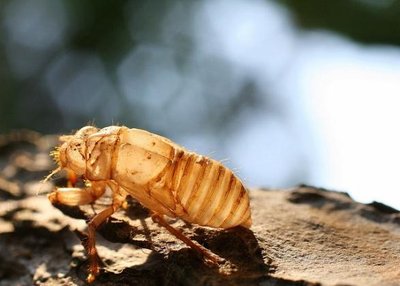
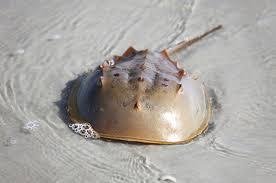
Chitin: Structural polysaccharide in animals; found in insect exoskeletons and whiskers.

Properties of Carbohydrates
Hydrophilic vs. Hydrophobic
Carbohydrates can be classified based on their interaction with water:
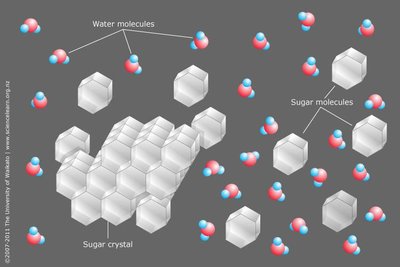
Hydrophilic: Polar covalent molecules that are attracted to or dissolve in water. Example: Sugars.
Hydrophobic: Non-polar covalent molecules that do not dissolve in water. Example: Cellulose, chitin.
Functional Groups in Biomolecules
Common Functional Groups
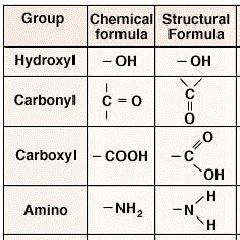
Functional groups are specific groups of atoms within molecules that are responsible for the characteristic chemical reactions of those molecules. The most common functional groups in biological molecules include:
Hydroxyl (–OH): Found in alcohols and carbohydrates.
Carbonyl (C=O): Found in ketones and aldehydes.
Carboxyl (–COOH): Found in organic acids.
Amino (–NH2): Found in amino acids and proteins.
Group | Chemical formula | Structural Formula |
|---|---|---|
Hydroxyl | –OH | –OH |
Carbonyl | C=O |
|
Carboxyl | –COOH | –COOH |
Amino | –NH2 | –NH2 |
Representation of Molecular Structures
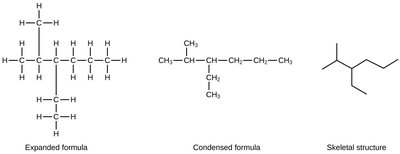
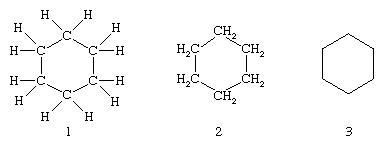
Molecules can be represented in several ways to convey different levels of detail:
Expanded formula: Shows all atoms and bonds.
Condensed formula: Groups atoms to simplify the structure.
Skeletal structure: Uses lines to represent bonds between carbon atoms, omitting hydrogen atoms for clarity.
Summary Table: Functional Groups
Group | Chemical formula | Structural Formula |
|---|---|---|
Hydroxyl | –OH | –OH |
Carbonyl | C=O |
|
Carboxyl | –COOH | –COOH |
Amino | –NH2 | –NH2 |
Key Equations
General Formula for Monosaccharides
Monosaccharides typically follow the formula:
Formation of Disaccharides
Disaccharides are formed by a dehydration reaction:
Additional info:
Carbohydrates are classified as monosaccharides, disaccharides, and polysaccharides based on the number of sugar units.
Functional groups determine the reactivity and properties of biomolecules.
