 Back
Biomolecules: Carbon, Functional Groups, Carbohydrates, Lipids, Proteins, and Nucleic Acids
Study Guide - Smart Notes
 Tailored notes based on your materials, expanded with key definitions, examples, and context.
Carbon: The Foundation of Life
Importance of Carbon in Biological Molecules
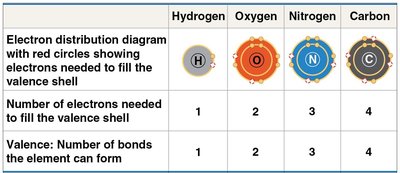
Carbon is a fundamental element in biology due to its unique ability to form four covalent bonds, allowing for a diversity of stable, complex molecular structures. This versatility makes carbon the backbone of all major biological macromolecules.
Electron Configuration: Carbon has four electrons in its valence shell, enabling it to form up to four covalent bonds with other atoms.
Structural Diversity: Carbon can create chains, branches, and rings, leading to a wide variety of organic molecules.
Biological Relevance: All major macromolecules—carbohydrates, lipids, proteins, and nucleic acids—are built upon carbon skeletons.
Bond Formation and Carbon Skeletons
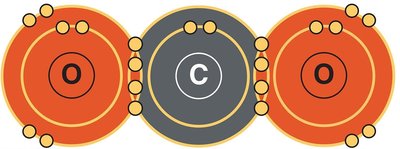
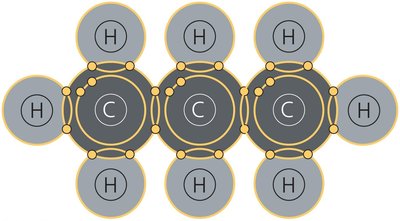
The ability of carbon to form bonds with itself and other elements is central to molecular diversity in living organisms.
Bonding with Other Elements: Carbon forms stable covalent bonds with elements such as hydrogen, oxygen, and nitrogen.
Bonding with Carbon: Carbon-carbon bonds allow for the formation of long chains and rings, which are essential for complex biomolecules.
 Im smart
Variation in Carbon Structures
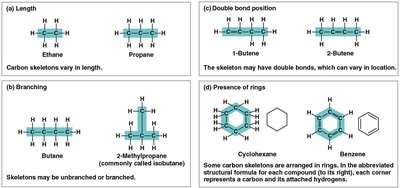
Carbon skeletons can vary in length, branching, double bond position, and presencIm smarte of rings, contributing to molecular diversity.
Length: Carbon chains can be short or long.
Branching: Chains may be unbranched or branched.
Double Bonds: Double bonds can vary in position along the chain.
Rings: Some carbon skeletons form rings, such as cyclohexane and benzene.
Functional Groups in Biomolecules
Common Functional Groups and Their Properties
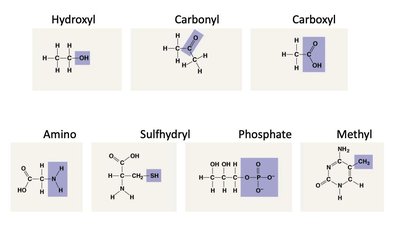
Functional groups are specific groups of atoms within molecules that determine the chemical properties and reactivity of those molecules. Each functional group participates in chemical reactions in a characteristic way.
Hydroxyl (-OH): Polar, forms hydrogen bonds, increases solubility in water.
Carbonyl (C=O): Found in aldehydes and ketones, polar.
Carboxyl (-COOH): Acidic, can donate a proton (H+).
Amino (-NH2): Basic, can accept a proton.
Sulfhydryl (-SH): Can form disulfide bonds, important in protein structure.
Phosphate (-PO4): Contributes negative charge, important in energy transfer (e.g., ATP).
Methyl (-CH3): Nonpolar, affects gene expression and molecular function.
Functional Groups Affect Function
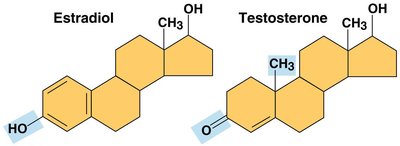
The presence and arrangement of functional groups in molecules such as hormones can dramatically affect their biological activity.
Example: Estradiol and testosterone differ only in their functional groups, yet have distinct effects in organisms.
Macromolecules: Structure and Function
Polymers and Monomers
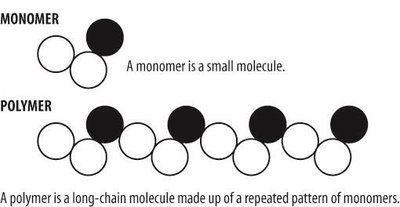
Most biological macromolecules are polymers, which are long chains made from repeating units called monomers.
Monomer: A small molecule that can join with others to form a polymer.
Polymer: A large molecule composed of many monomers linked together.
Synthesis and Breakdown of Polymers
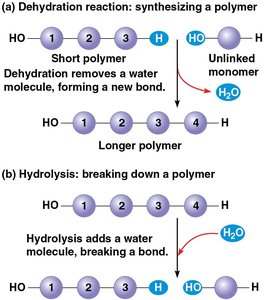
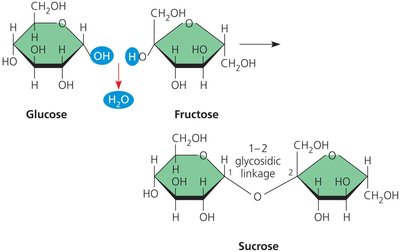
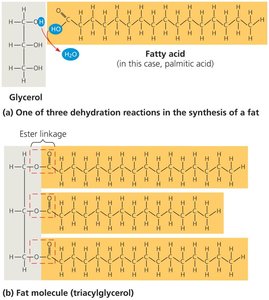
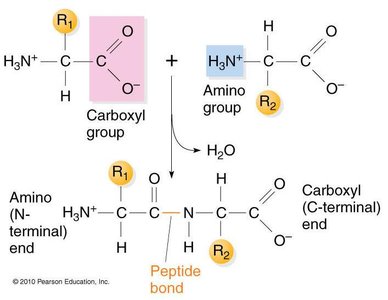
Dehydration Reaction: Joins monomers by removing a water molecule, forming a new bond.
Hydrolysis: Breaks polymers into monomers by adding a water molecule.
Carbohydrates
Monosaccharides: Simple Sugars
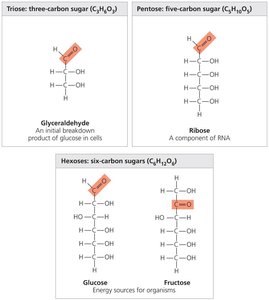
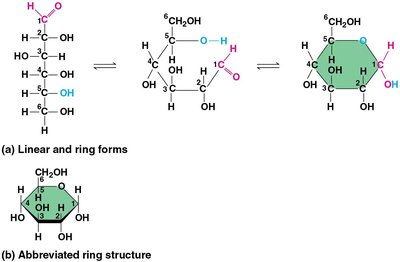
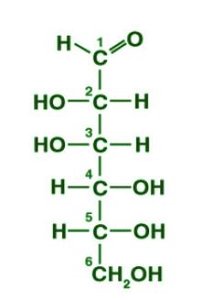
Carbohydrates are organic molecules consisting of carbon, hydrogen, and oxygen, typically in a ratio of 1:2:1. Monosaccharides are the simplest carbohydrates and serve as energy sources and building blocks for more complex carbohydrates.
Glucose (C6H12O6): The most common monosaccharide.
Classification: Based on the number of carbons and the placement of the carbonyl group.
Disaccharides and Polysaccharides
Disaccharides: Formed by joining two monosaccharides via a glycosidic bond (e.g., sucrose).
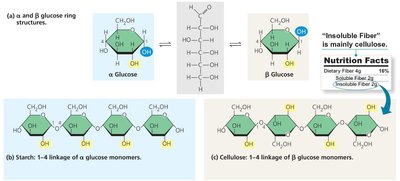
Polysaccharides: Long chains of monosaccharides; include starch (plants), glycogen (animals), and cellulose (plants).
Characteristics of Carbohydrates
Carbohydrates serve as energy sources, structural materials, and are involved in cell recognition.
Starch: Storage polysaccharide in plants.
Glycogen: Storage polysaccharide in animals.
Cellulose: Structural component in plant cell walls.
Lipids
Hydrophobic Nature and Types of Lipids
Lipids are hydrophobic molecules, primarily composed of hydrocarbons. They include fats, phospholipids, and steroids.
Fats: Store energy, composed of glycerol and fatty acids.
Phospholipids: Major component of cell membranes.
Steroids: Include hormones like cholesterol.

Saturated and Unsaturated Fats
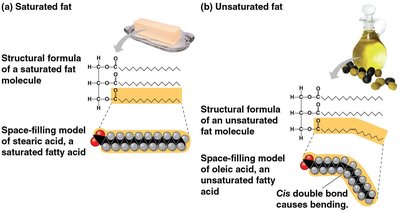
Saturated Fats: No double bonds, solid at room temperature.
Unsaturated Fats: One or more double bonds, liquid at room temperature, cis double bonds cause bending.
Proteins
Structure and Function of Proteins
Proteins are polymers of amino acids and perform a wide range of functions, including catalysis, structure, transport, and signaling.
Amino Acids: Building blocks of proteins, each with a unique side chain (R group).
Peptide Bonds: Link amino acids together to form polypeptides.
Classification of Amino Acids
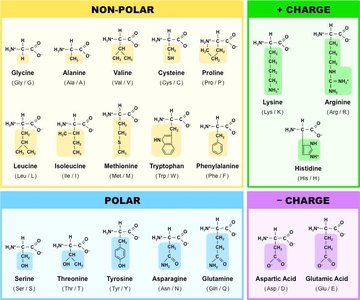
Amino acids are classified based on the properties of their side chains: non-polar, polar, positively charged, and negatively charged.
Non-polar: Hydrophobic side chains.
Polar: Hydrophilic side chains.
Charged: Acidic (negative) or basic (positive) side chains.
Protein Folding and Structure
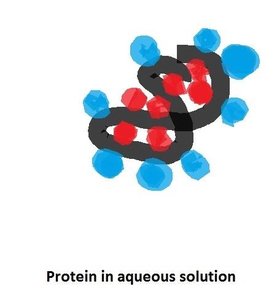
Proteins fold into specific three-dimensional shapes, which determine their function. Hydrophobic and hydrophilic regions influence folding in aqueous environments.
Primary Structure: Sequence of amino acids.
Secondary, Tertiary, Quaternary Structures: Higher levels of folding and organization.
Nucleic Acids
DNA and RNA: Structure and Function
Nucleic acids are polymers of nucleotides and are responsible for storing and transmitting genetic information.
DNA: Double-stranded, forms a double helix, contains deoxyribose sugar.
RNA: Single-stranded, contains ribose sugar.
Nucleotides: Composed of a sugar, phosphate group, and nitrogenous base.
Phosphodiester Linkages and Base Pairing
Phosphodiester Linkage: Joins nucleotides in a nucleic acid chain.
Base Pairing: Adenine pairs with thymine (or uracil in RNA), cytosine pairs with guanine.
DNA as a Tape Measure of Evolution
DNA sequence similarity is used to assess evolutionary relationships among individuals and species.
Greater similarity: Indicates closer biological relationship.
Molecular biology: Used to study evolutionary history.
Case Study: Fueling the Summit
Carbon in Nutrition and Energy Storage
Glucose: Rapidly used for energy during intense activity.
Lipids: Provide more energy per gram than carbohydrates, used during prolonged activity.
Glycogen: Storage form of glucose in animals; genetic mutations affecting glycogen breakdown can cause fatigue.
Summary Table: Valence and Bonding of Key Elements
Hydrogen | Oxygen | Nitrogen | Carbon | |
|---|---|---|---|---|
Electron distribution diagram | H | O | N | C |
Number of electrons needed to fill the valence shell | 1 | 2 | 3 | 4 |
Valence: Number of bonds the element can form | 1 | 2 | 3 | 4 |
Additional info:
All explanations are expanded for academic completeness and clarity.
Images included are directly relevant to the adjacent content and reinforce key concepts.
