 Back
Chapter 2 : Biomolecules
Study Guide - Smart Notes
 Tailored notes based on your materials, expanded with key definitions, examples, and context.
Biomolecules
Introduction to Organic Molecules
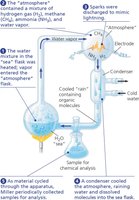
Organic molecules are compounds primarily composed of carbon atoms bonded with hydrogen, oxygen, nitrogen, sulfur, and phosphorus. Their diversity and complexity are foundational to life. Organic chemistry is central to understanding the origin of life, as organic compounds can form spontaneously under certain conditions, as demonstrated by classic experiments.
Organic Compounds: Molecules containing carbon and hydrogen, often with other elements.
Origin of Life: Experiments such as Miller-Urey simulated early Earth conditions, showing that organic molecules like amino acids could form spontaneously.
Major Elements of Life: Carbon (C), Hydrogen (H), Oxygen (O), Nitrogen (N), Sulfur (S), and Phosphorus (P).
Examples: Formaldehyde (CH2O), Hydrogen Cyanide (HCN), amino acids, and hydrocarbons.
Carbon: The Backbone of Biological Molecules
Atomic Structure and Bonding
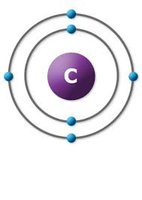
Carbon's unique electron configuration allows it to form four covalent bonds, resulting in a vast array of molecular structures. This versatility is key to the diversity of organic molecules.
Electron Configuration: Carbon has four valence electrons, enabling it to form single, double, or triple bonds with other atoms.
Covalent Bonding: Carbon forms stable covalent bonds with itself and other elements, creating chains, rings, and complex structures.
Shape and Function: The three-dimensional shape of carbon-based molecules is directly related to their biological function.
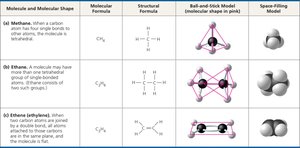
Examples of Carbon Compounds
Carbon forms the basis of many important biological molecules, including methane, ethane, and ethene. The arrangement of atoms affects the molecule's shape and properties.
Valence and Bonding Capacity
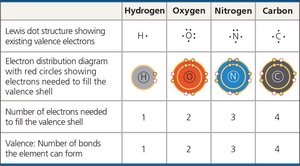
The number of bonds an atom can form is determined by its valence electrons. This property is crucial for understanding molecular structure and reactivity.
Hydrogen | Oxygen | Nitrogen | Carbon | |
|---|---|---|---|---|
Lewis dot structure | H• | •O• | •N• | •C• |
Electrons needed to fill shell | 1 | 2 | 3 | 4 |
Valence (bonds formed) | 1 | 2 | 3 | 4 |
Molecular Diversity: Variations in Carbon Skeletons
Types of Carbon Skeletons
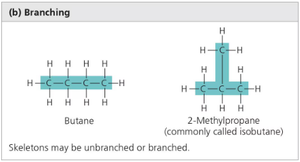
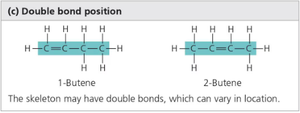
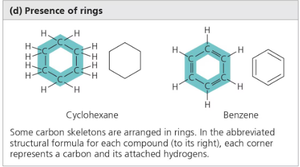
Carbon chains can vary in length, branching, double bond position, and ring formation, contributing to the diversity of organic molecules.
Length: Carbon chains can be short or long.
Branching: Chains may be unbranched or branched.
Double Bond Position: Double bonds can occur at different positions along the chain.
Rings: Carbon skeletons can form rings, such as cyclohexane and benzene.
Isomers: Structural Diversity
Types of Isomers
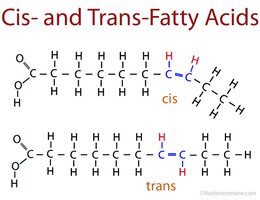
Isomers are compounds with the same molecular formula but different structures, leading to different properties.
Structural Isomers: Differ in the covalent arrangement of atoms.
Cis-trans (Geometric) Isomers: Differ in spatial arrangement around a double bond.
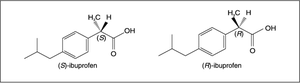
Enantiomers: Mirror images of each other, often with different biological activities.
Chemical Groups and Functional Diversity
Functional Groups
Chemical groups attached to carbon skeletons affect the molecular shape, charge, and reactivity, playing a critical role in biological processes.
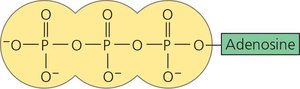
Hydroxyl, Carbonyl, Carboxyl, Amino, Sulfhydryl, Phosphate, Methyl: Each group imparts specific properties to molecules, such as polarity, acidity, or the ability to participate in chemical reactions.
Hydrophilicity: Most functional groups (except methyl and sulfhydryl) increase solubility in water.
Methyl Group: Often serves as a molecular tag, affecting gene expression.
Macromolecules: Polymers and Monomers
Polymerization and Depolymerization
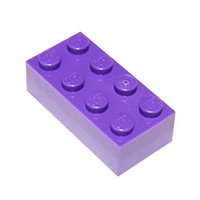
Macromolecules are large molecules formed by the polymerization of smaller units called monomers. Polymer assembly and disassembly involve dehydration and hydrolysis reactions.
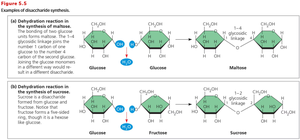
Dehydration Reaction: Joins monomers by removing a water molecule.
Hydrolysis Reaction: Breaks polymers into monomers by adding water.
Carbohydrates
Structure and Function
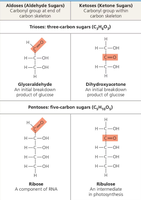
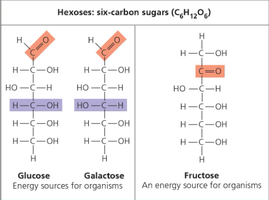
Carbohydrates are sugars and their polymers, serving as energy sources and structural materials. They are classified as monosaccharides, disaccharides, and polysaccharides.
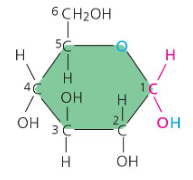
Monosaccharides: Simple sugars (e.g., glucose, fructose).
Disaccharides: Two monosaccharides joined by a glycosidic bond (e.g., maltose, sucrose).
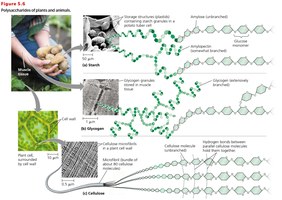
Polysaccharides: Long chains of monosaccharides (e.g., starch, glycogen, cellulose).
Lipids
Structure and Types
Lipids are hydrophobic molecules, not true polymers, and include fats, phospholipids, and steroids. They are important for energy storage, membrane structure, and signaling.
Fats: Composed of glycerol and fatty acids; store energy.
Phospholipids: Major components of cell membranes.
Steroids: Include cholesterol and hormones such as testosterone and estrogen.
Proteins
Structure and Function
Proteins are polymers of amino acids, performing a vast array of functions in cells. Their function depends on their complex three-dimensional structure.
Amino Acids: 20 different types, each with a unique R group.
Polypeptides: Chains of amino acids linked by peptide bonds.
Protein Structure: Four levels—primary, secondary, tertiary, and quaternary—determine function.
Denaturation: Changes in pH, temperature, or salinity can disrupt protein structure and function.
Nucleic Acids
DNA and RNA
Nucleic acids store, transmit, and express hereditary information. DNA and RNA are polymers of nucleotides, each with a unique sequence that encodes genetic information.
DNA: Double-stranded, stores genetic information.
RNA: Single-stranded, involved in protein synthesis and gene regulation.
Flow of Information: DNA → RNA → Protein (Central Dogma of Molecular Biology).
Key Concepts
Macromolecules are polymers built from monomers.
Dehydration and hydrolysis reactions assemble and disassemble polymers.
Carbohydrates serve as fuel and building material.
Lipids are a diverse group of hydrophobic molecules.
Proteins have diverse structures and functions.
Nucleic acids store, transmit, and help express hereditary information.
