 Back
Biomolecules: Structure, Function, and Diversity in Cells
Study Guide - Smart Notes
 Tailored notes based on your materials, expanded with key definitions, examples, and context.
Biomolecules: Structure, Function, and Diversity in Cells
Introduction to Biomolecules
Biomolecules are essential organic compounds that form the foundation of all living organisms. Cells synthesize large, complex molecules from a limited set of small molecules, primarily through the assembly of monomers into polymers. The four major classes of biomolecules are nucleic acids, proteins, carbohydrates, and lipids. These macromolecules are critical for structure, function, and regulation of the body's tissues and organs.
Macromolecules are large molecules, often polymers, made from repeating units called monomers.
Cells are composed of about 80% water; the remaining 20% consists of these biomolecules in varying proportions.
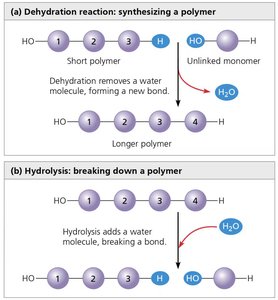
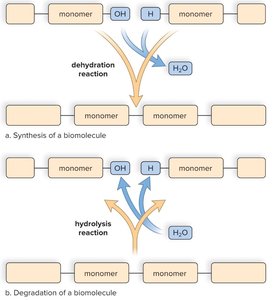
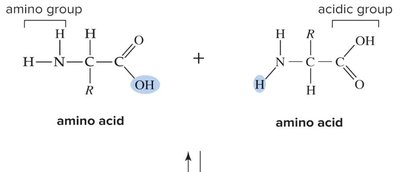
Polymers are synthesized by dehydration synthesis (condensation) and broken down by hydrolysis.
Major Classes of Biomolecules
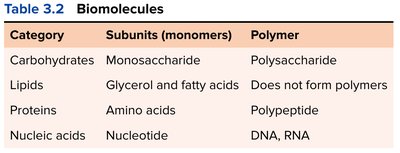
Category | Subunits (Monomers) | Polymer |
|---|---|---|
Carbohydrates | Monosaccharide | Polysaccharide |
Lipids | Glycerol and fatty acids | Does not form polymers |
Proteins | Amino acids | Polypeptide |
Nucleic acids | Nucleotide | DNA, RNA |
Carbon: The Backbone of Life
Properties of Carbon
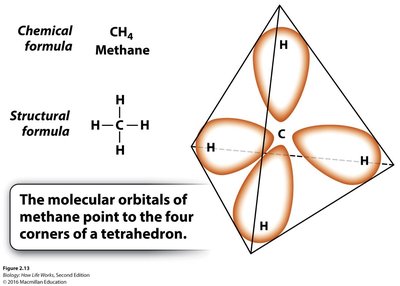
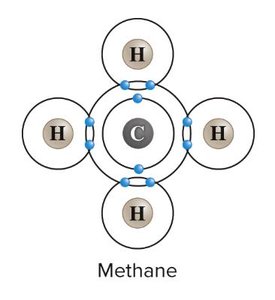
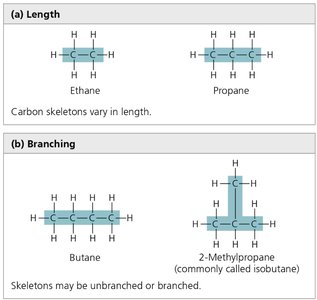
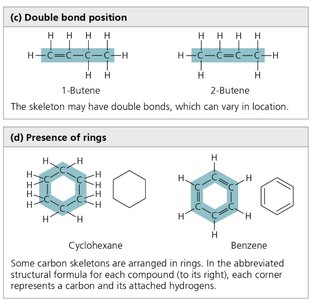
Carbon is the central element in organic molecules due to its ability to form four covalent bonds, allowing for a diversity of stable structures. This versatility enables the formation of chains, branches, and rings, which are the basis for the complexity of biological molecules.
Carbon atoms can bond to four other atoms, creating a tetrahedral geometry.
Carbon-based molecules are called organic compounds.
Carbon skeletons can vary in length, branching, double bond position, and ring formation.
Elemental Composition of Cells
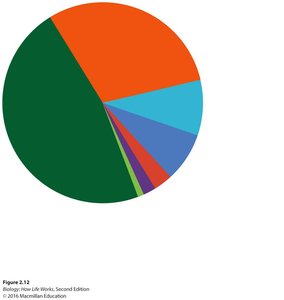
The majority of a cell's dry mass is composed of carbon, oxygen, hydrogen, and nitrogen, with smaller amounts of phosphorus, sulfur, and other elements.
Carbon (C): 47%
Oxygen (O): 30%
Hydrogen (H): 9%
Nitrogen (N): 8%
Other elements (P, S, K, Ca, Na, Cl, Mg): minor percentages
Functional Groups in Biomolecules
Definition and Importance
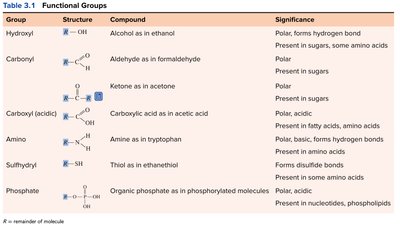
Functional groups are specific groups of atoms within molecules that are responsible for the characteristic chemical reactions of those molecules. They play a crucial role in the structure and function of biomolecules.
Common functional groups include hydroxyl, carbonyl, carboxyl, amino, sulfhydryl, and phosphate.
Functional groups determine the properties and reactivity of organic molecules.
Group | Structure | Compound | Significance |
|---|---|---|---|
Hydroxyl | –OH | Alcohols | Polar, forms hydrogen bonds |
Carbonyl | –C=O | Aldehydes, Ketones | Polar, present in sugars |
Carboxyl | –COOH | Carboxylic acids | Polar, acidic |
Amino | –NH2 | Amines | Polar, basic |
Sulfhydryl | –SH | Thiols | Forms disulfide bonds |
Phosphate | –PO4 | Organic phosphates | Polar, acidic |
Formation and Breakdown of Polymers
Dehydration Synthesis and Hydrolysis
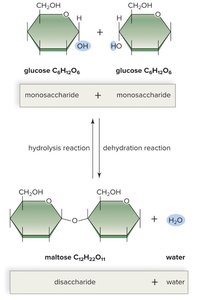
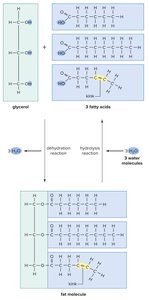
Polymers are formed by linking monomers through dehydration synthesis, a reaction that removes a water molecule to form a new bond. Conversely, hydrolysis breaks polymers into monomers by adding water.
Dehydration synthesis: Joins monomers, releasing water.
Hydrolysis: Breaks polymers, consuming water.
Carbohydrates
Structure and Function
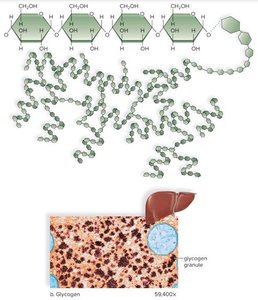
Carbohydrates are composed of monosaccharide monomers, such as glucose. They serve as energy sources and structural components in cells. Disaccharides and polysaccharides are formed by dehydration synthesis of monosaccharides.
Monosaccharides: Simple sugars (e.g., glucose, C6H12O6).
Disaccharides: Two monosaccharides joined (e.g., maltose).
Polysaccharides: Long chains of monosaccharides (e.g., glycogen, starch).
Lipids
Structure and Function
Lipids are hydrophobic molecules that include fats, oils, and phospholipids. They are not true polymers but are assembled from glycerol and fatty acids. Lipids function as energy storage, insulation, and components of cell membranes.
Fats: Composed of glycerol and three fatty acids (triglycerides).
Phospholipids: Major component of cell membranes.
Proteins
Structure and Function
Proteins are polymers of amino acids linked by peptide bonds. They perform a vast array of functions, including catalysis (enzymes), structure, transport, and signaling. The structure of a protein determines its function and is organized into four levels: primary, secondary, tertiary, and quaternary.
Primary structure: Sequence of amino acids.
Secondary structure: Alpha helices and beta sheets formed by hydrogen bonding.
Tertiary structure: Three-dimensional folding due to side chain interactions.
Quaternary structure: Association of multiple polypeptide subunits.
Protein Folding and Denaturation
The folding of proteins is determined by the chemical properties of their side chains. Changes in temperature or pH can disrupt these interactions, leading to denaturation and loss of function.
Hydrophobic side chains: Tend to be buried inside the protein.
Hydrophilic side chains: Exposed to the aqueous environment.
Denaturation: Loss of three-dimensional structure and function due to environmental changes.
Nucleic Acids
Structure and Function
Nucleic acids, including DNA and RNA, are polymers of nucleotides. They store and transmit genetic information and direct the synthesis of proteins. Each nucleotide consists of a sugar, a phosphate group, and a nitrogenous base.
DNA: Double-stranded helix, stable, stores genetic information.
RNA: Single-stranded, less stable, involved in protein synthesis and regulation.
Nucleotide structure: Sugar (ribose or deoxyribose), phosphate, nitrogenous base (A, T, G, C, U).
Phosphodiester bonds: Link nucleotides in a chain, giving directionality (5' to 3').
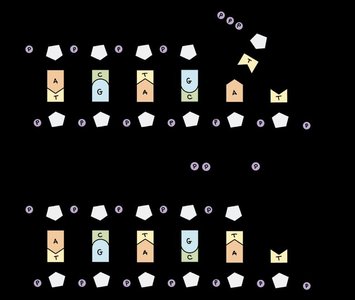
Base Pairing and Replication
In DNA, bases pair specifically (A with T, G with C) via hydrogen bonds, ensuring accurate replication. The two strands are antiparallel, and the sequence of bases encodes genetic information.
Base pairing: A=T (2 hydrogen bonds), G≡C (3 hydrogen bonds).
Replication: Each strand serves as a template for a new complementary strand.
Summary and Key Concepts
pH affects the ionization and behavior of biomolecules, especially proteins and nucleic acids.
Carbon is the backbone of biomolecules due to its bonding versatility.
Functional groups determine the chemical properties and reactivity of biomolecules.
Dehydration synthesis and hydrolysis are key reactions in the formation and breakdown of polymers.
Understanding the structure and function of biomolecules is fundamental to all biological processes.
