 Back
Biomolecules: Structure, Function, and Synthesis in General Biology
Study Guide - Smart Notes
 Tailored notes based on your materials, expanded with key definitions, examples, and context.
Macromolecules and Polymers
Overview of Biological Macromolecules
Biological macromolecules are large, complex molecules essential for life, constructed from smaller units called monomers. Cells synthesize these macromolecules from a limited set of small molecules, and they play critical roles in structure, function, and regulation.
Macromolecules are often polymers, which are long chains of monomers.
Four major classes: Nucleic acids, Proteins, Carbohydrates, and Lipids.
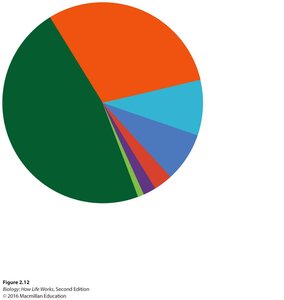
Cells are composed of ~80% water; the remaining 20% consists of these biomolecules in varying proportions.
Polymer Formation and Breakdown
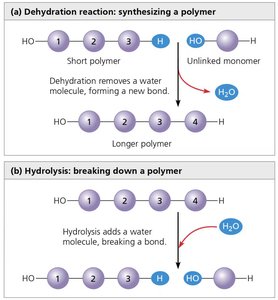
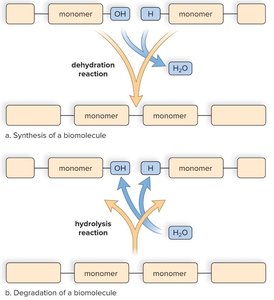
Macromolecules are assembled and disassembled through specific chemical reactions.
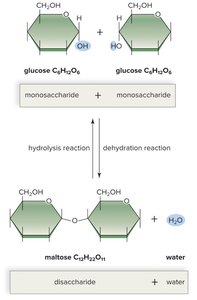
Dehydration Synthesis (Condensation): Joins monomers by removing a water molecule, forming a polymer.
Hydrolysis: Breaks polymers into monomers by adding water.
Biomolecule Classification
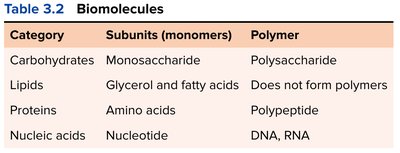
The four classes of biomolecules differ in their monomers and polymers.
Category | Subunits (Monomers) | Polymer |
|---|---|---|
Carbohydrates | Monosaccharide | Polysaccharide |
Lipids | Glycerol and fatty acids | Does not form polymers |
Proteins | Amino acids | Polypeptide |
Nucleic acids | Nucleotide | DNA, RNA |
Carbon: The Backbone of Life
Properties of Carbon
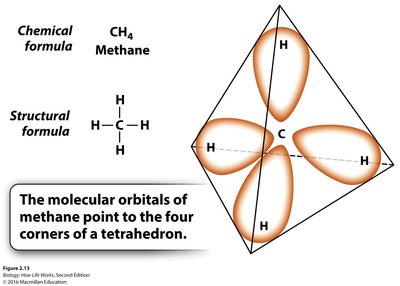
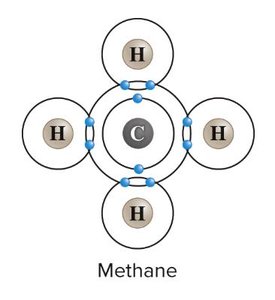
Carbon is the foundational element in organic molecules due to its versatile bonding properties.
Can form four covalent bonds, allowing for diverse molecular shapes and functions.
Carbon-based molecules are called organic compounds.
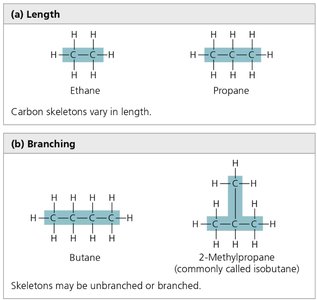
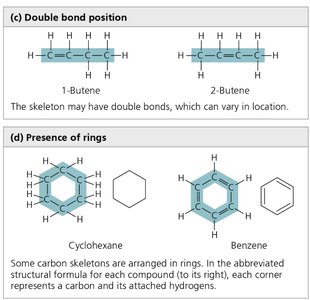
Carbon skeletons can vary in length, branching, double bond position, and ring formation.
Functional Groups in Biomolecules
Key Functional Groups
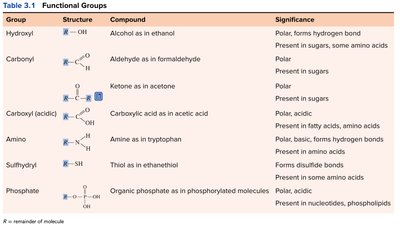
Functional groups are specific groups of atoms attached to the carbon backbone, determining the chemical reactivity and properties of biomolecules.
Common functional groups: Hydroxyl, Carboxyl, Amino, Sulfhydryl, Phosphate, Methyl.
Functional groups participate in chemical reactions and contribute to structural diversity.
Group | Structure | Compound | Significance |
|---|---|---|---|
Hydroxyl | –OH | Alcohol | Polar, forms hydrogen bonds |
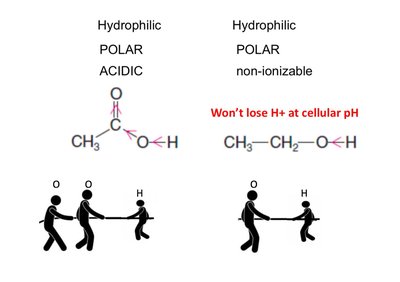
Carboxyl | –COOH | Carboxylic acid | Polar, acidic |
Amino | –NH2 | Amine | Polar, basic |
Sulfhydryl | –SH | Thiols | Forms disulfide bonds |
Phosphate | –PO4 | Organic phosphate | Polar, acidic |
Carbohydrates
Structure and Function
Carbohydrates are energy-providing molecules and structural components.
Monomers: Monosaccharides (e.g., glucose).
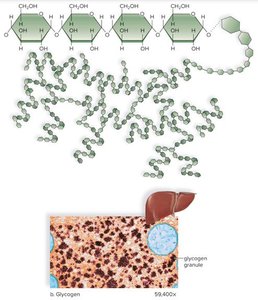
Polymers: Polysaccharides (e.g., starch, glycogen).
Disaccharides are formed by dehydration synthesis between two monosaccharides.
Lipids
Structure and Function
Lipids are hydrophobic molecules important for energy storage, membrane structure, and signaling.
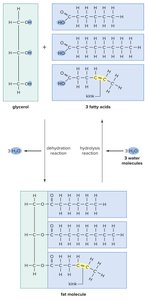
Not true polymers; composed of glycerol and fatty acids.
Formation of fats involves dehydration synthesis.
Proteins
Structure and Function
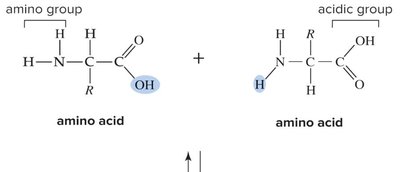
Proteins are polymers of amino acids, serving as enzymes, structural components, and signaling molecules.
Monomers: Amino acids, each with a unique side chain (R group).
Polymers: Polypeptides, formed by peptide bonds via dehydration synthesis.
Protein structure is hierarchical: primary, secondary, tertiary, and quaternary.
Protein Structure Levels
Primary structure: Sequence of amino acids.
Secondary structure: Hydrogen bonding forms alpha helices and beta sheets.
Tertiary structure: Interactions among side chains (hydrophobic, ionic, hydrogen bonds).
Quaternary structure: Multiple polypeptide subunits interact.
Protein Denaturation
Changes in temperature or pH can disrupt protein structure, leading to loss of function.
Nucleic Acids
Structure and Function
Nucleic acids (DNA and RNA) store and transmit genetic information.
Monomers: Nucleotides, each composed of a sugar, phosphate, and nitrogenous base.
Polymers: DNA (double-stranded, stable) and RNA (single-stranded, less stable).
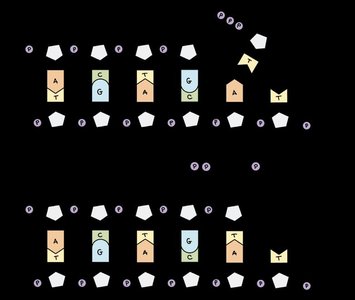
Nucleotides are linked by phosphodiester bonds via dehydration synthesis.
DNA Structure and Replication
DNA strands are antiparallel and complementary (A-T, G-C base pairing).
Replication involves separation of strands and synthesis of new complementary strands.
RNA Structure
RNA can fold into loops and 3D structures, enabling diverse functions.
pH and Biomolecules
Impact of pH on Biomolecules
pH affects the ionization state of functional groups, influencing biomolecule structure and function.
Acids donate H+ ions; bases accept H+ ions.
Side chains in proteins can be charged or uncharged depending on pH, affecting folding and activity.

Summary and Recap
Biomolecules are constructed from monomers via dehydration synthesis and broken down by hydrolysis.
Carbon's versatility enables molecular diversity.
Functional groups determine biomolecule properties and reactivity.
Protein structure is critical for function and is sensitive to environmental changes.
Nucleic acids store genetic information and are essential for cellular processes.
pH influences biomolecule behavior, especially in proteins.
Additional info: Some explanations and context were expanded for clarity and completeness, including definitions, examples, and structural details.
