 Back
Biomolecules: The Molecules of Cells – Study Guide
Study Guide - Smart Notes
 Tailored notes based on your materials, expanded with key definitions, examples, and context.
The Molecules of Cells
Introduction to Organic Compounds
Organic compounds are the foundation of life, primarily due to the unique properties of carbon. Carbon atoms can form diverse and complex molecules, making them essential for biological processes.
Carbon-based molecules are called organic compounds and usually contain hydrogen.
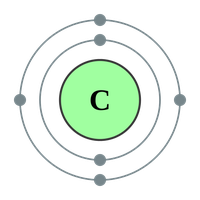
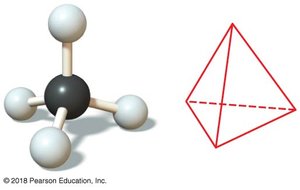
Carbon has four electrons in its outer shell, allowing it to form four covalent bonds.
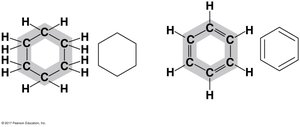
Organic compounds can be large and complex, forming chains, rings, and branched structures.
Molecular Interactions in Biology
Molecular interactions drive all biological processes. For example, the breakdown of lactose (a carbohydrate) by lactase (an enzyme, which is a protein) is directed by instructions in DNA (a nucleic acid).
Enzymes are proteins that catalyze biochemical reactions.
DNA contains the genetic instructions for protein synthesis.

Biomolecules: Essential Molecules for Life
Biomolecules are classified into four major types, each with unique functions and structures. They are primarily composed of the elements carbon, hydrogen, oxygen, nitrogen, phosphorus, and sulfur (CHONPS).
Carbohydrates (sugars and starches)
Lipids (fats, oils, waxes)
Proteins
Nucleic Acids (DNA and RNA)
Carbon Skeletons and Isomers
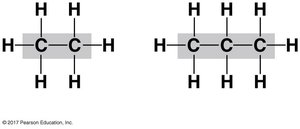
Carbon skeletons can vary in length, branching, and ring formation. Isomers are compounds with the same formula but different structural arrangements, leading to diverse properties.
Hydrocarbons are molecules made only of carbon and hydrogen, important in energy storage but rare in living organisms.
Isomers demonstrate the relationship between structure and function in organic molecules.
Functional Groups
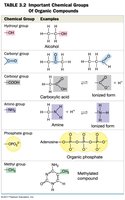
Functional groups are specific groups of atoms within molecules that determine the chemical properties and reactions of those molecules. They are critical in the structure and function of biomolecules.
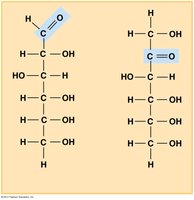
Common functional groups include hydroxyl, carbonyl, carboxyl, amino, phosphate, and methyl groups.
Some functional groups do not contain carbon, such as phosphate.
Chemical Group | Example |
|---|---|
Hydroxyl | Alcohol |
Carbonyl | Carboxylic acid |
Amino | Amino acid |
Phosphate | Organic phosphate |
Methyl | Methylated compound |
Macromolecules and Polymerization
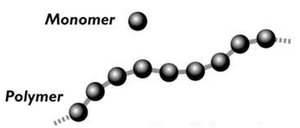
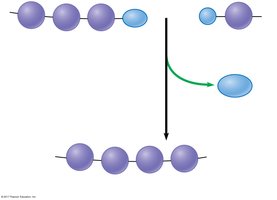
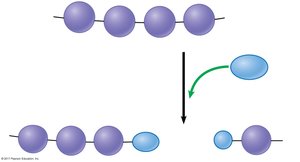
Macromolecules are large biomolecules formed by joining smaller units called monomers. The four classes of macromolecules are carbohydrates, lipids, proteins, and nucleic acids.
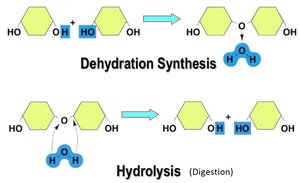
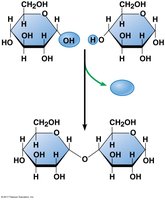
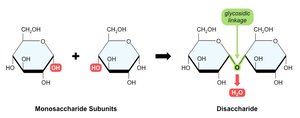
Polymerization occurs via dehydration reactions, linking monomers to form polymers.
Hydrolysis breaks polymers into monomers by adding water.
Enzymes mediate these reactions.

Carbohydrates
Carbohydrates are organic molecules composed of carbon, hydrogen, and oxygen, typically in a ratio of 1:2:1. They serve as quick energy sources and structural components.
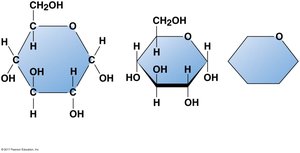
Monosaccharides are simple sugars (e.g., glucose, fructose, galactose).
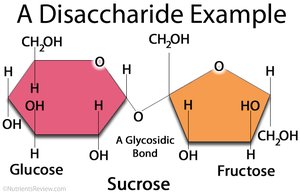
Disaccharides are formed by joining two monosaccharides via dehydration synthesis (e.g., sucrose, lactose).
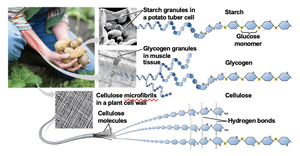
Polysaccharides are long chains of monosaccharides (e.g., starch, glycogen, cellulose).
Polysaccharides
Starch: Energy storage in plants.
Glycogen: Energy storage in animals.
Cellulose: Structural component in plant cell walls; indigestible by animals.

Testing for Carbohydrates
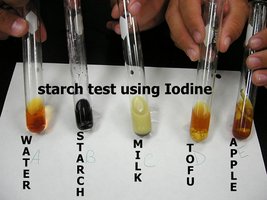
Iodine test for starch: Positive result is a blue-black color.
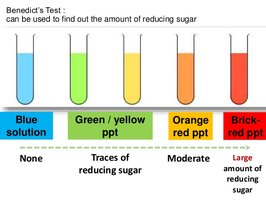
Benedict test for monosaccharides: Positive result is a color change from blue to brick-red.
Lipids
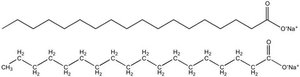
Lipids are hydrophobic molecules, including fats, oils, and waxes. They are important for energy storage, insulation, cell membrane structure, and signaling.
Fats (triglycerides) consist of glycerol and three fatty acids.
Saturated fatty acids have no double bonds; solid at room temperature.
Unsaturated fatty acids have one or more double bonds; liquid at room temperature.
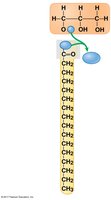
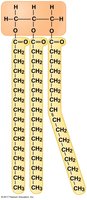

Phospholipids and Steroids
Phospholipids are major components of cell membranes, with hydrophilic heads and hydrophobic tails.
Steroids (e.g., cholesterol, hormones) act as chemical messengers.
Testing for Lipids
Sudan Red test: Positive result is a red-stained lipid layer.
Paper Bag test: Positive result is a translucent spot.
Proteins
Proteins are diverse biomolecules made from amino acids. They perform a wide range of functions, including catalysis, transport, defense, signaling, structure, and storage.
Monomer: Amino acid (20 types)
Peptide bonds link amino acids to form polypeptides.
Protein function depends on its shape, which can be altered by denaturation.
Levels of Protein Structure
Primary structure: Sequence of amino acids.
Secondary structure: Alpha helix and beta pleated sheet, stabilized by hydrogen bonds.
Tertiary structure: 3D shape formed by interactions among R groups.
Quaternary structure: Association of multiple polypeptide chains.
Nucleic Acids
Nucleic acids (DNA and RNA) are polymers of nucleotides. They store and transmit genetic information and direct protein synthesis.
Monomer: Nucleotide (composed of a sugar, phosphate group, and nitrogenous base)
DNA: Double helix; stores genetic information
RNA: Single strand; involved in protein synthesis
Recap: Classes of Biomolecules
Class | Monomer | Polymer | Function | Example |
|---|---|---|---|---|
Carbohydrates | Monosaccharide | Polysaccharide | Energy, structure | Starch, glycogen, cellulose |
Lipids | Fatty acid, glycerol | Triglyceride | Energy storage, membranes | Fats, oils, phospholipids |
Proteins | Amino acid | Polypeptide | Enzymes, structure, transport | Lactase, collagen |
Nucleic Acids | Nucleotide | DNA, RNA | Genetic information | DNA, RNA |
Additional info:
Structure and function are closely related in all biomolecules.
Enzymes are essential for catalyzing reactions in cells.
Mutations in DNA can affect protein structure and function, leading to physiological changes.
