 Back
Biotechnology and Genetically Modified Organisms (GMOs) in Plants
Study Guide - Smart Notes
 Tailored notes based on your materials, expanded with key definitions, examples, and context.
Biotechnology
Introduction to Biotechnology
Biotechnology involves the use of living organisms or their systems to develop or make products, often by manipulating genetic material. Modern biotechnology has enabled the creation of genetically modified organisms (GMOs), which are central to agricultural innovation and food production.
Genetically Modified Organisms (GMOs): Organisms that have had one or more genes from another species inserted by artificial means in a laboratory. Also known as transgenics.
Example: Salmon genetically modified to express more active growth hormone.
Most GMOs in the food supply: Plant-derived, not the result of traditional plant breeding.
Genetically Modified Organisms (GMOs)
Purpose and Importance of GMOs
GMOs are developed to address global food shortages and improve agricultural efficiency.
Food shortages: Farmers must produce significantly more grain per hectare to meet future population demands.
UN predictions: By 2050, food production must increase by 50-60% compared to current levels.
Traits Targeted by Genetic Modification
Genetic engineering targets specific traits to enhance crop performance and quality.
Delayed ripening
Resistance to spoilage
Drought resistance
Disease resistance
Longer shelf life
Improved flavor
Increased nutritional value
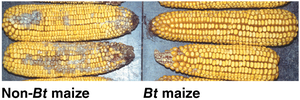
Pest resistance: Example: Bacillus thuringiensis (Bt) maize reduces the need for chemical insecticides.
Herbicide resistance: Allows crops to grow while weeds are destroyed.
Photosynthetic efficiency: Changing from C3 to C4 photosynthesis for greater productivity.
Recombinant DNA Technology
Creation of GMOs
Recombinant DNA technology combines DNA from different sources to produce desired traits.
Host DNA + Gene of interest: The gene is inserted into the host organism's genome.
Regulatory Sequences in GMO Creation
For a gene to be expressed in a GMO, regulatory sequences are required.
Promoter (35S): Initiates transcription of the gene.
Terminator (NOS): Signals the end of transcription.
Identifying GMO Crops
Detection Methods
GMO crops can be identified by isolating DNA and searching for specific regulatory sequences.
35S promoter and NOS terminator: Common markers for GMOs.
PCR (Polymerase Chain Reaction): Used to amplify the signal for detection.
PCR – Polymerase Chain Reaction
Principles and Steps
PCR is a technique to produce many copies of a specific DNA sequence, enabling detection and analysis.
Denature (94 ℃): Heat separates DNA strands.
Anneal (50-65 ℃): Primers bind to target sequences.
Extension (72 ℃): Taq polymerase synthesizes new DNA strands.
PCR Components
DNA template
Primers: Specific to 35S or NOS sequences.
Master Mix
Taq polymerase: Heat-stable enzyme.
dNTPs: Nucleotide building blocks.
MgCl2: Cofactor for polymerase activity.
Gel Electrophoresis
Principle and Application
Gel electrophoresis sorts DNA molecules by size using an electric charge.
DNA ladder: Used as a reference for fragment size.
Large fragments: Move slowly, stay near the top.
Small fragments: Move quickly to the bottom.
Prevalence of GM Crops in the Food Supply
Consumption and Reporting
GM crops are widespread in the United States and are used in many processed foods.
Corn: 92% GM
Soybean: 94% GM
Canola: 95% GM
Sugar beets: 99% GM
Most GM plants: Used to make ingredients like cornstarch, corn syrup, and high-fructose corn syrup (HFCS).
Reporting requirements: See FDA guidelines for GMO crops and food products.
Biological Concerns and Ecological Impact
Health and Environmental Issues
The use of GMOs raises several biological and ecological concerns.
Allergens: No evidence that GM plants designed for human consumption cause allergenic effects.
Bt corn: Healthier than non-GMO corn, which may contain fungal toxins.
Effect on nontarget organisms: Potential impact on pollinators and other ecological relationships.
Gene escape: Transfer of GM genes to wild relatives via pollen, leading to "super weeds".
Addressing Transgene Escape
Strategies are being developed to prevent the spread of transgenes.
Male sterility: Prevents pollen production.
Transgenes in chloroplast DNA: Chloroplast genes are not transferred by pollen.
Genetic modification to prevent flower opening: Enforces strict self-pollination.
Summary Table: GMO Traits and Purposes
Trait | Purpose |
|---|---|
Delayed ripening | Longer shelf life |
Drought resistance | Survive in dry conditions |
Pest resistance (Bt) | Reduce insecticide use |
Herbicide resistance | Control weeds |
Improved flavor | Consumer preference |
Increased nutritional value | Health benefits |
Key Equations
PCR Amplification Equation
The number of DNA copies after n cycles of PCR: Where is the initial number of DNA molecules and is the number of cycles.
Gel Electrophoresis Principle
DNA migration rate is inversely proportional to fragment size: Where is migration velocity and is fragment length.
Conclusion
Biotechnology and GMOs play a crucial role in modern agriculture, addressing food security, improving crop traits, and raising important biological and ecological questions. Understanding the science behind GMOs, their detection, and their impact is essential for informed decision-making in biology and society.
