 Back
Biotechnology: DNA Technology, Genetic Engineering, and Applications
Study Guide - Smart Notes
 Tailored notes based on your materials, expanded with key definitions, examples, and context.
Biotechnology and Genetic Engineering
Introduction to Genetic Engineering
Genetic engineering involves the direct manipulation of an organism's DNA to alter its characteristics. This field has revolutionized biology by enabling scientists to study, modify, and utilize genetic material for various applications.
Artificial Selection: The earliest form of genetic engineering, where humans breed organisms with desirable traits (e.g., domesticated animals, agricultural crops).
Modern Genetic Engineering: Utilizes molecular tools such as bacterial plasmids and restriction enzymes to manipulate genes at the molecular level.
Plasmids and Their Role in Biotechnology
Plasmids are small, circular, self-replicating DNA molecules found in bacteria, separate from the main chromosome. They often carry genes beneficial for survival, such as antibiotic resistance.
F Plasmid: Enables bacteria to form sex pili for conjugation (gene transfer between cells).
R Plasmid: Provides resistance to antibiotics.
Genetic Recombination in Prokaryotes
Mechanisms of Genetic Exchange
Prokaryotes can exchange genetic material through several mechanisms, increasing genetic diversity and adaptability.
Transformation: Uptake of naked DNA fragments from the environment by a bacterial cell.
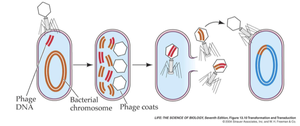
Transduction: Transfer of DNA from one bacterium to another via bacteriophages (viruses that infect bacteria).
Conjugation: Direct transfer of DNA between two bacterial cells through a physical connection (sex pilus).
Recombinant DNA Technology
Restriction Enzymes and DNA Cloning
Restriction enzymes are proteins that cut DNA at specific sequences called restriction sites. They are essential tools for creating recombinant DNA molecules.
Common restriction enzymes: EcoRI, BamHI, HindIII, TaqI.
Restriction enzymes often produce "sticky ends"—overhanging single-stranded DNA that can base-pair with complementary sequences.
DNA ligase seals the bonds between restriction fragments, forming stable recombinant DNA.
Polymerase Chain Reaction (PCR)
Principle and Steps of PCR
The Polymerase Chain Reaction (PCR) is a technique used to amplify a specific DNA sequence, generating millions of copies from a tiny initial sample. PCR is fundamental for DNA analysis in research, medicine, and forensics.
Denaturation: DNA is heated (~94–96°C) to separate strands by breaking hydrogen bonds.
Annealing: Temperature is lowered (~50–65°C) so primers can bind to complementary sequences on each strand.
Extension: DNA polymerase (usually Taq polymerase) synthesizes new DNA strands at ~72°C.
The cycle is repeated 30–40 times, exponentially increasing the number of DNA copies.
Key Features and Applications of PCR
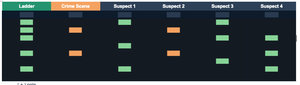
Allows analysis of DNA from very small or degraded samples (e.g., crime scenes).
Essential for DNA fingerprinting, genetic testing, and research.
Gel Electrophoresis
Principle and Procedure
Gel electrophoresis is a technique used to separate DNA fragments by size using an electric current through an agarose gel matrix.
DNA samples are loaded into wells in the gel.
Electric current causes negatively charged DNA fragments to migrate toward the positive electrode (anode).
Smaller fragments move faster and farther through the gel than larger ones.
Results are visualized as bands, each representing DNA fragments of a specific size.
Key Terms in Gel Electrophoresis
Term | Definition |
|---|---|
Gel electrophoresis | Technique that separates DNA fragments by size using an electric current through a gel matrix. |
Agarose gel | Porous material that acts as a sieve for DNA fragments. |
DNA ladder (marker) | Reference lane with fragments of known sizes for comparison. |
Band | Visible cluster of same-size DNA fragments in the gel. |
Migration distance | Distance a fragment travels from the well; smaller fragments travel farther. |
Restriction Fragment Length Polymorphisms (RFLPs)
Definition and Application
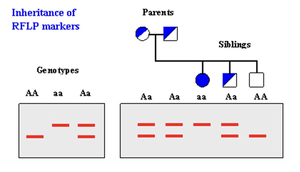
RFLPs are variations in DNA sequence that result in different patterns of restriction enzyme cutting, producing fragments of varying lengths. These patterns can be used for genetic mapping, disease diagnosis, and forensic analysis.
DNA Fingerprinting
Principle and Forensic Application
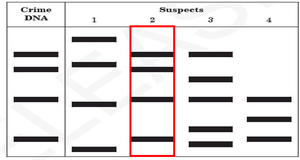
DNA fingerprinting uses PCR and gel electrophoresis to compare DNA samples. It is widely used in criminal investigations, paternity testing, and identification of individuals.
Banding patterns from gel electrophoresis are compared between samples (e.g., crime scene and suspects).
The probability of two unrelated individuals sharing an identical DNA fingerprint is extremely low, making this a powerful tool for identification.

DNA Sequencing
Principle and Sanger Sequencing
DNA sequencing determines the exact order of nucleotides in a DNA molecule. The Sanger (dideoxy) method uses chain-terminating nucleotides to generate DNA fragments of varying lengths, which are then separated and analyzed to deduce the sequence.
Allows for the identification of genetic variants and mutations.
Enables the creation of DNA fingerprints unique to each individual.
Summary Table: Key Techniques in DNA Technology
Technique | Purpose | Main Steps |
|---|---|---|
PCR | Amplify DNA | Denaturation, Annealing, Extension |
Gel Electrophoresis | Separate DNA fragments by size | Load samples, apply current, visualize bands |
Restriction Enzyme Digest | Cut DNA at specific sites | Incubate DNA with enzyme, analyze fragments |
DNA Sequencing | Determine nucleotide order | Chain termination, fragment separation, read sequence |
Additional info:
Genetic engineering has broad applications in medicine (gene therapy, diagnostics), agriculture (GMO crops), and research.
Understanding these molecular techniques is foundational for advanced studies in genetics, molecular biology, and biotechnology.
