 Back
BackBlood Vessels: Structure and Function
Study Guide - Smart Notes
 Tailored notes based on your materials, expanded with key definitions, examples, and context.
Blood Vessels
Overview of Blood Vessel Types
Blood vessels are essential components of the circulatory system, responsible for transporting blood throughout the body. There are five main types of blood vessels, each with distinct structural and functional characteristics:
Arteries
Arterioles
Capillaries
Venules
Veins
The lumen is the central gap inside a blood vessel through which blood flows.
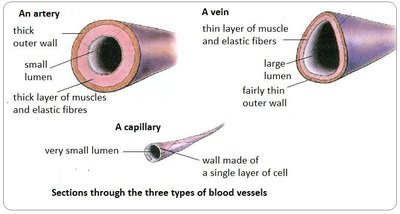
General Structure of Blood Vessels
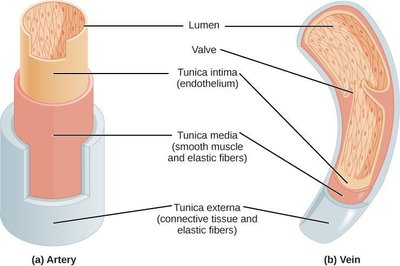
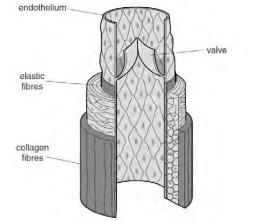
Except for capillaries, all blood vessels are composed of three main layers:
Endothelium: The innermost layer, providing a smooth lining for blood flow.
Smooth muscle and elastic fibers: The middle layer, responsible for vessel contraction and elasticity.
Collagen fibers (connective tissue): The outer layer, providing structural support.
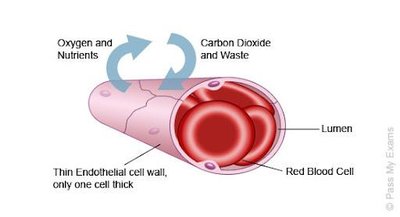
Capillaries are unique in having only the endothelium layer, which is one cell thick.
Arteries and Arterioles
Structure and Function
Arteries are large vessels that carry blood away from the heart, while arterioles are smaller branches connecting arteries to capillaries. Both types are adapted to withstand high blood pressure:
Thick, elastic walls allow expansion and contraction.
Narrow lumen due to thick walls.
Pulses can be detected where arteries are near the surface.
Contain sensors in their walls to regulate blood pressure and temperature.
Capillaries
Structure and Function
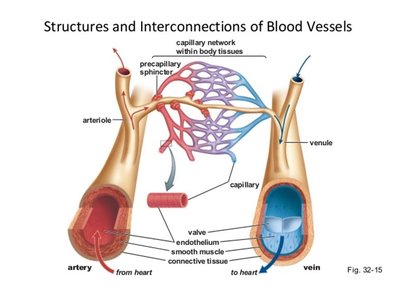
Capillaries connect arterioles and venules, forming networks that surround and interweave between cells and tissues. Their structure is specialized for exchange:
Walls are one cell thick, permitting efficient exchange of nutrients and waste.
Small lumen and low pressure facilitate material exchange.
Exchange occurs via diffusion (movement from high to low concentration) and osmosis (movement of fluid).
Venules and Veins
Structure and Function
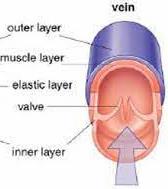
Venules receive blood from capillaries and empty it into veins, which return blood to the heart. Compared to arteries, veins have:
Thinner walls and less muscle.
Larger lumen.
Lower pressure, so less elasticity is needed.
Valves to prevent backflow of blood.
Comparison of Blood Vessel Types
Structural and Functional Differences
The following table summarizes the main differences between arteries, veins, and capillaries:
Type | Function | Pressure | Lumen Diameter | Wall Thickness | Wall Layers | Muscle & Elastic Fibers | Valves |
|---|---|---|---|---|---|---|---|
Arteries & Arterioles | Carries blood away from heart | High | Narrow | Thick | 3 (Endothelium, Smooth muscle & elastic fibers, Collagen fibers) | Large amounts | No |
Veins & Venules | Carries blood back to heart | Low | Wide | Thin | 3 (Endothelium, Smooth muscle & elastic fibers, Collagen fibers) | Small amounts | Yes |
Capillaries | Allows diffusion, exchange of materials | Low | Narrow | Very thin (1 cell thick) | 1 (Endothelium) | None | No |
Summary of Circulatory Pathways
Pulmonary and Systemic Circuits
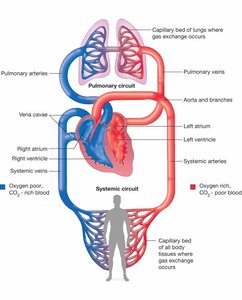
The circulatory system is divided into two main circuits:
Pulmonary circuit: Carries blood between the heart and lungs for gas exchange.
Systemic circuit: Distributes oxygen-rich blood to body tissues and returns oxygen-poor blood to the heart.
Key Terms and Concepts
Lumen: The central cavity of a blood vessel.
Endothelium: The innermost lining of blood vessels.
Diffusion: Movement of molecules from high to low concentration.
Osmosis: Movement of water across a semipermeable membrane.
Valve: Structure in veins preventing backflow of blood.
Additional info:
Blood vessel structure is closely related to function; arteries withstand high pressure, veins accommodate low pressure and require valves, capillaries maximize exchange.
Regulation of blood vessel diameter is crucial for maintaining blood pressure and temperature homeostasis.
