 Back
BSCI 1509: Biological Systems – Course Overview and Core Concepts
Study Guide - Smart Notes
 Tailored notes based on your materials, expanded with key definitions, examples, and context.
Course Overview
BSCI 1509: Biological Systems is an introductory college-level biology course designed to explore the foundational principles that govern living systems. The course emphasizes active, collaborative, and data-centered learning, focusing on how biological systems operate from the molecular to the ecosystem level. Students will engage with primary research data and develop skills in scientific inquiry, critical thinking, and problem-solving relevant to human health and the environment.
Instructional Team and Support
Instructors: Dr. David Gonzalez, Dr. Allison Leich-Hilbun
Learning Assistants (LAs): Undergraduate students providing in-class and out-of-class support
Teaching Assistant (TA): Jocelyn Dates
Student Hours: Times and locations posted on Brightspace
Textbook
Campbell Biology, 12th Edition by Urry et al. (Pearson)
Readings are assigned from this textbook and supplement lectures and assignments.
Course Structure and Community Expectations
Active Learning: Emphasis on collaborative work and data analysis.
Respect and Presence: Students are expected to contribute positively, respect diverse perspectives, and remain engaged during class.
Support: Accessibility accommodations and mental health resources are available through Vanderbilt’s Student Access Services and Student Care Network.
Academic Integrity
Honor Code: All coursework is governed by Vanderbilt’s Honor Code. Unauthorized use of old exams or AI for assignments is prohibited.
AI Policy: AI tools may be used for studying but not for graded assignments or exams.
Grading System
The course uses a Standards-Based Grading (SBG) system, with a total of 40 points distributed as follows:
Individual Accountability Standard (5 points): Based on homework and surveys.
Attendance Standard (5 points): Based on class attendance percentage.
Concept Standards (30 points): Six central biological concepts, each with five standards graded on a 1–5 scale.
Letter grades are assigned based on total points earned, with opportunities to revisit and improve proficiency in standards throughout the semester.
Exams and Reassessment
Four unit exams and one final exam assess understanding of new and revisited standards.
Regrade Requests: Must be submitted via Gradescope within one week of exam return.
Revisiting Standards: Students can improve scores on missed standards by completing error analysis and reassessment activities.
Course Schedule Overview
Unit 1: Introduction to biological systems and scientific inquiry
Unit 2: Chemical context of life, water, carbon, biological molecules, cell structure, and membranes
Unit 3: DNA sequence variation, central dogma, inheritance, evolution of populations
Unit 4: DNA replication, cancer biology, cell cycle, cell communication, tissue organization
Unit 5: Energy flow, photosynthesis, trophic levels, ecosystem stability, adaptation
Core Biological Concepts and Standards
The course is organized around six central concepts, each with specific standards:
Living Systems (LS)
LS1: Model biological systems as interacting parts and predict system-wide effects of changes.
LS2: Explain how eukaryotic cells meet the criteria for life.
LS3: Explain cell cycle regulation and predict outcomes of regulatory failure.
LS4: Link epigenetic regulation to gene expression and cell differentiation.
LS5: Predict how pathogens and biotic interactions alter communities.
Structures (ST)
ST1: Predict structure and function of biological molecules based on chemical properties.
ST2: Explain buffer systems and predict effects of pH and solution composition.
ST3: Relate DNA, RNA, and protein structure to their properties.
ST4: Connect amino acid chemistry to protein structure and predict effects of changes.
ST5: Connect compartmentalization to cellular functions and system-level processes.
Information (INF)
INF1: Translate mRNA to protein and evaluate effects of point mutations.
INF2: Describe DNA replication and repair; predict consequences of dysfunction.
INF3: Explain regulation of gene expression in response to signals.
INF4: Explain how genetic information determines protein structure and function.
INF5: Solve inheritance problems and connect genotype to phenotype.
Matter and Energy (ME)
ME1: Model energy flow through biological processes.
ME2: Interpret enzyme kinetics and predict changes.
ME3: Explain cellular respiration and glycolysis in regulating matter and energy.
ME4: Explain matter and energy flow through photosynthesis.
ME5: Construct and interpret ecological pyramids; predict effects across food webs.
Environment and Homeostasis (EH)
EH1: Explain how molecular regulators drive changes in cell and tissue behavior.
EH2: Explain how chromosomal mutations alter gene expression and disrupt signaling.
EH3: Predict how limiting factors affect populations and ecosystems.
EH4: Connect biomes to constraints and predict organism strategies.
EH5: Relate photosynthesis and carbon storage to biomass patterns in forests.
Evolution (EVO)
EVO1: Use data to identify natural selection modes and predict outcomes.
EVO2: Explain how selection shapes adaptation in populations.
EVO3: Use evidence to support evolutionary relationships.
EVO4: Predict effects of population size on genetic drift and diversity.
EVO5: Identify gene flow and predict effects on allele frequencies.
Conceptual Framework of Biological Systems
The course integrates the following framework for understanding biology:
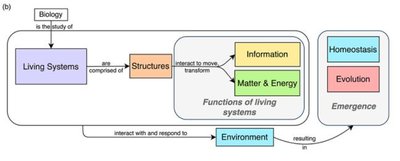
Living Systems are composed of Structures that interact to move and transform Information and Matter & Energy.
These functions interact with and respond to the Environment, resulting in Homeostasis, Evolution, and Emergence of complex properties.
Summary Table: Grading Scale
Letter Grade | Points |
|---|---|
A | 39-40 |
A- | 37.5-38.9 |
B+ | 35.6-37.4 |
B | 33.3-35.5 |
B- | 30.6-33.2 |
C+ | 27.5-30.5 |
C | 24.0-27.4 |
C- | 20.1-23.9 |
D+ | 15.8-20.0 |
D | 11.1-15.7 |
D- | 6.0-11.0 |
F | 0-5.9 |
Additional info:
This syllabus aligns closely with the core topics of a General Biology course, as outlined in the provided chapter list. The course covers evolution, the chemical context of life, cell structure and function, genetics, metabolism, ecology, and more.
The included diagram (image_2) visually summarizes the relationships among the major conceptual standards and is directly relevant to the course framework.
