 Back
Bulk Transport Across the Plasma Membrane: Exocytosis and Endocytosis
Study Guide - Smart Notes
 Tailored notes based on your materials, expanded with key definitions, examples, and context.
Bulk Transport Across the Plasma Membrane
Overview of Bulk Transport
Bulk transport is a cellular process that enables the movement of large molecules, such as proteins and polysaccharides, across the plasma membrane. Unlike small molecules, which can cross the membrane via diffusion or transport proteins, large molecules require specialized mechanisms: exocytosis and endocytosis. These processes involve the formation and fusion of vesicles, allowing cells to import and export substances efficiently.
Exocytosis
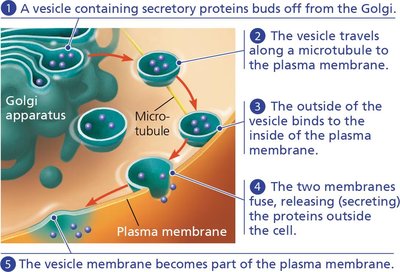
Exocytosis is the process by which cells secrete molecules by the fusion of vesicles with the plasma membrane. This mechanism is essential for the release of substances such as hormones, neurotransmitters, and components for cell wall construction in plants.
Step 1: A vesicle containing secretory proteins buds off from the Golgi apparatus.
Step 2: The vesicle travels along a microtubule of the cytoskeleton to the plasma membrane.
Step 3: The vesicle membrane binds to the plasma membrane.
Step 4: The two membranes fuse, releasing the vesicle contents outside the cell.
Step 5: The vesicle membrane becomes part of the plasma membrane.
Examples:
Pancreatic cells secrete insulin into the extracellular fluid by exocytosis.
Nerve cells release neurotransmitters to signal other neurons or muscle cells.
Plant cells deliver proteins and carbohydrates for cell wall synthesis via exocytosis.
Endocytosis
Endocytosis is the process by which cells take in molecules and particulate matter by forming new vesicles from the plasma membrane. The process is essentially the reverse of exocytosis and is vital for nutrient uptake, immune responses, and membrane recycling.
Step 1: The plasma membrane sinks inward to form a pocket.
Step 2: The pocket deepens and pinches off, forming a vesicle containing material from outside the cell.
There are three main types of endocytosis:
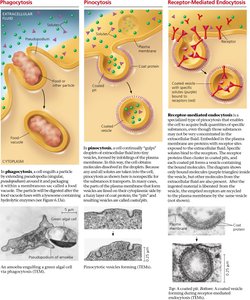
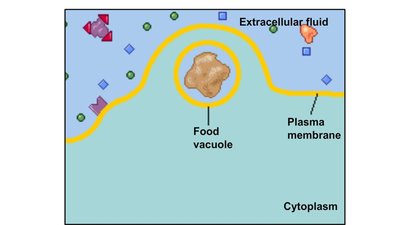
Phagocytosis (“cellular eating”): The cell engulfs large particles or cells, forming a food vacuole.
Pinocytosis (“cellular drinking”): The cell takes in extracellular fluid and dissolved solutes.
Receptor-mediated endocytosis: The cell selectively takes in specific molecules bound to receptors on the plasma membrane.
Phagocytosis Example
In phagocytosis, a cell engulfs a particle (such as an algal cell) by wrapping its plasma membrane around it, forming a food vacuole. This process is crucial for immune cells, such as macrophages, which ingest pathogens.
Receptor-Mediated Endocytosis Example
Human cells use receptor-mediated endocytosis to take in cholesterol for membrane synthesis. Cholesterol travels in the blood in particles called low-density lipoproteins (LDLs), which bind to LDL receptors on the plasma membrane and enter cells by endocytosis. In the inherited disease familial hypercholesterolemia, defective or missing LDL receptors prevent cholesterol uptake, leading to high blood cholesterol and increased risk of atherosclerosis.
Membrane Recycling and Homeostasis
Endocytosis and exocytosis also play a role in maintaining the balance of the plasma membrane. The addition of membrane by exocytosis offsets the loss of membrane by endocytosis, keeping the membrane area constant in nongrowing cells.
Concept Check
Membrane Expansion: As a cell grows, its plasma membrane expands primarily through exocytosis, which adds new membrane material.
Extracellular Matrix (ECM) Synthesis: Glycoproteins for the ECM are synthesized in the cell, packaged in vesicles, and secreted via exocytosis.
Summary Table: Comparison of Bulk Transport Mechanisms
Process | Direction | Main Function | Examples |
|---|---|---|---|
Exocytosis | Out of cell | Secretion of molecules | Insulin release, neurotransmitter release, cell wall synthesis |
Phagocytosis | Into cell | Uptake of large particles | Macrophage ingesting bacteria |
Pinocytosis | Into cell | Uptake of fluid and solutes | General nutrient absorption |
Receptor-mediated endocytosis | Into cell | Selective uptake of specific molecules | LDL cholesterol uptake |
Key Terms: Exocytosis, Endocytosis, Vesicle, Golgi Apparatus, Microtubule, Phagocytosis, Pinocytosis, Receptor-mediated Endocytosis, LDL, Familial Hypercholesterolemia, Atherosclerosis, Extracellular Matrix (ECM).
