 Back
BackCancer: Evolution, Genetics, and Therapeutic Strategies
Study Guide - Smart Notes
 Tailored notes based on your materials, expanded with key definitions, examples, and context.
Cancer: Evolution, Genetics, and Therapeutic Strategies
Introduction to Cancer
Cancer is a complex disease characterized by uncontrolled cell division arising from mutations in somatic cells. Unlike infectious diseases, cancer does not involve foreign agents but originates from the body's own cells, making it challenging to target and treat. The risk of developing cancer is significant, with a cumulative lifetime risk of approximately 1 in 3.
Somatic vs. Germ Line Cells: Somatic cells make up most of the body and do not transmit genetic information to offspring, while germ line cells (eggs and sperm) do.
Mutation Accumulation: With trillions of cells and countless cell divisions, somatic cells inevitably accumulate mutations, leading to genetic diversity within the body.
Cellular Cooperation and Policing: Multicellular organisms have evolved genetic pathways ("police genes") to regulate cell proliferation and eliminate cells that accumulate excessive mutations.
Mechanisms of Cancer Development
Cancer arises when mutations disrupt the normal regulation of the cell cycle, allowing cells to divide uncontrollably. This process is governed by a balance between genes that promote cell division and those that suppress it.
Oncogenes: Genes that drive cell division by promoting the expression of cyclin-dependent kinases (CDKs). Overexpression leads to accelerated and error-prone cell division.
Tumor Suppressor Genes: Genes that inhibit cell division, acting as brakes on the cell cycle. Mutations that inactivate these genes remove critical controls, allowing unchecked proliferation.
Balance of Regulation: Normal cell proliferation depends on the interplay between oncogenes and tumor suppressor genes, both responsive to environmental and molecular signals.
Clonal Evolution and Tumor Heterogeneity
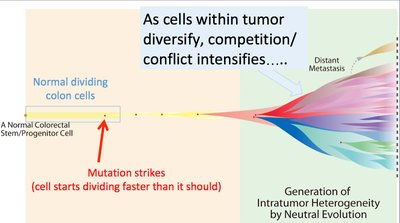
Once a cell acquires mutations that allow uncontrolled division, it forms a clone of rapidly dividing cells. Additional mutations accumulate, leading to genetic divergence among subclones within the tumor. This process is exponential and drives tumor evolution.
Subclones: Genetically distinct cell lines within a tumor that compete for resources, accelerating evolution through increased variation and selection pressure.
Intratumor Heterogeneity: The genetic diversity within a tumor, which increases competition and the rate of evolution.
Population Genetics: In small populations, genetic drift dominates; as the tumor grows, selection becomes more important.
Stages of Tumor Progression
Despite the randomness of initial mutations, tumors typically progress through predictable stages, culminating in metastasis—the spread of cancer cells to distant sites.
Metastasis: The most dangerous stage, where cancer cells establish new populations in other tissues.
Early Detection: Surgical removal is most effective before metastasis and before significant genetic divergence occurs within the tumor.
Cancer Therapy and Evolution of Resistance
Treatment strategies for cancer often involve surgery and chemotherapy, but the evolutionary dynamics of tumor cell populations can lead to drug resistance.
Chemotherapy: Targets rapidly dividing cells but also harms normal proliferating tissues (e.g., hair follicles, bone marrow, gut lining).
Evolution of Resistance: If some cancer cells survive treatment, they may possess or develop resistance, leading to relapse and treatment failure.
Managing Resistance: Strategies include using lower or intermittent doses to maintain a population of drug-susceptible cells that outcompete resistant ones, and employing sequential drug therapies that exploit evolutionary trade-offs.
The Two-Hit Hypothesis and Cancer Risk
Cancer typically requires mutations in both copies of a critical gene (due to diploidy), explaining why it is more common with age and why some cancers are inherited.
Two-Hit Hypothesis: Both alleles of a tumor suppressor gene must be inactivated for cancer to develop in a cell.
Inherited Predisposition: Individuals who inherit one mutated allele are at higher risk, as only one additional mutation is needed.
Environmental Mutagens: Exposure to carcinogens (e.g., tobacco, radiation, chemicals) increases mutation rates and cancer risk.
Prevention and Early Detection
Reducing exposure to mutagens and regular monitoring are key to lowering cancer risk and improving outcomes. Early detection allows for more effective intervention before tumors become genetically diverse and resistant to therapy.
Environmental Management: Limiting exposure to known carcinogens reduces mutation rates.
Screening: Regular self-exams and medical screenings are especially important for individuals with inherited predispositions.
Early Intervention: Increases the likelihood of successful treatment and reduces the chance of resistance evolving.
Summary Table: Key Concepts in Cancer Biology
Concept | Definition | Example/Application |
|---|---|---|
Oncogene | Gene that promotes cell division; can cause cancer when overactive | Mutated RAS gene in many cancers |
Tumor Suppressor Gene | Gene that inhibits cell division; loss leads to cancer | Mutated TP53 gene in many cancers |
Clonal Evolution | Process by which tumor cells accumulate mutations and diversify | Subclones within a tumor competing for resources |
Metastasis | Spread of cancer cells to distant tissues | Breast cancer cells colonizing the lungs |
Two-Hit Hypothesis | Both alleles of a gene must be mutated for cancer to develop | Inherited RB1 mutation in retinoblastoma |
Relevant Equation: Evolutionary Rate in Tumors
The rate of evolutionary change in a tumor population can be described by:
R: Response to selection (rate of evolutionary change)
h2: Heritability (proportion of variation due to genetics)
s: Selection differential (strength of selection)
Take-home Message: Cancer is fundamentally an evolutionary process within the body, driven by mutations, selection, and genetic drift. Understanding these dynamics is crucial for developing effective prevention and treatment strategies.
