 Back
Carbohydrates and Lipids: Structure, Function, and Biological Importance
Study Guide - Smart Notes
 Tailored notes based on your materials, expanded with key definitions, examples, and context.
Carbohydrates and Lipids
Overview of Organic Molecules in Living Organisms
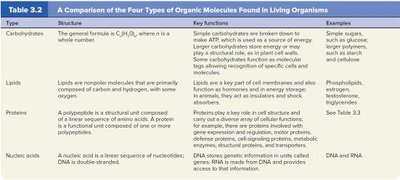
Organic molecules are essential for life, serving as the building blocks and functional components of cells. The four major types are carbohydrates, lipids, proteins, and nucleic acids. Each type has distinct structures, functions, and examples in biological systems.
Type | Structure | Key Functions | Examples |
|---|---|---|---|
Carbohydrates | General formula: Cn(H2O)n | Energy source, structural support, cell recognition | Simple sugars, starch, glycogen, cellulose |
Lipids | Nonpolar molecules, mainly C and H | Energy storage, membrane structure, signaling | Phospholipids, triglycerides, steroids |
Proteins | Polymers of amino acids | Structure, catalysis, transport, signaling | Enzymes, antibodies |
Nucleic acids | Polymers of nucleotides | Genetic information storage and transfer | DNA, RNA |
Building Blocks and Macromolecules
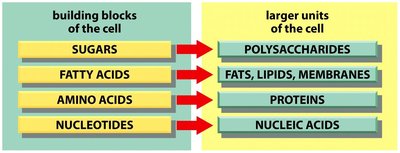
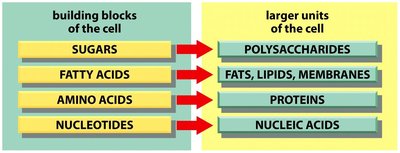
Cells are constructed from small organic molecules (monomers) that combine to form larger macromolecules (polymers). The main building blocks and their corresponding macromolecules are:
Sugars → Polysaccharides
Fatty acids → Fats, lipids, membranes
Amino acids → Proteins
Nucleotides → Nucleic acids
Carbohydrates
Monosaccharides
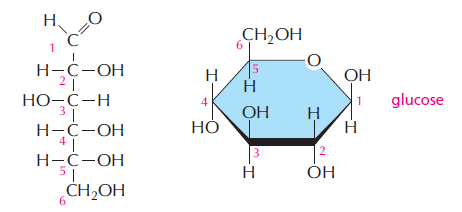
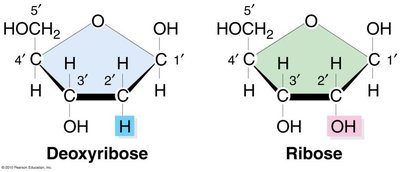
Monosaccharides are the simplest carbohydrates and serve as monomers for more complex carbohydrates. They are composed of carbon (C), hydrogen (H), and oxygen (O), typically following the formula Cn(H2O)n. Common monosaccharides include pentoses (5C) and hexoses (6C), such as glucose, ribose, and deoxyribose.
Glucose is a primary energy source in cells and exists mainly as a ring structure.
Ribose and deoxyribose are important in nucleic acids (RNA and DNA, respectively).
Isomers of Glucose
Isomers are molecules with the same chemical formula but different structures. Glucose has several isomers, including stereoisomers and enantiomers:
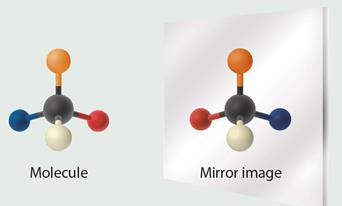
Enantiomers are mirror images of each other, such as D-glucose and L-glucose. Only D-glucose is biologically active in cells.
Stereoisomers have the same bonding relationships but differ in spatial arrangement. For example, glucose, galactose, and mannose are stereoisomers.
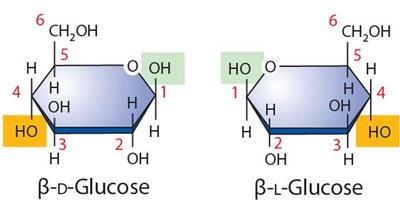
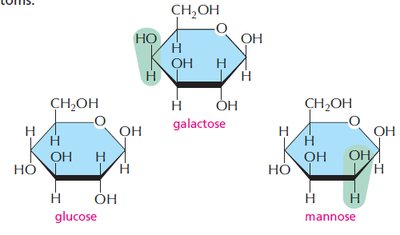
Alpha and Beta Forms of Glucose
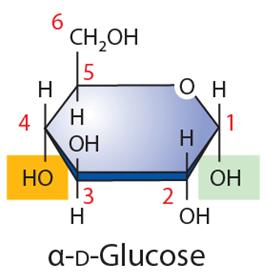
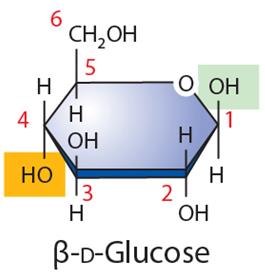
Glucose can exist in two anomeric forms, alpha (α) and beta (β), depending on the position of the hydroxyl group (-OH) attached to the first carbon in the ring structure:
α-D-glucose: -OH group below the plane of the ring at C1
β-D-glucose: -OH group above the plane of the ring at C1
Disaccharides
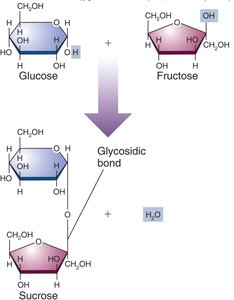
Disaccharides are formed by joining two monosaccharides through a dehydration reaction, resulting in a glycosidic bond. This bond can be broken by hydrolysis, often catalyzed by specific enzymes.
Common disaccharides: Sucrose (glucose + fructose), lactose (glucose + galactose), maltose (glucose + glucose)
Polysaccharides
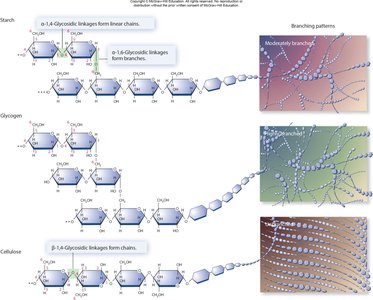
Polysaccharides are large polymers composed of hundreds to thousands of monosaccharide units linked by glycosidic bonds. Their structure and function depend on the type of monomer and the nature of the glycosidic linkages.
Starch: Storage polysaccharide in plants, composed of α-D-glucose; moderately branched.
Glycogen: Storage polysaccharide in animals, composed of α-D-glucose; highly branched.
Cellulose: Structural polysaccharide in plants, composed of β-D-glucose; unbranched and forms strong fibers.
Structural Polysaccharides
Some polysaccharides serve structural roles:
Cellulose: Provides rigidity to plant cell walls due to hydrogen bonding between chains.
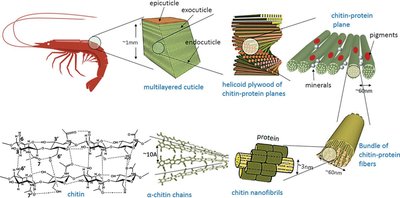
Chitin: Forms the exoskeleton of arthropods and the cell walls of fungi; composed of modified glucose units.
Lipids
General Properties of Lipids
Lipids are hydrophobic, nonpolar molecules primarily composed of carbon and hydrogen, with some oxygen. They are insoluble in water and serve as energy storage molecules, structural components of membranes, and signaling molecules.
Main types: Triglycerides, phospholipids, steroids
Fatty Acids
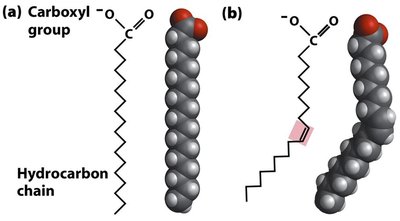
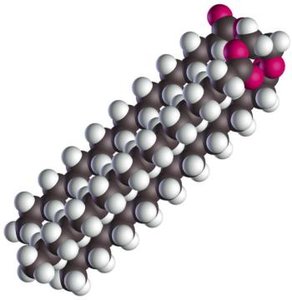
Fatty acids are long hydrocarbon chains with a terminal carboxyl group (-COOH). They vary by chain length and the presence or absence of double bonds:
Saturated fatty acids: No double bonds; straight chains; solid at room temperature.
Unsaturated fatty acids: One or more double bonds; kinked chains; liquid at room temperature.
Triglycerides (Fats and Oils)
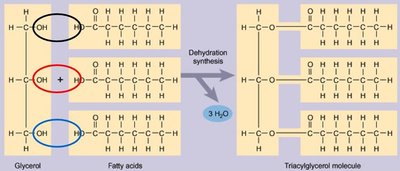
Triglycerides are formed by the esterification of three fatty acids to a glycerol backbone. They are the main form of energy storage in animals and plants.
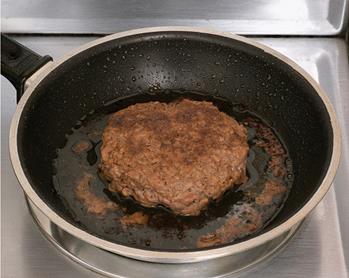
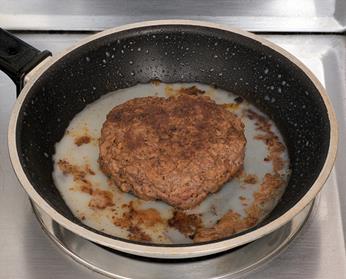
Animal fats: High in saturated fatty acids; solid at room temperature.
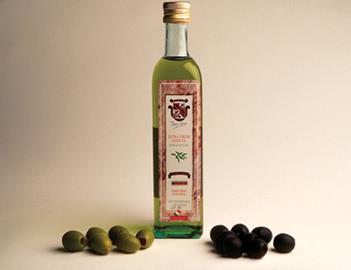
Plant oils: High in unsaturated fatty acids; liquid at room temperature.
Phospholipids
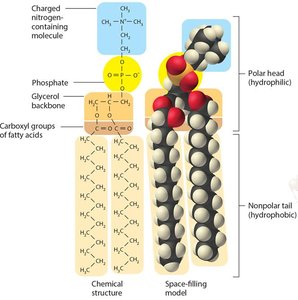
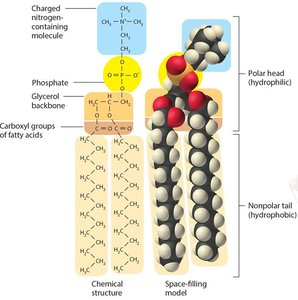
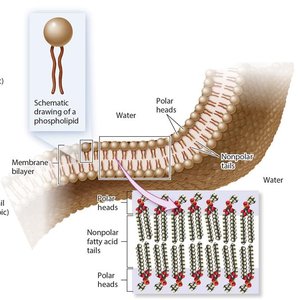
Phospholipids are major components of cell membranes. They consist of a glycerol backbone, two fatty acids, and a phosphate group attached to a charged molecule. Their amphipathic nature (hydrophilic head, hydrophobic tails) allows them to form bilayers in aqueous environments.
Phospholipid bilayers are the foundation of biological membranes, with polar heads facing water and nonpolar tails shielded inside.
Steroids
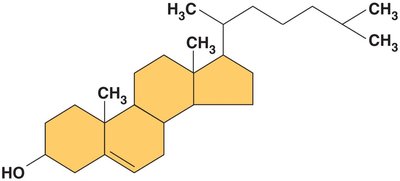
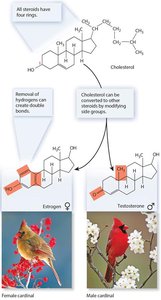
Steroids are lipids with a characteristic structure of four fused carbon rings. Cholesterol is a key steroid in animal cell membranes and serves as a precursor for steroid hormones such as estrogen and testosterone.
Cholesterol: Regulates membrane fluidity and is a precursor for other steroids.
Steroid hormones: Function as signaling molecules in the body.
Bonds in Macromolecules
Types of Bonds
Macromolecules are formed by specific covalent bonds between monomers:
Glycosidic bonds: Link monosaccharides in carbohydrates.
Ester bonds: Link fatty acids to glycerol in lipids.
Peptide bonds: Link amino acids in proteins (not covered in detail here).
Phosphodiester bonds: Link nucleotides in nucleic acids (not covered in detail here).
Example equation for dehydration synthesis (formation of a disaccharide):
Example equation for triglyceride formation:
