 Back
Carbohydrates: Structure, Function, and Biological Importance
Study Guide - Smart Notes
 Tailored notes based on your materials, expanded with key definitions, examples, and context.
Carbohydrates: Structure, Function, and Biological Importance
Overview of Carbohydrates
Carbohydrates are essential biomolecules that serve as both fuel and structural components in living organisms. They include simple sugars (monosaccharides), double sugars (disaccharides), and complex polymers (polysaccharides). Their diversity in structure allows for a wide range of biological functions.
Monosaccharides
Definition and General Structure
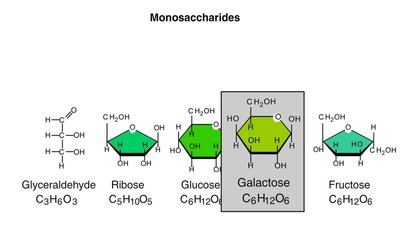
Monosaccharides are the simplest carbohydrates, consisting of single sugar units with the general formula CnH2nOn. They are the building blocks for more complex carbohydrates.
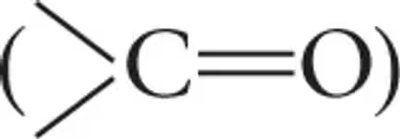
Key Features: Contain a carbonyl group (either an aldehyde or ketone) and multiple hydroxyl groups.
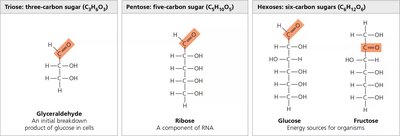
Classification: Based on the number of carbon atoms: trioses (3C), pentoses (5C), hexoses (6C).
Examples: Glucose, fructose, galactose, ribose, and glyceraldehyde.
Chemical Structure and Isomerism
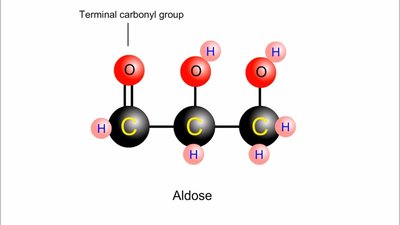
Monosaccharides can be classified as aldoses (with an aldehyde group) or ketoses (with a ketone group), depending on the position of the carbonyl group.
Aldose: Carbonyl group at the end of the carbon chain (e.g., glucose).
Ketose: Carbonyl group within the carbon chain (e.g., fructose).
Ring Formation
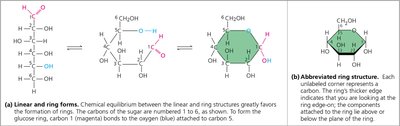
In aqueous solutions, most five- and six-carbon sugars form ring structures, which are more stable under physiological conditions. The ring formation involves the reaction between the carbonyl group and a hydroxyl group within the same molecule.
Glucose: Commonly exists in a six-membered ring form.
Fructose: Forms a five-membered ring.
Disaccharides
Formation and Examples
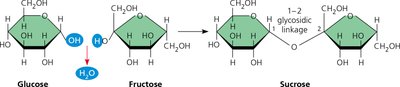
Disaccharides are formed by joining two monosaccharides via a glycosidic linkage, a covalent bond created through a dehydration reaction (removal of water).
Sucrose: Glucose + Fructose (table sugar)
Lactose: Glucose + Galactose (milk sugar)
Maltose: Glucose + Glucose (product of starch digestion)
Disaccharides must be hydrolyzed into monosaccharides to be used for energy by organisms.
Polysaccharides
Structure and Function
Polysaccharides are large macromolecules composed of hundreds to thousands of monosaccharide units joined by glycosidic linkages. Their structure and function depend on the types of monomers and the nature of the linkages.
Storage Polysaccharides: Serve as energy reserves.
Structural Polysaccharides: Provide support and protection.
Storage Polysaccharides
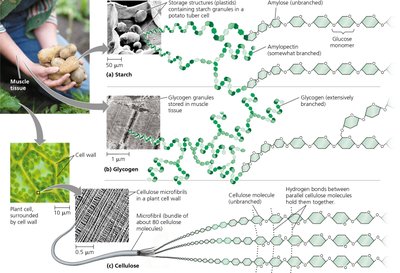
Starch: Main storage polysaccharide in plants; composed of amylose (unbranched) and amylopectin (branched).
Glycogen: Main storage polysaccharide in animals; highly branched and stored in liver and muscle cells.
Structural Polysaccharides
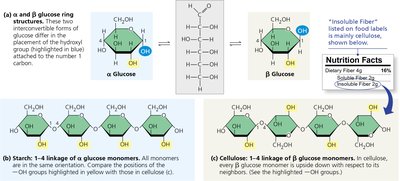
Cellulose: Major component of plant cell walls; composed of β-glucose monomers linked by β-1,4-glycosidic bonds, forming straight, unbranched chains that aggregate into strong fibers (microfibrils).
Chitin: Found in arthropod exoskeletons and fungal cell walls; similar to cellulose but with nitrogen-containing side groups.
Comparison of Starch and Cellulose
The difference between starch and cellulose lies in the type of glycosidic linkage and the resulting three-dimensional structure:
Starch: α-1,4-glycosidic linkages; forms helical structures suitable for storage.
Cellulose: β-1,4-glycosidic linkages; forms straight, rigid structures for support.
Biological Importance of Carbohydrates
Energy Source: Glucose is a primary energy source for cells; polysaccharides like starch and glycogen serve as energy reserves.
Structural Role: Cellulose provides rigidity to plant cell walls; chitin forms protective exoskeletons in arthropods.
Dietary Fiber: Cellulose acts as insoluble fiber in the human diet, aiding digestive health even though it is not digestible by human enzymes.
Biological Recognition: Oligosaccharides on cell surfaces play roles in cell-cell recognition and signaling.
Practice Questions
Write the formula for a monosaccharide that has three carbons. Answer: C3H6O3 (e.g., glyceraldehyde).
A dehydration reaction joins two glucose molecules to form maltose. The formula for glucose is C6H12O6. What is the formula for maltose? Answer: C12H22O11 (since one H2O is lost).
After a cow is given antibiotics to treat an infection, a vet gives the animal a drink of “gut culture” containing various prokaryotes. Why is this necessary? Answer: The prokaryotes are needed to help digest cellulose in the cow’s diet, as the cow relies on these microbes to break down cellulose into usable nutrients.
Key Equations
General formula for monosaccharides:
Dehydration reaction (formation of a disaccharide):
Additional info: Chitin is a structural polysaccharide found in fungal cell walls and arthropod exoskeletons, and its monomer is a glucose derivative with a nitrogen-containing group.
