 Back
Carbon and Key Chemical Groups: Foundations of Organic Chemistry in Biology
Study Guide - Smart Notes
 Tailored notes based on your materials, expanded with key definitions, examples, and context.
Chapter 2: Basic Chemistry
Core Concept: Organic Chemistry is Key to the Study of Life
Organic chemistry focuses on compounds containing carbon, which are fundamental to all living organisms. Organic compounds range from simple molecules, such as methane, to complex macromolecules like proteins and nucleic acids. The study of organic chemistry is essential for understanding biological processes.
Definition: Organic compounds are molecules primarily composed of carbon atoms bonded to hydrogen, oxygen, nitrogen, and other elements.
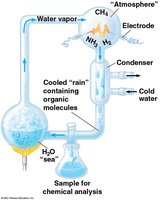
Abiotic Synthesis: Stanley Miller's classic experiment demonstrated that organic compounds, such as amino acids, can be synthesized abiotically under conditions thought to resemble those of early Earth.
Application: Understanding organic chemistry helps explain the molecular basis of life, including metabolism, genetic information, and cellular structure.
Core Concept: Carbon Atoms Can Form Diverse Molecules by Bonding to Four Other Atoms
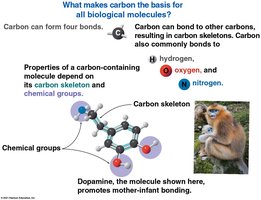
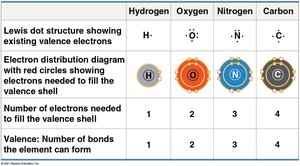
Carbon's unique electron configuration allows it to form four covalent bonds, enabling the creation of a vast array of molecular structures. This versatility is the foundation for the diversity of organic molecules in living systems.
Electron Configuration: Carbon has four valence electrons, allowing it to form stable bonds with other atoms.
Bonding Partners: The most frequent bonding partners of carbon are hydrogen, oxygen, and nitrogen.
Carbon Skeletons: Carbon atoms can bond to other carbons, forming chains, rings, and branched structures.
Properties: The properties of a carbon-containing molecule depend on its carbon skeleton and attached chemical groups.
Major Elements of Life
The overall percentages of the major elements—carbon, hydrogen, oxygen, nitrogen, phosphorus, and sulfur—are quite uniform among living organisms. These elements are essential for the structure and function of biomolecules.
Key Elements: C, H, O, N, P, S
Uniformity: The relative abundance of these elements is consistent across different species.
Isomers: Structural Diversity in Organic Molecules
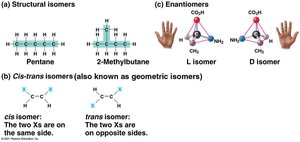
Isomers are compounds with the same molecular formula but different structures and properties. The existence of isomers increases the diversity of organic molecules.
Structural Isomers: Have different covalent arrangements of their atoms.
Cis-Trans Isomers (Geometric Isomers): Have the same covalent bonds but differ in spatial arrangement.
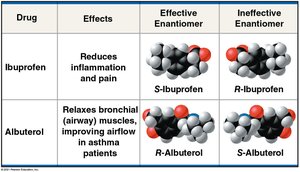
Enantiomers: Are mirror images of each other and can have different biological activities.
Example: Drugs such as ibuprofen and albuterol have enantiomers, with only one form being biologically effective.
Core Concept: Key Chemical Groups Determine Molecular Function
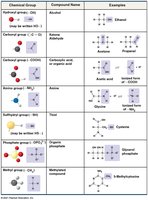
Certain chemical groups, known as functional groups, are critical to the function of organic molecules. These groups participate in chemical reactions and influence the properties of molecules.
Functional Groups: Components of organic molecules most commonly involved in chemical reactions.
Seven Key Functional Groups:
Hydroxyl group (–OH)
Carbonyl group (C=O)
Carboxyl group (–COOH)
Amino group (–NH2)
Sulfhydryl group (–SH)
Phosphate group (–OPO32−)
Methyl group (–CH3)
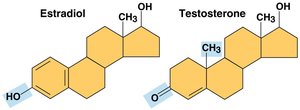
Example: The difference between estradiol and testosterone is due to their functional groups, which result in distinct biological effects.
ATP: An Important Source of Energy for Cellular Processes
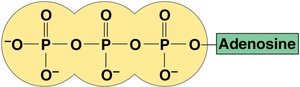
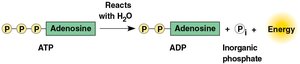
ATP (adenosine triphosphate) is the primary energy carrier in cells. Its structure includes three phosphate groups, and the hydrolysis of ATP releases energy used for cellular work.
Structure: ATP consists of adenosine and three phosphate groups.
Energy Release: Hydrolysis of ATP to ADP and inorganic phosphate releases energy.
Equation:
Application: ATP is used in muscle contraction, active transport, and biosynthesis.
Additional info:
Organic chemistry is foundational for understanding biomolecules such as carbohydrates, lipids, proteins, and nucleic acids.
Functional groups are often used to classify and predict the reactivity of organic molecules in biological systems.
