 Back
Carbon and Macromolecules: Foundations of Biological Chemistry
Study Guide - Smart Notes
 Tailored notes based on your materials, expanded with key definitions, examples, and context.
Carbon and Macromolecules: Foundations of Biological Chemistry
Aqueous Chemistry and Molarity
Biological systems are fundamentally aqueous, with water acting as the universal solvent. Understanding solution chemistry is essential for grasping how molecules interact in cells.
Solvent: The substance in which solutes are dissolved (commonly water in biology).
Solute: The substance dissolved in the solvent.
Molarity (M): The number of moles of solute per liter of solution. Denoted as [X], e.g., [Ca2+].
Equilibrium Constant (Keq): Describes the ratio of product to reactant concentrations at equilibrium:
Example Calculation: Determining the molarity of Cl- in seawater (assuming 35 ppt salinity, 90% NaCl):
The Chemical Context of Life: The Importance of Carbon
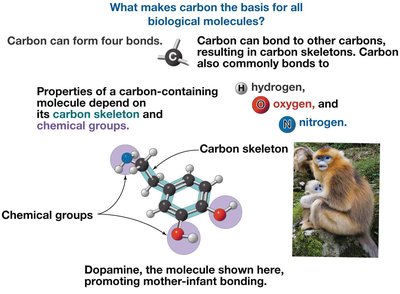
Carbon is the backbone of biological molecules due to its unique bonding properties.
Valence: Carbon has four valence electrons, allowing it to form four covalent bonds with a variety of atoms.
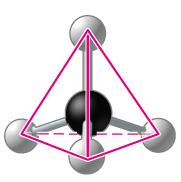
Tetrahedral Geometry: When bonded to four atoms, carbon forms a tetrahedral shape. Double bonds create planar structures.
Major Elements of Life: C, H, O, N, S, and P are the most common elements in living organisms.
Chemical Diversity: Arises from the arrangement of carbon skeletons and attached functional groups.
Experimental Origins: The Urey-Miller Experiment
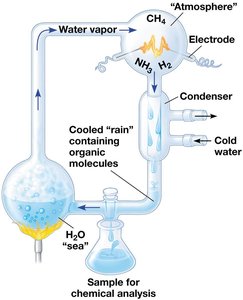
The Urey-Miller experiment demonstrated that organic molecules could form under prebiotic Earth conditions, supporting the idea that life's building blocks are chemically accessible.
Setup: Simulated early Earth atmosphere (CH4, NH3, H2, H2O) with electrical sparks to mimic lightning.
Result: Formation of amino acids and other organic molecules.
Structure and Diversity of Organic Molecules
Simple Organic Molecules: Methane, Ethane, Ethene
Carbon's bonding versatility allows for a variety of molecular shapes and complexities.
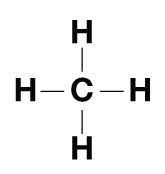
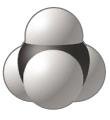
Methane (CH4): Tetrahedral geometry, single carbon bonded to four hydrogens.
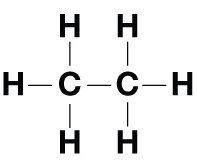
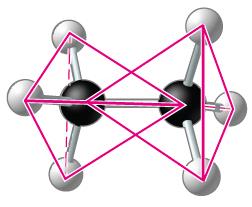
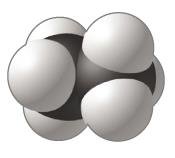
Ethane (C2H6): Two carbons single-bonded, each with three hydrogens.
Ethene (C2H4): Two carbons double-bonded, each with two hydrogens, planar geometry.
Molecule | Formula | Structural Formula | Ball-and-Stick Model | Space-Filling Model |
|---|---|---|---|---|
Methane | CH4 |
|
|
|
Ethane | C2H6 |
|
|
|
Ethene | C2H4 |
|
|
|
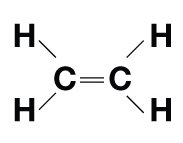
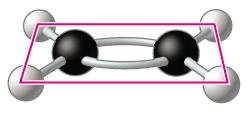
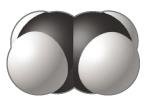
Valence and Electron Configuration of Key Elements
The number of valence electrons determines how many bonds an atom can form, which is crucial for molecular structure.
Element | Lewis Dot Structure | Bohr Model | Valence Electrons | Typical Bonds |
|---|---|---|---|---|
Hydrogen | H• |
| 1 | 1 |
Oxygen | O•••••• |
| 6 | 2 |
Nitrogen | N••••• |
| 5 | 3 |
Carbon | C•••• |
| 4 | 4 |

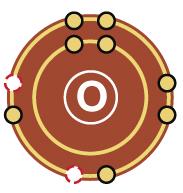
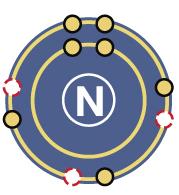
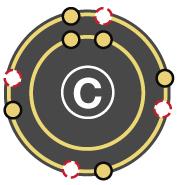
Types of Carbon Skeletons
Carbon skeletons can vary in length, branching, double bond position, and ring structure, contributing to molecular diversity.
Alkanes: Saturated hydrocarbons with single bonds.
Inorganic: Molecules not based on carbon-hydrogen bonds.
Polycyclic: Multiple rings fused together.
Amides: Contain a carbonyl group bonded to nitrogen.
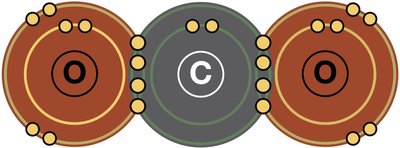
Hydrocarbons
Hydrocarbons are organic molecules consisting entirely of carbon and hydrogen. They are important energy sources and structural components in biology.
Properties: Nonpolar, hydrophobic, can release energy when oxidized.
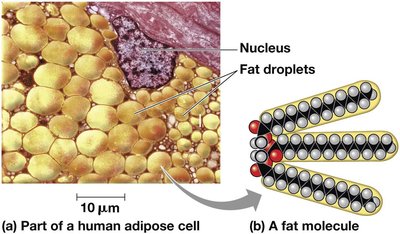
Examples: Fats contain hydrocarbon chains, though they are not pure hydrocarbons.
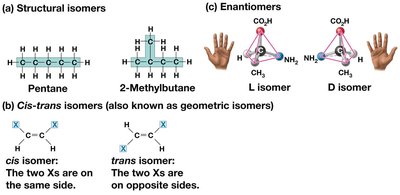
Isomers: Structural, Cis-Trans, and Enantiomers
Isomers are compounds with the same molecular formula but different structures and properties.
Structural Isomers: Different covalent arrangements of atoms.
Cis-Trans (Geometric) Isomers: Same covalent bonds, different spatial arrangements around a double bond.
Enantiomers: Mirror images of each other, important in biological specificity (e.g., L-amino acids).
Functional Groups
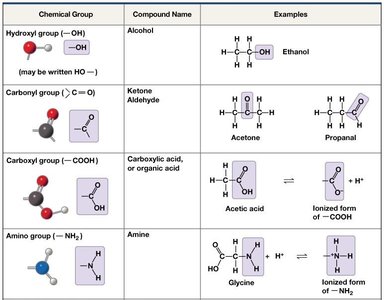
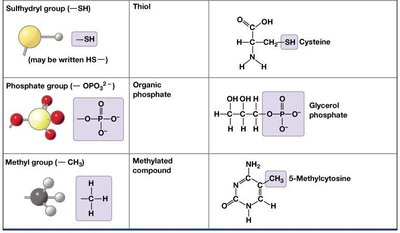
Functional groups are specific groups of atoms within molecules that determine the chemical reactivity and interactions of those molecules.
Chemical Group | Compound Name | Examples |
|---|---|---|
Hydroxyl (–OH) | Alcohol | Ethanol |
Carbonyl (>C=O) | Ketone, Aldehyde | Acetone, Propanal |
Carboxyl (–COOH) | Carboxylic acid | Acetic acid |
Amino (–NH2) | Amine | Glycine |
Sulfhydryl (–SH) | Thiol | Cysteine |
Phosphate (–OPO32–) | Organic phosphate | Glycerol phosphate |
Methyl (–CH3) | Methylated compound | 5-Methylcytosine |
Macromolecules: Structure and Function
Polymers and Monomers
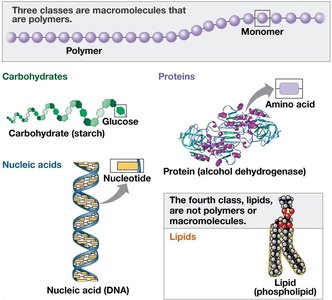
Macromolecules are large molecules composed of repeating subunits called monomers. The main classes are carbohydrates, proteins, and nucleic acids.
Polymer: Long molecule made of many similar or identical building blocks (monomers).
Monomer: The repeating unit that serves as a building block.
Oligomer: A molecule with a few monomer units.
Polymerization: The process of linking monomers to form a polymer.
Macromolecule Assembly and Disassembly
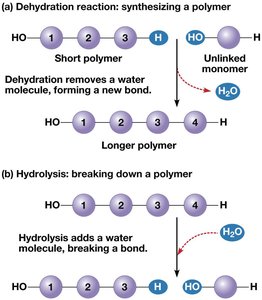
Polymers are synthesized and broken down by dehydration and hydrolysis reactions, respectively.
Dehydration Reaction: Joins two monomers by removing a water molecule.
Hydrolysis: Breaks a bond between monomers by adding a water molecule.
Carbohydrates: Structure and Classification
Carbohydrates are sugars and polymers of sugars, serving as energy sources and structural materials.
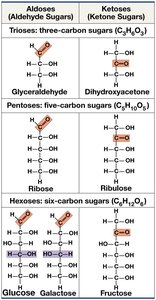
Monosaccharides: Simple sugars (e.g., glucose, fructose) with the general formula (CH2O)n.
Disaccharides: Two monosaccharides joined by a glycosidic linkage (e.g., sucrose).
Polysaccharides: Polymers of sugars (e.g., starch, glycogen, cellulose, chitin).
Classification: Based on the location of the carbonyl group (aldose or ketose) and the number of carbons in the skeleton.
Polysaccharides: Storage and Structural Roles
Polysaccharides serve as storage forms of energy or as structural components in cells.
Starch: Storage polysaccharide in plants, composed of α-glucose monomers, largely helical.
Glycogen: Storage polysaccharide in animals, highly branched, stored in liver and muscle cells.
Cellulose: Structural polysaccharide in plant cell walls, composed of β-glucose monomers, straight and unbranched.
Chitin: Structural polysaccharide in arthropod exoskeletons and fungal cell walls, monomer is N-acetylglucosamine.
Enzymatic Digestion of Polysaccharides
Enzymes that digest starch (α-linkages) cannot digest cellulose (β-linkages), which is why cellulose acts as insoluble fiber in the human diet. Only certain microbes can break down cellulose.
Symbiosis: Animals like cows rely on gut microbes to digest cellulose.
Summary Table: Major Biological Macromolecules
Class | Monomer | Polymer | Example |
|---|---|---|---|
Carbohydrates | Monosaccharide | Polysaccharide | Starch, Cellulose |
Proteins | Amino acid | Polypeptide | Enzymes, Structural proteins |
Nucleic acids | Nucleotide | Polynucleotide | DNA, RNA |
Lipids | Fatty acid, Glycerol | Not true polymers | Fats, Phospholipids |
Additional info:
Chirality (handedness) of molecules is crucial for biological function; only one enantiomer may be biologically active (e.g., L-amino acids, S-ibuprofen).
Functional groups determine the chemical reactivity and interactions of organic molecules, influencing acidity, polarity, and hydrogen bonding.
