 Back
Carbon & Molecular Structure: Diversity and Properties in Organic Molecules
Study Guide - Smart Notes
 Tailored notes based on your materials, expanded with key definitions, examples, and context.
Carbon & Molecular Structure
Why Carbon Creates So Much Diversity
Carbon is the fundamental element in organic molecules, forming the backbone of life's chemical diversity. Its unique ability to form four covalent bonds allows for a vast array of molecular shapes and properties.
Four Covalent Bonds: Carbon can form four bonds simultaneously, more than most other elements.
Bonding to Other Carbons: Enables the creation of long chains and complex frameworks.
Single & Double Bonds: Carbon forms both single and double bonds, contributing to shape variety.
Chains, Branches & Rings: Carbon skeletons can be straight, branched, or looped into rings, leading to different molecular architectures.
Bottom Line: Different bonding arrangements result in different molecular shapes and properties.
The Bonding Rules You Need
To analyze molecular structures, it is essential to know the expected number of bonds for each atom. This knowledge is foundational for understanding organic chemistry.
Valence Cheat Sheet:
H (Hydrogen): 1 bond
O (Oxygen): 2 bonds
N (Nitrogen): 3 bonds
C (Carbon): 4 bonds
Double Bond Counting: A double bond counts as two bonds toward an atom's total.
Example (Formaldehyde):
Carbon: 2 single bonds (to H) + 1 double bond (to O) = 4 bonds
Oxygen: 1 double bond to carbon = 2 bonds
Each Hydrogen: 1 single bond = 1 bond
Molecules Are 3-Dimensional
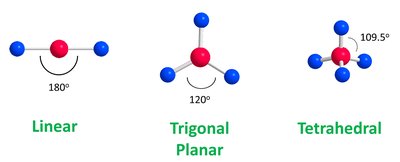
Structural drawings are flat, but real molecules occupy three-dimensional space. The geometry around each carbon atom depends on the types of bonds it forms.
Methane (CH4): Four single bonds create a tetrahedral shape (~109.5° bond angles).
Ethene (C2H4): Double bonds create a planar arrangement (~120° bond angles).
Key Insight: Flat drawings are maps; real molecules exist in 3-D space.
Carbon Skeletons Can Vary
The same atoms can be arranged in dramatically different ways, resulting in molecules with identical atom counts but different structures and properties.
Length: Carbon chains can be short or long, affecting molecular behavior.
Branching: Chains can be straight or branched, altering shape, boiling point, and reactivity.
Double-Bond Position: Double bonds can appear at different locations, changing geometry and chemical behavior.
Rings: Carbon skeletons can form rings, creating distinct architectures.
How to Read an Unfamiliar Structure
Analyzing unfamiliar molecules is possible by following a systematic approach. You do not need to know a molecule's name to extract useful information from its structure.
Count the atoms: How many C, H, O, N atoms are present?
Count the bonds: Tally all single and double bonds around each atom.
Check valence: Does each atom have the right number of bonds? (H=1, O=2, N=3, C=4)
Look for double bonds: Mark any C=C or C=O, as they affect shape and reactivity.
Look for rings & branches: Note where the skeleton closes into a ring or forks.
Predict 3-D shape: Single bonds → tetrahedral; double bonds → planar region.
Practice: Analyzing Molecules
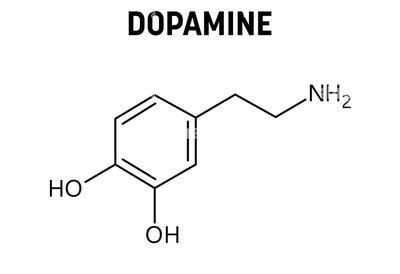
Apply the six-step procedure to molecules such as dopamine. Even without knowing the name, you can deduce atom counts, bond types, and predict 3-D regions.
Example: Dopamine contains a ring, branches, and both single and double bonds. Its structure can be analyzed for atom counts and bond types.
Comparing Carbon Skeletons
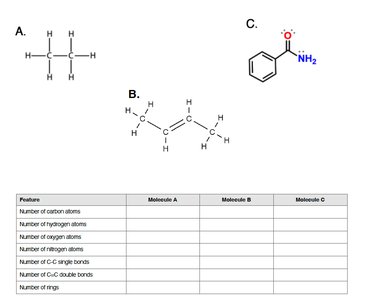
Different carbon skeletons built from the same atoms can have vastly different properties. Comparing features such as atom counts, bond types, and ring presence is essential for understanding molecular diversity.
Feature | Molecule A | Molecule B | Molecule C |
|---|---|---|---|
Number of carbon atoms | 4 | 4 | 7 |
Number of hydrogen atoms | 10 | 8 | 7 |
Number of oxygen atoms | 0 | 0 | 1 |
Number of nitrogen atoms | 0 | 0 | 1 |
Number of C-C single bonds | 3 | 1 | 6 |
Number of C=C double bonds | 0 | 1 | 1 |
Number of rings | 0 | 0 | 1 |
Additional info: Table entries inferred from typical molecular structures: A (butane), B (butene), C (phenylamine).
Building Carbon Skeletons
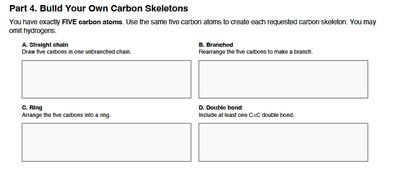
Using five carbon atoms, you can create a variety of skeletons: straight chains, branches, rings, and structures with double bonds. This exercise demonstrates how rearranging the same atoms leads to different molecular architectures.
Straight Chain: Five carbons in a single, unbranched chain.
Branched: Rearranged to create a branch.
Ring: Five carbons arranged in a ring.
Double Bond: Structure includes at least one C=C double bond.
Summary: Key Points for Analyzing Carbon-Based Molecules
Counting Atoms: Essential for understanding molecular composition.
Checking Bonds: Ensures each atom satisfies its valence.
Predicting 3-D Shape: Bond types determine geometry (tetrahedral, planar, etc.).
Comparing Skeletons: Structural differences lead to different properties.
Explaining Properties: Changes in structure affect boiling point, reactivity, and biological function.
Additional info: These concepts are foundational for understanding biomolecules, cell components, and the chemistry of life.
