 Back
BackCarbon and the Molecular Diversity of Life: Study Notes
Study Guide - Smart Notes
 Tailored notes based on your materials, expanded with key definitions, examples, and context.
Carbon and the Molecular Diversity of Life
Concept: Carbon in Biological Systems
Carbon is a fundamental element in living organisms, forming the backbone of organic molecules such as carbohydrates, proteins, nucleic acids, and lipids. Its unique chemical properties allow it to create a vast array of molecular structures essential for life.
Bulk Elements: CHNOPS (Carbon, Hydrogen, Nitrogen, Oxygen, Phosphorus, Sulfur) are the primary elements in biological systems. Excluding water, carbon is the most abundant element in living systems.
Organic Molecules: Defined as molecules containing covalently linked carbon and hydrogen atoms. These include carbohydrates, proteins, nucleic acids, and lipids.
Hydrocarbons: Organic molecules composed solely of carbon and hydrogen atoms. They serve as the simplest form of organic molecules and are often used as energy sources.
Practice Question: Organic molecules are defined as chemical compounds that contain: a) Carbon b) Carbon & Oxygen c) Carbon & Nitrogen d) Carbon & Hydrogen
Carbon as a Building Block
Carbon's ability to form four covalent bonds makes it a versatile atomic building block, enabling the formation of diverse molecular structures. The carbon backbone of organic molecules can vary in several ways, contributing to molecular diversity.
Bonding: Carbon can form up to four covalent bonds, allowing for complex and stable molecular structures.
Variations in Carbon Backbones: The structure of carbon backbones can differ in:
Length: Number of carbon atoms in the chain.
Position of Double Bonds: Location of double bonds within the carbon chain.
Branch Points: Presence of branches off the main carbon chain.
Linear vs. Ring Forms: Carbon chains can be straight or form rings.
Example: Variations of Carbon Backbones are illustrated below.
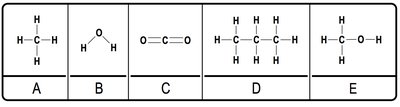
Concept: Functional Groups
Functional groups are specific groups of atoms within molecules that are responsible for the characteristic chemical reactions of those molecules. They are commonly found attached to the carbon backbone and play a crucial role in the reactivity and function of organic molecules.
Definition: Functional groups are reactive and commonly found together in biological molecules.
Attachment: Typically extend off the carbon backbone of a molecule.
Common Functional Groups: There are seven functional groups frequently encountered in biology:
Hydroxyl (-OH)
Carbonyl (C=O)
Carboxyl (-COOH)
Amino (-NH2)
Sulfhydryl (-SH)
Phosphate (-PO4)
Methyl (-CH3)
Practice Question: Which functional group is not present in this molecule? a) Carboxyl b) Sulfhydryl c) Hydroxyl d) Amino
Practice Question: What is the name of the functional group shown in the figure? a) Carbonyl b) Ketone c) Carboxyl d) Methyl e) Phosphate
Practice Question: All of the following are examples of functional groups in biology except: a) -CH3 b) -COOH c) -H2O d) -NH2 e) -OH
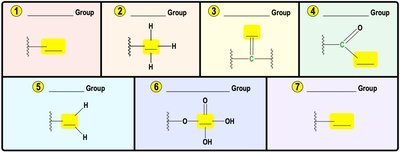
Classification and Comparison of Functional Groups
Functional groups can be classified based on their structure and chemical properties. Understanding their differences is essential for predicting the behavior of organic molecules in biological systems.
Functional Group | Structure | Properties | Example |
|---|---|---|---|
Hydroxyl | -OH | Polar, forms hydrogen bonds | Alcohols (e.g., ethanol) |
Carbonyl | C=O | Polar, found in ketones and aldehydes | Acetone, formaldehyde |
Carboxyl | -COOH | Acidic, can donate H+ | Acetic acid |
Amino | -NH2 | Basic, can accept H+ | Amino acids |
Sulfhydryl | -SH | Forms disulfide bonds | Cysteine |
Phosphate | -PO4 | Contributes negative charge | ATP, DNA |
Methyl | -CH3 | Nonpolar, affects gene expression | Methylated DNA |
Summary of Key Concepts
Carbon is the most abundant element in living systems (excluding water) and forms the backbone of organic molecules.
Organic molecules contain covalently linked carbon and hydrogen atoms.
Hydrocarbons are composed solely of carbon and hydrogen.
Carbon backbones can vary in length, branching, double bond position, and ring formation.
Functional groups are key determinants of molecular properties and reactivity in biological systems.
