 Back
BackCarbon and the Molecular Diversity of Life: Organic Chemistry Foundations
Study Guide - Smart Notes
 Tailored notes based on your materials, expanded with key definitions, examples, and context.
Carbon and the Molecular Diversity of Life
Organic Chemistry: The Study of Carbon Compounds
Organic chemistry is a fundamental branch of biology that focuses on compounds containing carbon. Carbon's unique properties allow it to form a vast array of complex and diverse molecules, which are essential for life.
Definition: Organic chemistry is the study of compounds that contain carbon atoms.
Carbon's Versatility: Carbon is unparalleled in its ability to form large, complex, and diverse molecules due to its bonding properties.
Hydrogen Inclusion: Most organic compounds also contain hydrogen atoms in addition to carbon atoms.
Range of Organic Compounds: Organic compounds can be simple (like methane) or colossal (such as proteins and DNA).
Atomic Structure and Valence of Key Elements
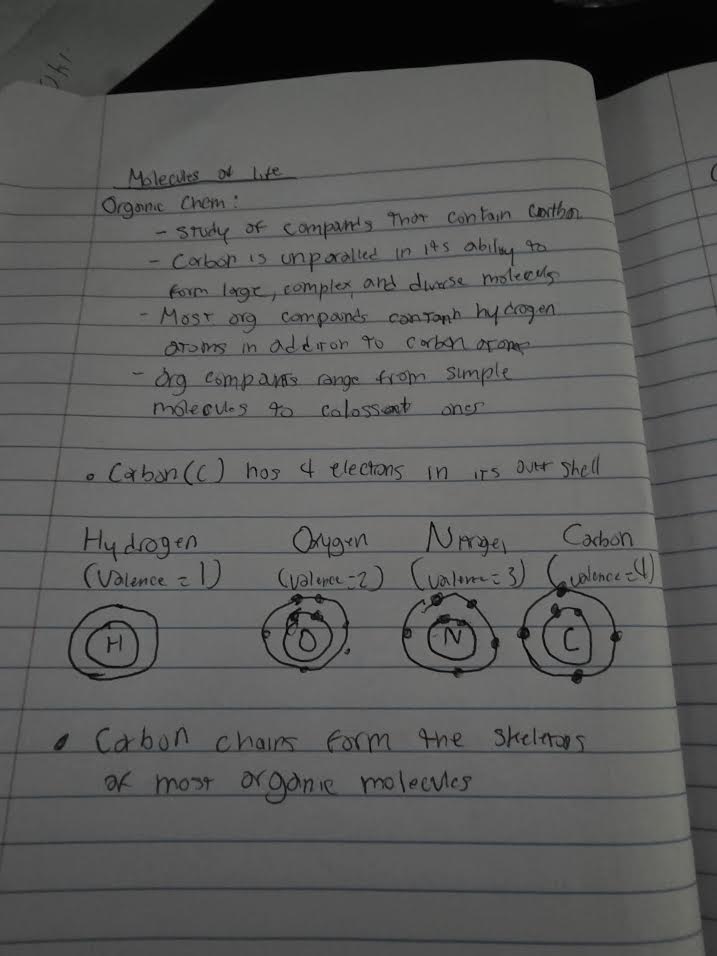
The ability of carbon to form multiple bonds is due to its electron configuration. Understanding the valence of common elements is crucial for predicting molecular structure.
Carbon (C): Has 4 electrons in its outer shell, allowing it to form four covalent bonds.
Hydrogen (H): Valence = 1; forms one bond.
Oxygen (O): Valence = 2; forms two bonds.
Nitrogen (N): Valence = 3; forms three bonds.
Example: The structure of organic molecules is determined by the valence of these atoms, which dictates how they bond and interact.
Carbon Chains: The Backbone of Organic Molecules
Carbon atoms can link together to form chains, which serve as the skeletons of most organic molecules. These chains can vary in length and shape, contributing to the diversity of organic compounds.
Carbon Chains: Linear, branched, or ring-shaped structures formed by carbon atoms.
Importance: The structure of carbon chains determines the properties and functions of organic molecules.
Application: Carbon chains are found in molecules such as fatty acids, amino acids, and carbohydrates.
Additional info: The ability of carbon to form stable covalent bonds with many elements, including hydrogen, oxygen, and nitrogen, is the foundation for the molecular diversity observed in living organisms.
----------------------------------------
