 Back
BackChapter 4: Carbon and the Molecular Diversity of Life: Structure, Function, and Biological Relevance
Study Guide - Smart Notes
 Tailored notes based on your materials, expanded with key definitions, examples, and context.
Organic Chemistry and the Origin of Life
Definition and Importance
Organic chemistry is the study of compounds that contain carbon, regardless of their origin. Organic compounds range from simple molecules to complex macromolecules, and their study is central to understanding biological systems. The field is foundational to the origin of life, as demonstrated by classic experiments such as Stanley Miller’s, which showed that organic molecules could form under prebiotic Earth conditions.
Organic molecules are essential for life and can be synthesized abiotically.
Major elements of life include carbon (C), hydrogen (H), oxygen (O), nitrogen (N), sulfur (S), and phosphorus (P).
The versatility of carbon is a key factor in the diversity of life forms.
Electron configuration determines the bonding behavior of atoms, especially carbon.
Carbon: The Backbone of Biological Molecules
Bonding Properties of Carbon
Carbon atoms have four valence electrons, allowing them to form four covalent bonds with a variety of atoms. This enables the construction of large, complex, and diverse molecules. The geometry of carbon bonding can be tetrahedral or planar, depending on the presence of single or double bonds.
Carbon’s valence (number of covalent bonds it can form) is typically four.
Most frequent bonding partners: hydrogen, oxygen, nitrogen.
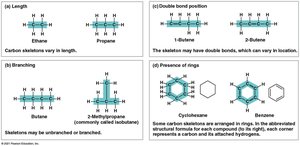
Carbon chains form the skeletons of most organic molecules and can vary in length, branching, double bond position, and ring formation.
Molecular Diversity Arising from Variation in Carbon Skeletons
Types of Carbon Skeleton Variation
Carbon skeletons can differ in several ways, contributing to the diversity of organic molecules:
Length: Chains can be short or long.
Branching: Chains may be unbranched or branched.
Double bond position: Double bonds can occur at different positions along the chain.
Presence of rings: Chains may form closed rings.
Hydrocarbons
Definition and Biological Role
Hydrocarbons are organic molecules consisting only of carbon and hydrogen. They are found in many biological molecules, such as fats, and can undergo reactions that release significant amounts of energy.
Hydrocarbons are nonpolar and hydrophobic.
They serve as energy storage molecules in biological systems.
Isomers: Structural Diversity in Organic Molecules
Types of Isomers
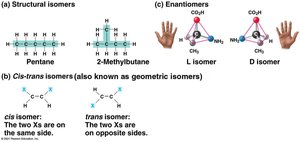
Isomers are compounds with the same molecular formula but different structures and properties. There are three main types:
Structural isomers: Differ in the covalent arrangement of atoms.
Cis-trans (geometric) isomers: Same covalent bonds but different spatial arrangements due to inflexible double bonds.
Enantiomers: Mirror images of each other, differing in spatial arrangement around an asymmetric carbon.
Biological Importance of Enantiomers
Enantiomers are especially significant in biology and pharmacology. Two enantiomers of a drug may have different effects in the body, with only one often being biologically active. This highlights the sensitivity of biological systems to molecular structure.
Chemical Groups and Molecular Function
Functional Groups
The distinctive properties of organic molecules depend on the carbon skeleton and the chemical groups attached to it. Functional groups are the components most commonly involved in chemical reactions, and their number and arrangement give each molecule its unique properties.
Seven key functional groups: Hydroxyl, Carbonyl, Carboxyl, Amino, Sulfhydryl, Phosphate, Methyl.
These groups are critical for the function and reactivity of biomolecules.
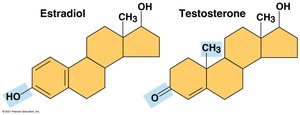
Examples: Estradiol and Testosterone
Estradiol and testosterone are both steroids with a common carbon skeleton of four fused rings. Their differing chemical groups account for their distinct biological activities as sex hormones.
ATP: The Energy Currency of the Cell
Structure and Function
Adenosine triphosphate (ATP) is an organic molecule consisting of adenosine attached to three phosphate groups. ATP stores potential energy that can be released through hydrolysis, providing energy for cellular processes.
ATP hydrolysis:
Application: Stanley Miller’s Experiment and Abiotic Synthesis
Experimental Evidence for the Origin of Organic Molecules
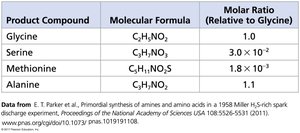
Stanley Miller’s classic experiment simulated early Earth conditions and demonstrated the abiotic synthesis of organic molecules, supporting the hypothesis that life’s building blocks could form naturally.
Product Compound | Molecular Formula | Molar Ratio (Relative to Glycine) |
|---|---|---|
Glycine | C2H5NO2 | 1.0 |
Serine | C3H7NO3 | 3.0 × 10⁻² |
Methionine | C5H11NO2S | 1.8 × 10⁻³ |
Alanine | C3H7NO2 | 1.1 |
Review and Practice Questions
What type of chemical bond joins a functional group to the carbon skeleton of a large molecule? Answer: Covalent bond
Which functional group behaves as a base in organic molecules? Answer: Amino group
Which functional group is present in this molecule?
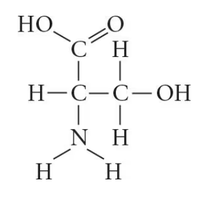 Answer: Amino group
Summary
The versatility of carbon underlies the diversity of organic molecules, which is foundational to biological diversity. Variation in carbon skeletons, the presence of functional groups, and the existence of isomers all contribute to the complexity and specificity of biological molecules. Understanding these principles is essential for studying life at the molecular level.
