Back
BackCarbon and the Molecular Diversity of Life
Study Guide - Smart Notes
 Tailored notes based on your materials, expanded with key definitions, examples, and context.
Chapter 4: Carbon and the Molecular Diversity of Life
Introduction
This chapter explores the unique properties of carbon that make it the foundation of all biological molecules. It covers the structure and diversity of organic molecules, the significance of isomerism, the role of functional groups, and the importance of ATP in cellular energy transfer.
Importance of Carbon in Biology
Carbon’s Electron Configuration and Bonding
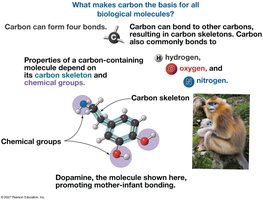
Carbon is unparalleled in its ability to form large, complex, and diverse molecules essential for life. Its electron configuration allows it to form four covalent bonds, enabling a vast array of molecular structures.
Valence Electrons: Carbon has four valence electrons, allowing it to form up to four covalent bonds with other atoms.
Bonding Partners: Carbon commonly bonds with hydrogen, oxygen, and nitrogen, forming the backbone of organic molecules.
Versatility: The ability to form single, double, or triple bonds and to bond with itself leads to a diversity of molecular shapes and sizes.
Organic Chemistry and the Origin of Life
Definition and Scope
Organic chemistry is the study of carbon-containing compounds, regardless of their origin. These compounds range from simple molecules like methane to complex macromolecules such as proteins and nucleic acids.
Carbon’s Bonding and Molecular Diversity
Formation of Bonds and Molecular Shapes
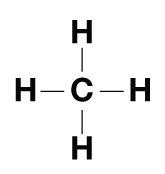
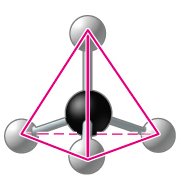
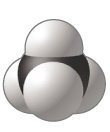
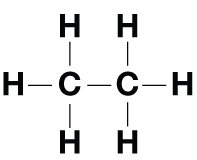
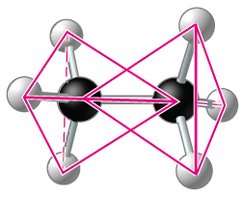
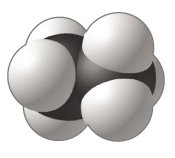
Carbon’s four covalent bonds allow for the formation of molecules with various shapes, including tetrahedral geometry and planar structures when double bonds are present.
Tetrahedral Shape: When carbon forms four single bonds, the molecule adopts a tetrahedral geometry.
Planar Structure: Double bonds between carbons result in a planar arrangement of the bonded atoms.
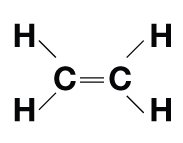
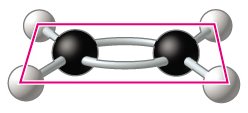
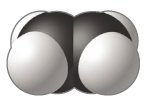
Valence and Major Elements in Organic Molecules
The number of unpaired electrons in the valence shell determines the number of covalent bonds an atom can form, known as its valence.
Hydrogen: Valence of 1
Oxygen: Valence of 2
Nitrogen: Valence of 3
Carbon: Valence of 4




Variation in Carbon Skeletons
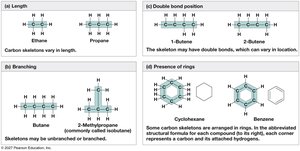
Carbon skeletons can vary in length, branching, double bond position, and the presence of rings, contributing to the diversity of organic molecules.
Length: Carbon chains can be short or long.
Branching: Chains may be unbranched or branched.
Double Bonds: Double bonds can vary in position.
Rings: Carbon atoms can form ring structures.
Hydrocarbons
Structure and Properties
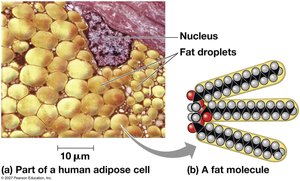
Hydrocarbons are organic molecules consisting entirely of carbon and hydrogen. They are hydrophobic due to their nonpolar C-H bonds and can store significant amounts of energy.
Examples: Fats contain hydrocarbon components.
Energy Storage: Hydrocarbons can undergo reactions that release large amounts of energy.
Isomers
Types of Isomers
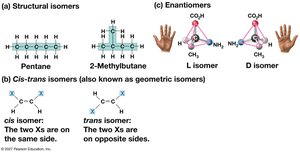
Isomers are compounds with the same molecular formula but different structures and properties. There are three main types:
Structural Isomers: Differ in the covalent arrangement of atoms.
Geometric (cis-trans) Isomers: Differ in spatial arrangement around a double bond.
Enantiomers: Mirror images of each other, differing in spatial arrangement around an asymmetric carbon.
Chemical Groups and Functional Groups
Role in Biological Molecules
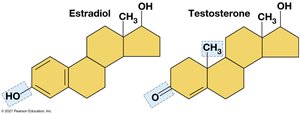
The properties of organic molecules depend on their carbon skeleton and the chemical groups attached. Functional groups are specific groups of atoms within molecules that are responsible for the characteristic chemical reactions of those molecules.
Estradiol and Testosterone: Both are steroids with a common carbon skeleton but differ in functional groups, resulting in different biological functions.
Major Functional Groups in Biology
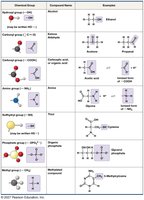
There are several major functional groups commonly found in biological molecules, each conferring specific properties:
Functional Group | Structure | Properties | Example |
|---|---|---|---|
Hydroxyl | -OH | Polar, forms hydrogen bonds | Alcohols |
Carbonyl | >C=O | Polar, found in sugars | Ketones, Aldehydes |
Carboxyl | -COOH | Acidic, donates H+ | Carboxylic acids |
Amino | -NH2 | Basic, picks up H+ | Amines |
Sulfhydryl | -SH | Forms disulfide bonds | Thiols |
Phosphate | -OPO32- | Contributes negative charge | Organic phosphates |
Methyl | -CH3 | Affects gene expression | Methylated compounds |
ATP: The Energy Currency of the Cell
Structure and Function of ATP
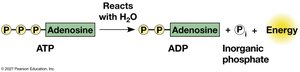
Adenosine triphosphate (ATP) is the primary energy transfer molecule in living cells. It consists of adenosine attached to three phosphate groups. The bonds between phosphate groups store potential energy that can be released to fuel cellular processes.
Hydrolysis of ATP: The reaction of ATP with water releases energy, forming ADP (adenosine diphosphate) and inorganic phosphate.
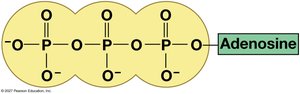
ATP to ADP Reaction
The hydrolysis of ATP is a key reaction in cellular metabolism:
Equation:
Significance: The released energy is used for cellular work, such as muscle contraction, active transport, and biosynthesis.