 Back
Carbon and the Molecular Diversity of Life: Biomolecules and Macromolecules
Study Guide - Smart Notes
 Tailored notes based on your materials, expanded with key definitions, examples, and context.
Carbon and the Molecular Diversity of Life
Introduction to Carbon Chemistry
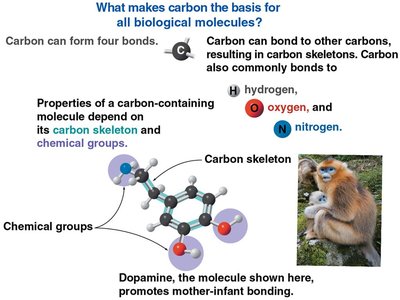
Carbon is the foundational element of all biological molecules due to its unique ability to form four covalent bonds, allowing for a vast diversity of molecular structures. The versatility of carbon enables the formation of complex molecules essential for life, including carbohydrates, lipids, proteins, and nucleic acids.
Carbon's Bonding Capacity: Carbon can form single, double, or triple bonds with other atoms, including itself, resulting in chains, branched molecules, and rings.
Common Elements Bonded to Carbon: Hydrogen, oxygen, and nitrogen are frequently found in organic molecules alongside carbon.
Importance of Structure: The properties of carbon-containing molecules depend on their carbon skeleton and attached chemical groups.
Example: Dopamine, a carbon-based molecule, is involved in mother-infant bonding in mammals.
Shapes and Types of Carbon Molecules
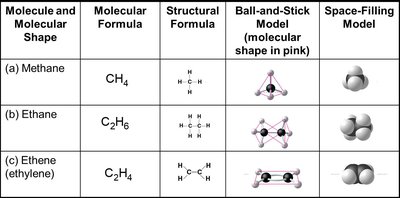
Carbon atoms can form molecules of various shapes and sizes, which influences their function in biological systems. The molecular formula, structural formula, and three-dimensional models help visualize these differences.
Molecule and Molecular Shape | Molecular Formula | Structural Formula | Ball-and-Stick Model | Space-Filling Model |
|---|---|---|---|---|
Methane | CH4 | H | H–C–H | H | 3D tetrahedral | Compact sphere |
Ethane | C2H6 | H H | | H–C–C–H | | H H | 3D linear | Two connected spheres |
Ethene (ethylene) | C2H4 | H2C=CH2 | Planar | Flattened spheres |
Variation in Carbon Skeletons
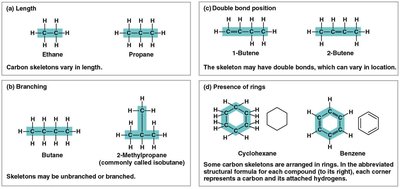
The diversity of organic molecules is further increased by variations in the carbon skeleton, including length, branching, double bond position, and the presence of rings.
Length: Carbon chains can be short or long (e.g., ethane vs. propane).
Branching: Skeletons may be unbranched or branched (e.g., butane vs. isobutane).
Double Bond Position: Double bonds can occur at different positions along the chain (e.g., 1-butene vs. 2-butene).
Rings: Some carbon skeletons form rings (e.g., cyclohexane, benzene).
Isomers: Structural Diversity and Biological Function
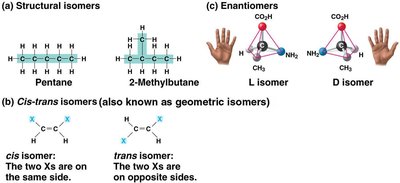
Isomers are molecules with the same molecular formula but different structures, leading to different properties and functions in biological systems.
Structural Isomers: Differ in the covalent arrangement of atoms (e.g., pentane vs. 2-methylbutane).
Cis-Trans (Geometric) Isomers: Differ in spatial arrangement around double bonds (cis: same side, trans: opposite sides).
Enantiomers: Mirror-image isomers important in biology (e.g., L and D isomers of amino acids).
Electron Distribution and Valence of Key Elements
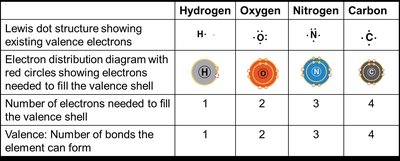
The chemical behavior of atoms is determined by the distribution of electrons in their valence shells. Hydrogen, oxygen, nitrogen, and carbon are the primary elements in biological molecules, each with a specific valence (bonding capacity).
Element | Valence Electrons | Electrons Needed to Fill Shell | Valence (Bonds Formed) |
|---|---|---|---|
Hydrogen | 1 | 1 | 1 |
Oxygen | 6 | 2 | 2 |
Nitrogen | 5 | 3 | 3 |
Carbon | 4 | 4 | 4 |
Macromolecules: Structure and Synthesis
Monomers and Polymers
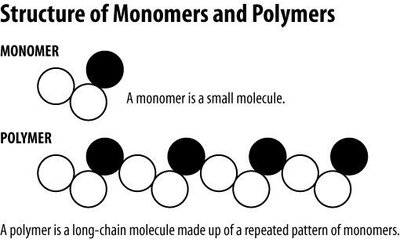
Macromolecules are large molecules essential for life, built from smaller subunits called monomers. When monomers are linked together, they form polymers, which have unique properties and functions.
Monomer: A small molecule that can join with others to form a polymer.
Polymer: A long-chain molecule made up of repeating monomer units.
Polymerization: Dehydration and Hydrolysis Reactions
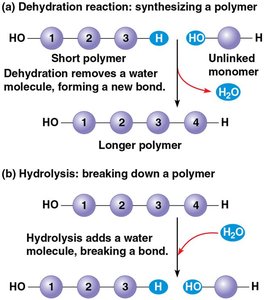
Polymers are synthesized and broken down by specific chemical reactions:
Dehydration Reaction: Joins monomers by removing a water molecule, forming a new bond.
Hydrolysis: Breaks bonds between monomers by adding a water molecule.
Carbohydrates: Structure and Function
Overview of Carbohydrates
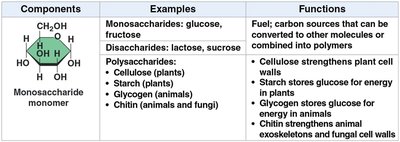
Carbohydrates are organic molecules that serve as fuel and building material. They are polymers built from sugar monomers (monosaccharides).
Monosaccharides: Simple sugars (e.g., glucose, fructose).
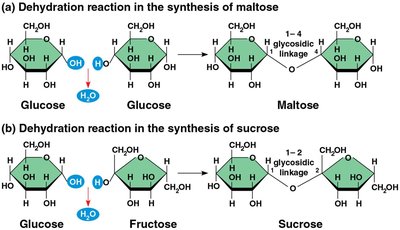
Disaccharides: Two monosaccharides joined by a dehydration reaction (e.g., lactose, sucrose).
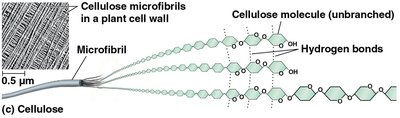
Polysaccharides: Long chains of monosaccharides with storage (starch, glycogen) or structural (cellulose, chitin) roles.
Formation of Disaccharides
Disaccharides are formed by dehydration reactions between two monosaccharides, creating glycosidic linkages.
Maltose: Formed from two glucose molecules.
Sucrose: Formed from glucose and fructose.
Polysaccharides: Storage and Structural Roles
Polysaccharides have diverse functions depending on their structure:
Storage Polysaccharides: Starch (plants) and glycogen (animals, fungi) store energy.
Structural Polysaccharides: Cellulose (plants) and chitin (animals, fungi) provide structural support.
Lipids: Structure and Function
Overview of Lipids
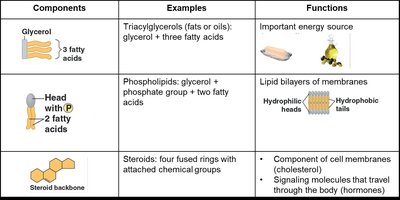
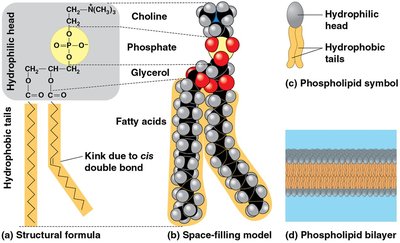
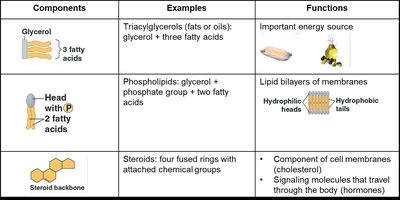
Lipids are a diverse group of hydrophobic molecules, including fats, phospholipids, and steroids. They are not true polymers but are essential for energy storage, membrane structure, and signaling.
Component | Examples | Functions |
|---|---|---|
Glycerol + 3 fatty acids | Fats (oils) | Energy storage, insulation, cushioning |
Glycerol + phosphate + 2 fatty acids | Phospholipids | Main component of cell membranes |
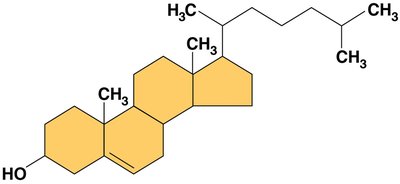
Steroid backbone | Steroids (cholesterol, hormones) | Membrane structure, signaling |
Fats: Synthesis and Types
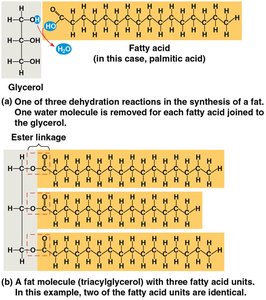
Fats are formed by joining glycerol to fatty acids via dehydration reactions, creating ester linkages. Fats can be saturated (no double bonds) or unsaturated (one or more double bonds), affecting their physical properties.
Saturated Fats: No double bonds, solid at room temperature (e.g., butter).
Unsaturated Fats: One or more double bonds, liquid at room temperature (e.g., oils).
Phospholipids and Steroids
Phospholipids have hydrophilic heads and hydrophobic tails, forming the bilayer structure of cell membranes. Steroids are characterized by four fused carbon rings and include cholesterol and hormones.
Proteins: Structure and Function
Overview of Proteins
Proteins are polymers made from 20 different amino acids. They perform a wide range of functions, including catalysis, defense, storage, transport, signaling, movement, and structural support.
Component | Examples | Functions |
|---|---|---|
Amino acids | Enzymes, antibodies, hemoglobin, insulin, actin, collagen | Catalysis, defense, transport, signaling, movement, support |
Amino Acids and Peptide Bonds
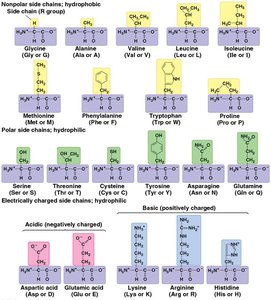
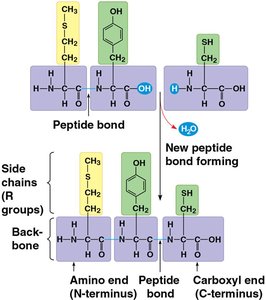
All proteins are built from the same set of 20 amino acids, linked by peptide bonds to form polypeptides. The sequence and chemical properties of amino acids determine protein structure and function.
Levels of Protein Structure
Protein structure is organized into four levels:
Primary Structure: Unique sequence of amino acids.
Secondary Structure: Coils and folds (α-helix, β-sheet) due to hydrogen bonding.
Tertiary Structure: 3D shape formed by interactions among side chains (R groups).
Quaternary Structure: Association of multiple polypeptide chains.
Protein Denaturation
Proteins are sensitive to environmental changes such as temperature and pH. Denaturation is the loss of a protein's native structure, resulting in loss of function.
Nucleic Acids: Structure and Function
Overview of Nucleic Acids
Nucleic acids store, transmit, and help express hereditary information. The two main types are DNA and RNA.
Nucleotides: Building blocks of nucleic acids, each consisting of a sugar, phosphate group, and nitrogenous base.
DNA: Double-stranded, contains deoxyribose sugar, bases A, T, C, G.
RNA: Single-stranded, contains ribose sugar, bases A, U, C, G.
The Central Dogma of Molecular Biology
Genetic information flows from DNA to RNA to protein, a process known as the central dogma. This underlies the expression of genetic information in all living organisms.
Transcription: DNA is transcribed into RNA.
Translation: RNA is translated into protein.
