 Back
Carbon and the Molecular Diversity of Life & Structure and Function of Large Biological Molecules
Study Guide - Smart Notes
 Tailored notes based on your materials, expanded with key definitions, examples, and context.
Carbon and the Molecular Diversity of Life
Overview: Carbon—The Backbone of Life
Although cells are primarily composed of water, the majority of their remaining mass consists of carbon-based compounds. Carbon is the foundational element in organic molecules such as proteins, DNA, and carbohydrates, which are essential for life.
Organic chemistry is the study of carbon-containing compounds, regardless of their origin.
Most organic compounds also contain hydrogen, forming C–C and C–H bonds.
The versatility of carbon allows for the formation of a vast array of organic molecules, contributing to the diversity of life.
Electron Configuration and Bonding
The electron configuration of carbon determines its chemical properties and bonding behavior.
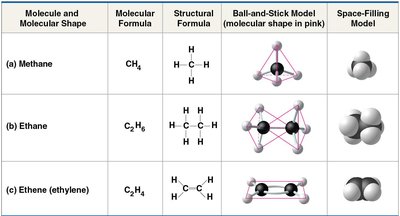
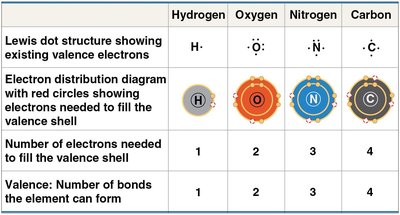
Carbon has four valence electrons, allowing it to form four covalent bonds with other atoms.
This tetravalence enables the construction of large, complex molecules with diverse shapes and functions.
Common bonding partners include hydrogen, oxygen, and nitrogen.
Carbon Chains and Molecular Diversity
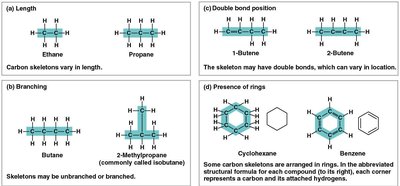
Carbon atoms can bond to each other, forming chains that serve as the skeletons of most organic molecules. These chains vary in length, branching, double bond position, and ring formation, contributing to molecular diversity.
Examples include hydrocarbons (molecules of only carbon and hydrogen) and more complex molecules with functional groups attached.
Isomers
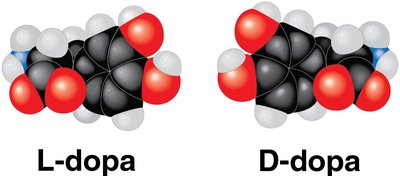
Isomers are compounds with the same molecular formula but different structures and properties.
Structural isomers: Differ in covalent arrangement of atoms.
Cis-trans (geometric) isomers: Same covalent bonds, different spatial arrangements.
Enantiomers: Mirror images of each other, important in biological systems (e.g., pharmaceuticals).
Functional Groups
Functional groups are specific groups of atoms attached to carbon skeletons that determine the chemical properties and reactivity of organic molecules. The seven most important functional groups in biology are:
Hydroxyl (–OH)
Carbonyl (C=O)
Carboxyl (–COOH)
Amino (–NH2)
Sulfhydryl (–SH)
Phosphate (–PO42−)
Methyl (–CH3)
Chemical Group | Compound Name | Examples |
|---|---|---|
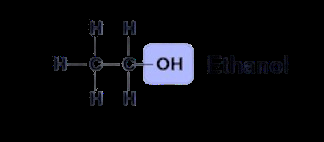
Hydroxyl (–OH) | Alcohol | Ethanol |
Carbonyl (C=O) | Ketone/Aldehyde | Acetone, Propanal |
Carboxyl (–COOH) | Carboxylic acid | Acetic acid |
Amino (–NH2) | Amine | Glycine |
Sulfhydryl (–SH) | Thiols | Cysteine |
Phosphate (–PO4) | Organic phosphate | Glycerol phosphate |
Methyl (–CH3) | Methylated compound | 5-Methyl cytidine |
ATP: The Energy Currency of the Cell
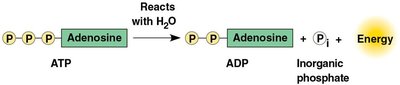
Adenosine triphosphate (ATP) is a key organic phosphate that stores and transfers energy within cells. Hydrolysis of ATP releases energy used for cellular processes.
ATP consists of adenosine attached to three phosphate groups.
Energy is released when ATP is hydrolyzed to ADP and inorganic phosphate.
The Structure and Function of Large Biological Molecules
Classes of Biological Macromolecules
All living organisms are composed of four major classes of large biological molecules:
Carbohydrates
Lipids
Proteins
Nucleic acids
Macromolecules are polymers built from monomers, except for lipids, which are not true polymers.
Polymer Synthesis and Breakdown
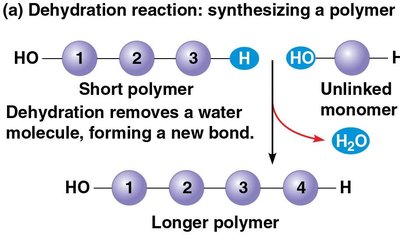
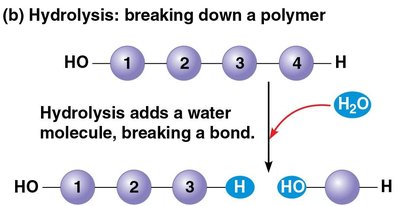
Polymers are synthesized by dehydration reactions and broken down by hydrolysis.
Dehydration reaction: Joins monomers by removing a water molecule.
Hydrolysis: Breaks polymers into monomers by adding water.
Carbohydrates
Carbohydrates serve as fuel and building material. They include sugars and their polymers.
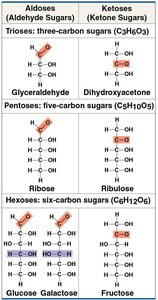
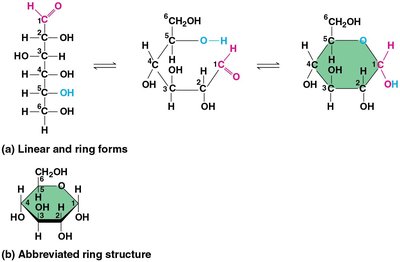
Monosaccharides: Simple sugars (e.g., glucose, C6H12O6), classified by carbonyl group location and carbon number.
Disaccharides: Formed by dehydration reaction between two monosaccharides (glycosidic linkage).
Polysaccharides: Storage (starch, glycogen) or structural (cellulose, chitin) roles.
Lipids
Lipids are hydrophobic molecules, including fats, phospholipids, and steroids. They are important for energy storage, membrane structure, and signaling.
Fats: Composed of glycerol and fatty acids; can be saturated (solid at room temperature) or unsaturated (liquid at room temperature).
Phospholipids: Two fatty acids and a phosphate group attached to glycerol; form cell membranes.
Steroids: Four fused carbon rings; e.g., cholesterol, sex hormones.
Proteins
Proteins are polymers of amino acids and perform a wide range of functions, including catalysis, structure, transport, and defense.
Amino acids: Organic molecules with amino and carboxyl groups; differ by side chains (R groups).
Polypeptides: Chains of amino acids linked by peptide bonds.
Protein structure: Four levels—primary (sequence), secondary (α-helix, β-sheet), tertiary (3D folding), quaternary (multiple polypeptides).
Nucleic Acids
Nucleic acids (DNA and RNA) store, transmit, and express hereditary information. They are polymers of nucleotides, each consisting of a nitrogenous base, a pentose sugar, and a phosphate group.
DNA: Double helix, antiparallel strands, base pairing (A-T, G-C).
RNA: Single-stranded, base pairing (A-U, G-C).
Summary Table: Major Classes of Biological Molecules
Class | Monomer | Polymer | Function |
|---|---|---|---|
Carbohydrates | Monosaccharide | Polysaccharide | Energy storage, structure |
Lipids | Fatty acids, glycerol | — | Energy storage, membranes, signaling |
Proteins | Amino acid | Polypeptide | Catalysis, structure, transport, defense |
Nucleic acids | Nucleotide | Polynucleotide | Genetic information storage and transfer |
