 Back
Carbon and the Molecular Diversity of Life
Study Guide - Smart Notes
 Tailored notes based on your materials, expanded with key definitions, examples, and context.
Carbon and the Molecular Diversity of Life
Introduction to Organic Chemistry
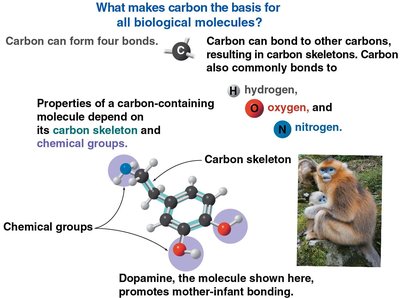
Organic chemistry is the study of compounds that contain carbon. Carbon's unique ability to form four covalent bonds makes it the foundation for the vast diversity of organic molecules essential to life. The structure and function of these molecules are central to biological processes.
Properties of Carbon
Valence Electrons: Carbon has four electrons in its outer shell and needs four more to fill it, allowing it to form up to four covalent bonds, which can be single, double, or triple bonds.
Bond Stability: Carbon-carbon bonds are stable across a wide range of temperatures, making them suitable for life.
Bonding Partners: The most frequent bonding partners of carbon are hydrogen, oxygen, and nitrogen.
Molecular Diversity: The ability of carbon to bond with many elements and itself leads to an immense variety of molecular structures.
Allotropes of Carbon: Diamond and Graphite
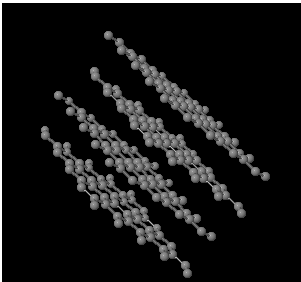
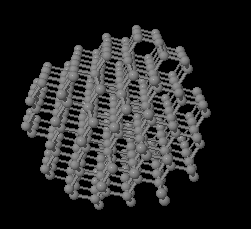
Diamond and graphite are both composed solely of carbon atoms, but their properties differ due to the arrangement of these atoms.
Diamond: Each carbon atom forms four strong covalent bonds in a tetrahedral structure, making diamond extremely hard.
Graphite: Carbon atoms are arranged in layers with weak forces between them, making graphite soft and slippery.


Valence and Covalent Bonding
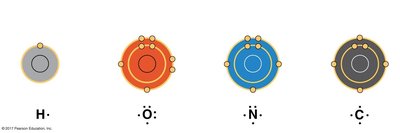
The number of unpaired electrons in the valence shell of an atom determines its valence, or the number of covalent bonds it can form. For example:
Hydrogen (H): Valence = 1
Oxygen (O): Valence = 2
Nitrogen (N): Valence = 3
Carbon (C): Valence = 4
Carbon Skeletons and Molecular Diversity
Carbon atoms can form chains, rings, and branched structures, creating the skeletons of organic molecules. These skeletons can vary in length, branching, and the presence of double bonds or rings.
Single, Double, and Triple Bonds: Carbon can form single (C–C), double (C=C), or triple (C≡C) bonds.
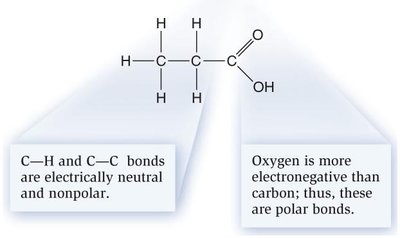
Polarity: Molecules with nonpolar bonds (like hydrocarbons) are poorly water soluble, while those with polar bonds are more water soluble.
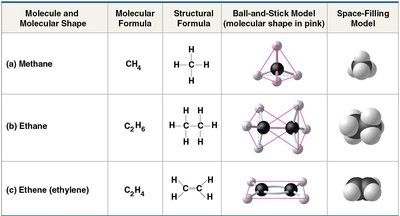
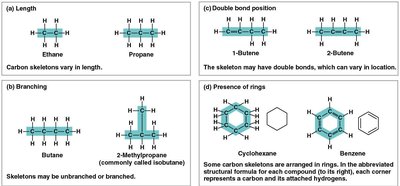
Hydrocarbons
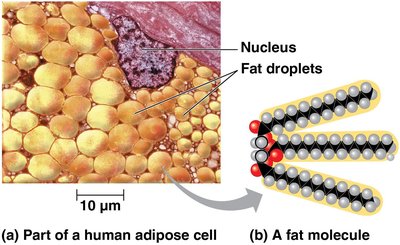
Hydrocarbons are organic molecules consisting only of carbon and hydrogen. They are major components of many biological molecules, such as fats, and can release large amounts of energy during reactions.
Isomers
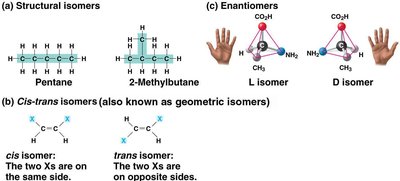
Isomers are compounds with the same molecular formula but different structures and properties. Types of isomers include:
Structural Isomers: Differ in the covalent arrangement of atoms.
Cis-Trans (Geometric) Isomers: Differ in spatial arrangement around a double bond.
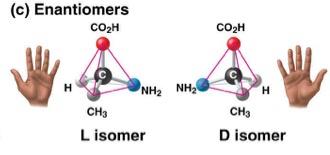
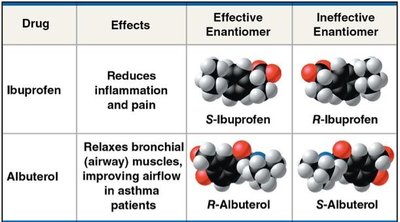
Enantiomers: Mirror images of each other, important in biological systems due to their different effects.
Functional Groups
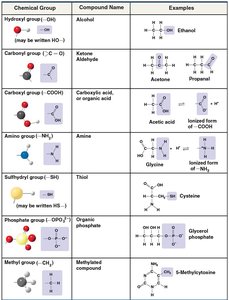
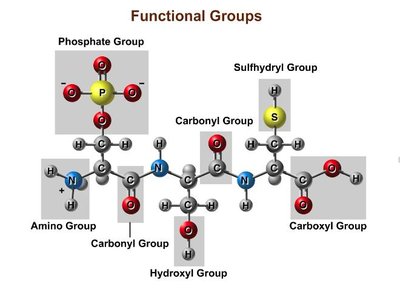
Functional groups are specific groups of atoms attached to carbon skeletons that determine the chemical properties and reactivity of organic molecules. The seven most important functional groups in biological molecules are:
Hydroxyl (–OH): Alcohols, e.g., ethanol
Carbonyl (C=O): Ketones and aldehydes, e.g., acetone
Carboxyl (–COOH): Carboxylic acids, e.g., acetic acid
Amino (–NH2): Amines, e.g., glycine
Sulfhydryl (–SH): Thiols, e.g., cysteine
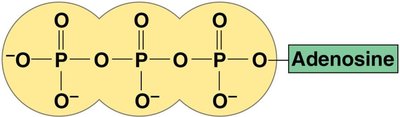
Phosphate (–OPO32–): Organic phosphates, e.g., ATP
Methyl (–CH3): Methylated compounds, e.g., 5-methylcytosine
Amphipathic Molecules
Some molecules contain both polar and nonpolar functional groups, making them amphipathic. These molecules play key roles in forming biological membranes and other structures.
Adenosine Triphosphate (ATP): The Energy Currency of the Cell
ATP is an important organic phosphate that stores and transfers energy within cells. It consists of adenosine attached to three phosphate groups. The hydrolysis of ATP releases energy used for cellular processes.
ATP Structure: Adenosine + three phosphate groups
Energy Release: ATP reacts with water to form ADP and inorganic phosphate, releasing energy.
Polymer Formation and Breakdown
Biological macromolecules are often polymers, formed by linking monomers through dehydration reactions and broken down by hydrolysis reactions.
Dehydration Reaction: Joins monomers by removing water.
Hydrolysis Reaction: Breaks polymers into monomers by adding water.
Summary: The Importance of Carbon in Biology
The versatility of carbon enables the formation of a vast array of organic molecules, which underlie the diversity of life. The structure and function of these molecules are determined by the arrangement of carbon skeletons and the functional groups attached to them.
