 Back
Carbon and the Molecular Diversity of Life & The Structure and Function of Large Biological Molecules
Study Guide - Smart Notes
 Tailored notes based on your materials, expanded with key definitions, examples, and context.
Carbon and the Molecular Diversity of Life
Distinctive Properties of Organic Molecules
Organic molecules are defined by their carbon skeletons and the chemical groups attached to them. These groups, known as functional groups, are responsible for the unique properties and reactivity of each molecule.
Carbon skeletons provide the basic framework for organic molecules.
Functional groups are specific groups of atoms that confer distinct chemical properties.
Variation in functional groups leads to molecular diversity and biological complexity.
Example: Estradiol and testosterone differ only in their functional groups, yet have vastly different biological effects.
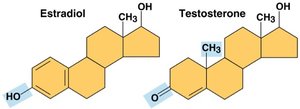
Key Chemical Groups in Molecular Function
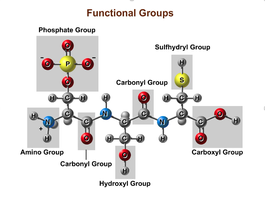
Functional groups are the most reactive parts of organic molecules and are commonly involved in chemical reactions. They determine the behavior and function of molecules in biological systems.
Hydroxyl group (–OH): Found in alcohols, increases solubility in water.
Carbonyl group (C=O): Found in ketones and aldehydes, important in sugars.
Carboxyl group (–COOH): Acts as an acid, found in amino acids and fatty acids.
Amino group (–NH2): Acts as a base, found in amino acids.
Sulfhydryl group (–SH): Found in proteins, forms disulfide bonds.
Phosphate group (–PO4): Found in nucleic acids and ATP, involved in energy transfer.
ATP: An Important Organic Phosphate
Adenosine triphosphate (ATP) is a key energy carrier in cells. It consists of adenosine attached to three phosphate groups. ATP stores potential energy and releases it through hydrolysis, fueling cellular processes.
ATP hydrolysis: ATP + H2O → ADP + Pi + energy
Energy released is used for cellular work.
The Versatility of Carbon
Carbon's ability to form four covalent bonds allows for a vast diversity of organic molecules. This molecular variation is the foundation of biological diversity.
Carbon can form chains, rings, and branched structures.
Organic molecules vary among cells, species, and kingdoms.
The Structure and Function of Large Biological Molecules
Macromolecules and Polymers
Large biological molecules, or macromolecules, are polymers built from repeating units called monomers. The main classes of macromolecules are carbohydrates, proteins, and nucleic acids.
Polymer: Long molecule made of many similar monomers.
Monomer: The basic building block of a polymer.
Enzymes: Specialized proteins that speed up chemical reactions, including polymer synthesis and breakdown.
Synthesis and Breakdown of Polymers
Polymers are synthesized by dehydration reactions and broken down by hydrolysis. These processes are catalyzed by enzymes.
Dehydration reaction: Joins two monomers by removing a water molecule.
Hydrolysis: Breaks a polymer into monomers by adding a water molecule.
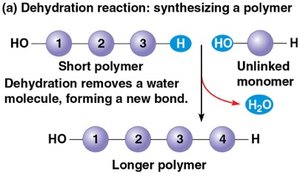
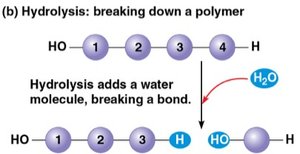
Diversity of Macromolecules
Cells contain thousands of different macromolecules. The variety arises from different combinations of a small set of monomers.
Macromolecules vary among cells, species, and kingdoms.
Small changes in monomer sequence can lead to large differences in function.
Carbohydrates: Fuel and Building Material
Carbohydrates are polymers of sugars and serve as energy sources and structural materials. The simplest carbohydrates are monosaccharides, which combine to form disaccharides and polysaccharides.
Monosaccharides: Simple sugars, usually multiples of CH2O. Example: Glucose (C6H12O6).
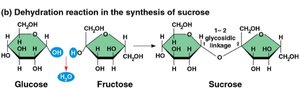
Disaccharides: Formed by joining two monosaccharides via a dehydration reaction.
Polysaccharides: Long chains of monosaccharides, serve storage and structural roles.
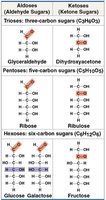
Monosaccharides and Ring Formation
Monosaccharides can exist as linear chains or ring structures, especially in aqueous solutions.
Disaccharides and Glycosidic Linkages
Disaccharides are formed when two monosaccharides are joined by a covalent bond called a glycosidic linkage.
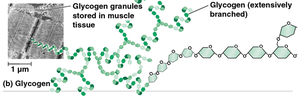
Polysaccharides: Storage and Structural Roles
Polysaccharides are classified based on their function and structure. Storage polysaccharides include starch in plants and glycogen in animals. Structural polysaccharides include cellulose in plants and chitin in arthropods and fungi.
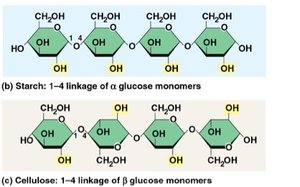
Starch: Storage polysaccharide in plants, composed of glucose monomers.
Glycogen: Storage polysaccharide in animals, stored in liver and muscle cells.
Cellulose: Structural polysaccharide in plant cell walls, composed of glucose with β linkages.
Chitin: Structural polysaccharide in arthropod exoskeletons and fungal cell walls.
Structural Differences: Starch vs. Cellulose
Starch and cellulose are both polymers of glucose, but differ in their glycosidic linkages. Starch has α linkages, making it helical, while cellulose has β linkages, making it straight and unbranched.
Enzymes that digest starch cannot digest cellulose due to the difference in linkage.
Cellulose passes through the human digestive tract as insoluble fiber.
Some microbes and herbivores can digest cellulose with specialized enzymes.
Summary Table: Types of Carbohydrates
Type | Structure | Function | Example |
|---|---|---|---|
Monosaccharide | Single sugar unit | Energy source | Glucose |
Disaccharide | Two sugar units | Transport sugar | Sucrose |
Polysaccharide (Storage) | Long chain, α linkages | Energy storage | Starch, Glycogen |
Polysaccharide (Structural) | Long chain, β linkages | Structural support | Cellulose, Chitin |
Additional info: Chitin is a modified polysaccharide containing nitrogen, providing extra strength and flexibility to exoskeletons and fungal cell walls.
