 Back
Carbon and the Molecular Diversity of Life
Study Guide - Smart Notes
 Tailored notes based on your materials, expanded with key definitions, examples, and context.
Carbon and the Molecular Diversity of Life
Why Carbon?
Carbon is a fundamental element in biological molecules due to its unique ability to form four covalent bonds, allowing for a diversity of stable organic compounds. Its electron configuration enables it to bond with many elements, including itself, forming chains, rings, and complex structures.
Valence Electrons: Carbon has four electrons in its outer shell, seeking to fill its valence shell by forming four covalent bonds.
Bonding Versatility: Carbon can form single, double, or triple bonds, and can bond with hydrogen, oxygen, nitrogen, and other carbons.
Structural Diversity: Carbon forms straight chains, branched chains, and rings, leading to a vast array of organic molecules.
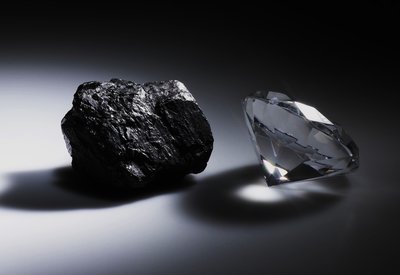
Allotropes: Carbon exists in different forms such as graphite and diamond, which have distinct physical properties due to different bonding arrangements.
Simple Hydrocarbons
Hydrocarbons are organic molecules consisting entirely of carbon and hydrogen. They serve as the backbone for more complex organic molecules.
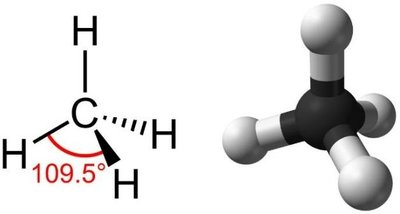
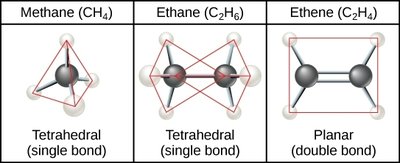
Methane (CH4): The simplest hydrocarbon, with a tetrahedral geometry.
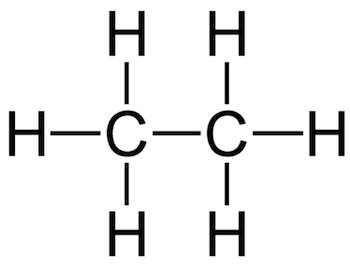
Ethane (C2H6): Two carbon atoms single-bonded, each with three hydrogens.
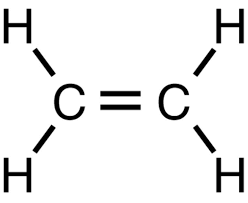
Ethylene (C2H4): Two carbon atoms double-bonded, each with two hydrogens.
Structural Variations in Hydrocarbons
Carbon's ability to form different structures leads to a variety of hydrocarbon shapes, including straight chains, branched chains, and rings.
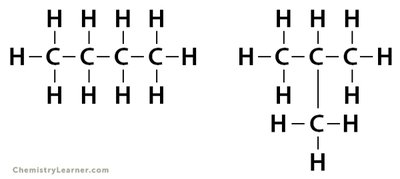
Butane and Isobutane: Both have the formula C4H10 but differ in structure (straight vs. branched).
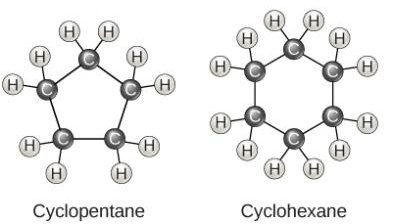
Cyclobutane: A ring structure with four carbon atoms.
Bonding and Molecular Geometry
The geometry of carbon-based molecules is determined by the type of bonds formed and the arrangement of atoms around the carbon atom.
Tetrahedral Geometry: Single bonds around carbon create a tetrahedral shape with bond angles of 109.5°.
Planar Geometry: Double bonds restrict rotation and create planar structures.
Valence and Bonding Capacity
The number of bonds an atom can form is determined by the number of electrons needed to fill its valence shell.
Element | Valence Electrons | Typical Bonds |
|---|---|---|
Hydrogen | 1 | 1 |
Oxygen | 2 | 2 |
Nitrogen | 3 | 3 |
Carbon | 4 | 4 |
Ring Structures and Carbon Nanotubes
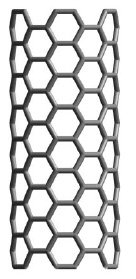
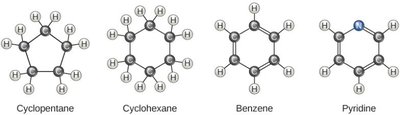
Carbon can form ring structures (cycloalkanes, aromatic rings) and complex architectures such as nanotubes, which are important in both biology and materials science.
Common Rings: Five- and six-membered rings are most stable and common in biological molecules.
Nanotubes: Cylindrical structures with unique mechanical and electrical properties.
Isomers
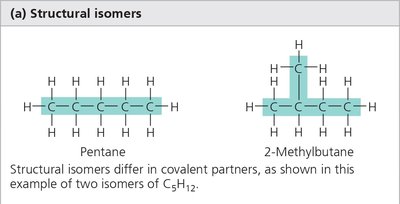
Isomers are molecules with the same molecular formula but different structures, leading to different properties.
Structural Isomers: Differ in the covalent arrangement of atoms.
Geometric (cis-trans) Isomers: Differ in spatial arrangement around a double bond.
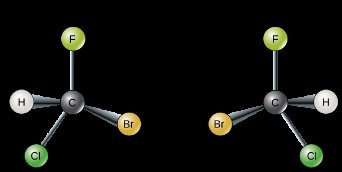
Enantiomers: Mirror images of each other, not superimposable, often with different biological activities.
Functional Groups
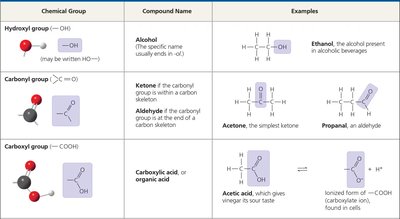
Functional groups are specific groups of atoms attached to carbon skeletons that determine the chemical reactivity and function of organic molecules.
Chemical Group | Compound Name | Examples |
|---|---|---|
Hydroxyl (–OH) | Alcohol | Ethanol |
Carbonyl (C=O) | Ketone/Aldehyde | Acetone/Propanal |
Carboxyl (–COOH) | Carboxylic acid | Acetic acid |
Amino (–NH2) | Amine | Glycine |
Sulfhydryl (–SH) | Thiol | Cysteine |
Phosphate (–OPO32–) | Organic phosphate | Glycerol phosphate |
Methyl (–CH3) | Methylated compound | 5-Methylcytosine |
Biological Importance of Functional Groups
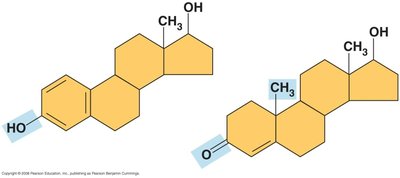
Small changes in functional groups can have large effects on biological function, as seen in hormones like estradiol and testosterone.
The Carbon Cycle
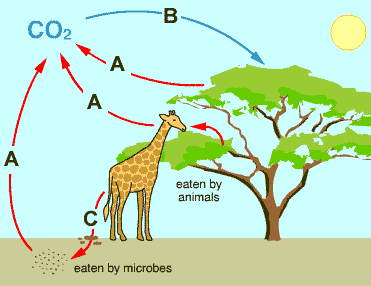
The carbon cycle describes the movement of carbon through the biosphere, atmosphere, hydrosphere, and geosphere, essential for life on Earth.
Photosynthesis: Plants convert CO2 into organic molecules.
Respiration and Decomposition: Return CO2 to the atmosphere.
ATP: The Energy Currency of the Cell
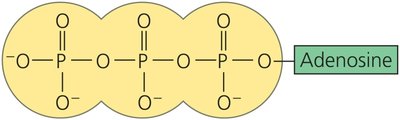
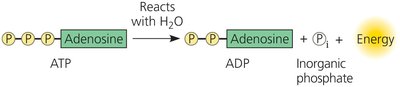
Adenosine triphosphate (ATP) is the primary energy carrier in cells. It stores energy in its phosphate bonds and releases it upon hydrolysis.
Structure: Adenosine attached to three phosphate groups.
Function: Hydrolysis of ATP releases energy for cellular processes.
Monomers and Polymers
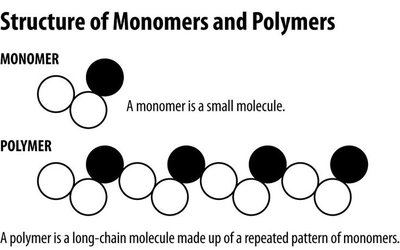
Biological macromolecules are polymers, built from repeating monomer units. The diversity of life arises from the arrangement of these monomers.
Monomer: A small molecule that can join with others to form a polymer.
Polymer: A long molecule consisting of many similar or identical monomers linked together.
Macromolecule Synthesis and Breakdown
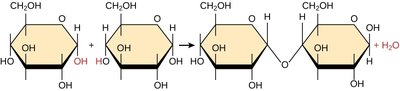
Macromolecules are assembled and disassembled by condensation (dehydration synthesis) and hydrolysis reactions.
Condensation (Dehydration Synthesis): Joins two monomers, releasing a water molecule.
Hydrolysis: Breaks a polymer into monomers by adding water.
Major Categories of Macromolecules
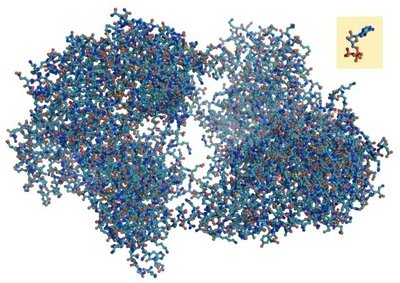
There are four major classes of biological macromolecules: carbohydrates, lipids, proteins, and nucleic acids. Each plays a unique role in cellular structure and function.
Carbohydrates: Sugars and polymers of sugars, used for energy and structure.
Lipids: Hydrophobic molecules, important for membranes and energy storage.
Proteins: Polymers of amino acids, with diverse functions including catalysis, structure, and signaling.
Nucleic Acids: DNA and RNA, store and transmit genetic information.
Carbohydrates
Carbohydrates are composed of carbon, hydrogen, and oxygen, typically with the formula (CH2O)n. They serve as energy sources, structural materials, and cellular identity tags.
Monosaccharides: Simple sugars like glucose, classified by carbon number and carbonyl group position.
Disaccharides: Two monosaccharides joined by a glycosidic bond (e.g., maltose, lactose, sucrose).
Polysaccharides: Long chains of monosaccharides, used for energy storage (starch, glycogen) or structure (cellulose).
Lipids
Lipids are hydrophobic molecules, including fats, phospholipids, and steroids. They are important for energy storage, membrane structure, and signaling.
Fats: Composed of glycerol and fatty acids; can be saturated or unsaturated.
Phospholipids: Major component of cell membranes, amphipathic in nature.
Steroids: Four fused carbon rings; include cholesterol and hormones.
Proteins
Proteins are polymers of amino acids, folded into specific three-dimensional shapes necessary for their function. They serve as enzymes, structural components, transporters, and more.
Primary Structure: Sequence of amino acids.
Secondary Structure: Local folding (α-helix, β-sheet) stabilized by hydrogen bonds.
Tertiary Structure: Overall 3D shape due to side chain interactions.
Quaternary Structure: Association of multiple polypeptide chains.
Nucleic Acids
Nucleic acids (DNA and RNA) are polymers of nucleotides, responsible for storing and transmitting genetic information.
DNA: Double-stranded, stores genetic information.
RNA: Single-stranded, involved in protein synthesis and gene regulation.
Genomics and Proteomics
Genomics is the study of whole genomes, while proteomics focuses on the entire set of proteins expressed by a genome. These fields have revolutionized biological research and applications in medicine, evolution, and conservation.
