 Back
Carbon and the Molecular Diversity of Life: Study Notes
Study Guide - Smart Notes
 Tailored notes based on your materials, expanded with key definitions, examples, and context.
Carbon and the Molecular Diversity of Life
Atomic Structure and Bonding of Carbon
Carbon's unique atomic structure allows it to form a wide variety of molecular shapes and sizes, making it fundamental to biological molecules. Its electron configuration determines the number and types of bonds it can form.
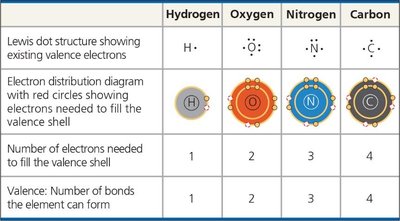
Electron Configuration: Carbon has 6 electrons: 2 in the first shell, 4 in the second (valence shell).
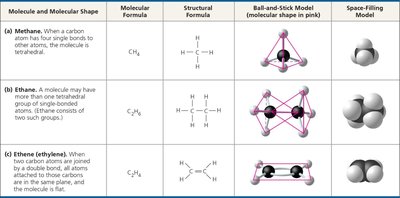
Covalent Bonding: Carbon completes its valence shell by sharing electrons, forming four covalent bonds.
Molecular Geometry: When bonded to four atoms, carbon adopts a tetrahedral geometry with bond angles of approximately 109.5°.
Double Bonds: When two carbons are joined by a double bond, the molecule is planar.
Valence: The number of unpaired electrons in the valence shell equals the number of covalent bonds an atom can form.
Common Bonding Partners: Hydrogen, oxygen, and nitrogen are frequent bonding partners of carbon.
Diversity of Carbon-Based Molecules
Carbon atoms can form diverse molecules by bonding with other atoms, including hydrogen, oxygen, and nitrogen. This versatility leads to a wide range of molecular structures.
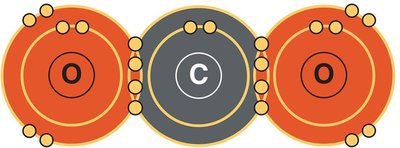
Carbon Dioxide (CO2): One carbon forms two double bonds with two oxygens, completing valence shells for all atoms.
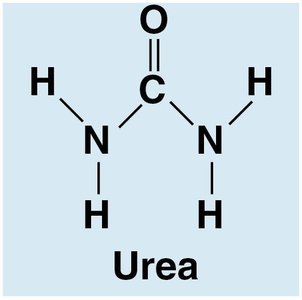
Urea (CO(NH2)2): Carbon forms both single and double bonds, completing valence shells for all atoms.
Carbon Skeletons: Carbon chains form the backbone of most organic molecules. Skeletons can be straight, branched, or arranged in rings, and may include double bonds.
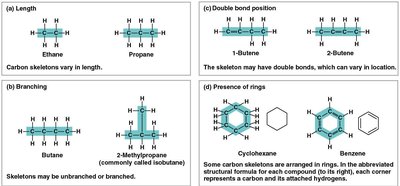
Hydrocarbons
Hydrocarbons are organic molecules composed only of carbon and hydrogen. They are important in both biological and industrial contexts.
Definition: Hydrocarbons consist solely of carbon and hydrogen atoms.
Biological Role: Fats contain long hydrocarbon tails attached to a nonhydrocarbon component.
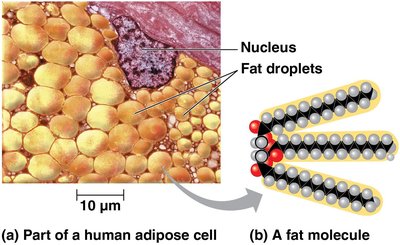
Chemical Properties: Hydrocarbons are hydrophobic due to their nonpolar C–H bonds.
Energy Content: Hydrocarbons release large amounts of energy during combustion reactions.
Isomers
Isomers are compounds with the same molecular formula but different structures, resulting in distinct chemical properties.
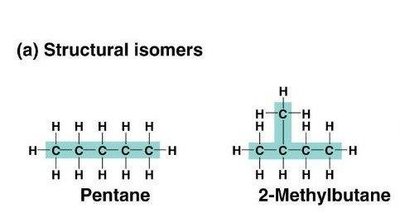
Structural Isomers: Differ in the covalent arrangement of atoms and/or the location of double bonds.
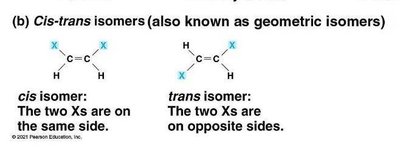
Cis-Trans Isomers (Geometric Isomers): Have the same covalent partnerships but differ in spatial arrangement around a double bond. The double bond restricts rotation.
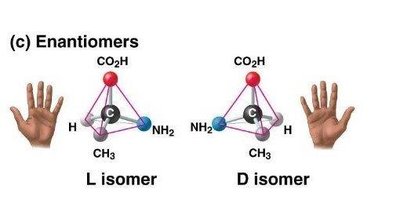
Enantiomers: Mirror-image isomers that occur when a carbon is bonded to four different groups. These are non-superimposable and often only one is biologically active.
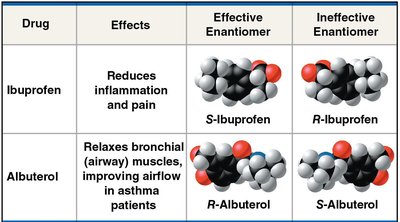
Biological Activity: Small structural differences between enantiomers can lead to major functional changes.
Key Chemical Groups in Biological Molecules
The unique properties of organic molecules depend on their carbon skeleton and the chemical groups attached. These groups affect molecular function and reactivity.
Functional Groups: Components of organic molecules directly involved in chemical reactions.
Seven Key Functional Groups: Hydroxyl, carbonyl, carboxyl, amino, sulfhydryl, phosphate, methyl.
Reactivity: The first six groups are chemically reactive and hydrophilic (except sulfhydryl, which is hydrophobic). Methyl is non-reactive and serves as a tag.

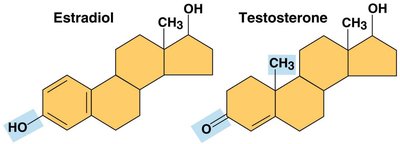
Example: Steroid Hormones: Testosterone and estradiol have the same carbon skeleton but differ in attached chemical groups, resulting in distinct biological effects.
ATP: The Energy Currency of the Cell
Adenosine triphosphate (ATP) is a key organic phosphate that stores and releases energy for cellular processes.
Structure: ATP consists of adenosine and three phosphate groups.
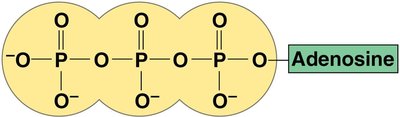
Conversion to ADP: When ATP reacts with water, one phosphate group is removed, forming adenosine diphosphate (ADP) and releasing energy.
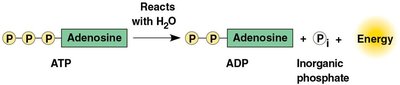
Energy Release: The energy released from ATP hydrolysis powers various cellular functions.
Summary Table: Functional Groups
The following table summarizes the properties and examples of the seven key functional groups found in biological molecules:
Chemical Group | Properties | Example |
|---|---|---|
Hydroxyl (–OH) | Polar, forms hydrogen bonds, increases solubility | Ethanol |
Carbonyl (C=O) | Polar, found in sugars | Acetone, Propanal |
Carboxyl (–COOH) | Acts as an acid, donates H+ | Acetic acid |
Amino (–NH2) | Acts as a base, picks up H+ | Glycine |
Sulfhydryl (–SH) | Forms disulfide bonds, stabilizes protein structure | Cysteine |
Phosphate (–OPO32–) | Contributes negative charge, transfers energy | ATP |
Methyl (–CH3) | Non-reactive, serves as a tag | 5-Methylcytosine |
Additional info: Functional groups are essential for the chemical reactivity and biological function of organic molecules. Their presence and arrangement determine the molecule's properties and interactions in biological systems.
