 Back
Carbon and the Molecular Diversity of Life: Structure and Function of Biomolecules
Study Guide - Smart Notes
 Tailored notes based on your materials, expanded with key definitions, examples, and context.
Carbon and the Molecular Diversity of Life
Introduction to Carbon in Biology
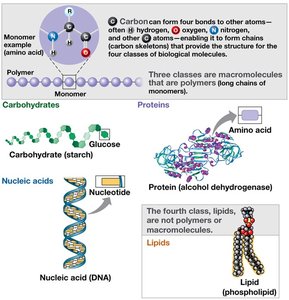
Carbon is the foundational element in biological molecules, forming the backbone of the four major classes of biomolecules essential for life. Its unique bonding properties allow for a vast diversity of molecular structures and functions.
Carbon forms stable covalent bonds with hydrogen, oxygen, nitrogen, sulfur, and phosphorus.
These bonds enable the construction of carbohydrates, proteins, nucleic acids, and lipids.
Carbon's versatility is due to its four valence electrons, allowing it to form up to four covalent bonds.
Properties of Carbon
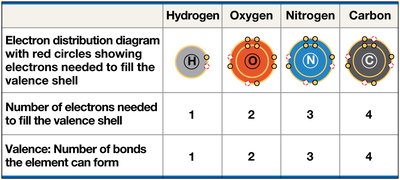
Valence and Bonding
Carbon's electron configuration allows it to form a variety of stable molecules with different shapes and properties.
Valence electrons: Carbon has four valence electrons, enabling it to form four covalent bonds.
Bonding partners: Commonly bonds with H, O, N, and S, creating molecular diversity.
Element | Valence Electrons Needed | Valence (Bonds Formed) |
|---|---|---|
Hydrogen | 1 | 1 |
Oxygen | 2 | 2 |
Nitrogen | 3 | 3 |
Carbon | 4 | 4 |
Types of Carbon Bonds
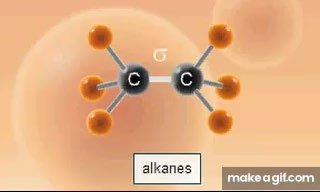
Carbon can form single, double, or triple bonds, each affecting molecular shape and flexibility.
Single bonds: Allow free rotation and flexibility (e.g., ethane).
Double bonds: Restrict rotation, resulting in planar structures (e.g., ethene).
Triple bonds: Create linear, rigid molecules (e.g., ethyne).


Carbon Skeleton Diversity
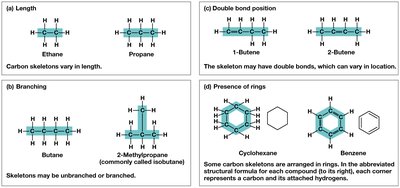
Carbon skeletons can vary in length, branching, bond position, and the presence of rings, contributing to the diversity of organic molecules.
Skeletons may be straight, branched, or arranged in rings.
Double bonds can vary in position, affecting molecular properties.
Hydrocarbons
Structure and Properties
Hydrocarbons are organic molecules consisting entirely of carbon and hydrogen. They are hydrophobic and serve as important energy sources in biological systems.
Found in the tails of fats and other biological molecules.
Nonpolar C–H bonds make them insoluble in water.
Can undergo reactions that release large amounts of energy.
Isomers
Types of Isomers
Isomers are compounds with the same molecular formula but different structures and properties. The three main types are:
Structural isomers: Differ in covalent arrangement of atoms.
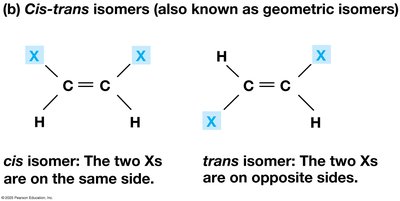
Cis-trans (geometric) isomers: Differ in spatial arrangement around double bonds.
Enantiomers: Mirror images due to chiral carbons; not superimposable.
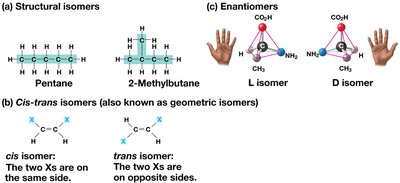
Structural Isomers
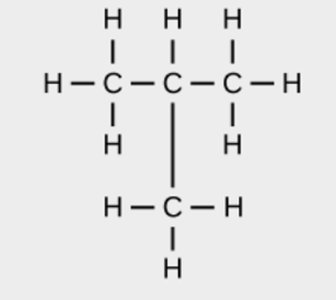
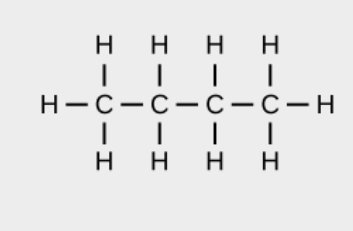
Structural isomers have different covalent arrangements, leading to differences in physical properties such as boiling and melting points.
Example: Butane and isobutane have the same formula (C4H10) but different structures and properties.
Cis-Trans Isomers
Cis-trans isomers have the same covalent bonds but differ in spatial arrangement due to restricted rotation around double bonds.
Cis isomer: Substituents on the same side of the double bond.
Trans isomer: Substituents on opposite sides.
Enantiomers
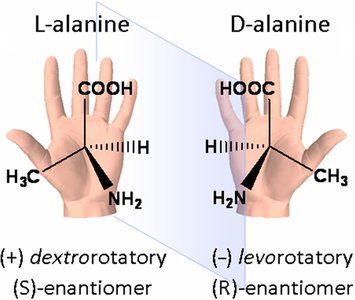
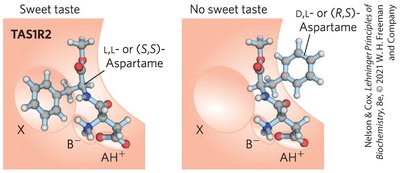
Enantiomers are isomers that are mirror images of each other, often due to a chiral carbon. They can have drastically different biological activities.
Only one enantiomer is usually biologically active, fitting specific enzymes or receptors.
Example: (R)-thalidomide is a sedative; (S)-thalidomide is a teratogen.

Acids, Bases, and Biological Molecules
Acids and Bases in Biology
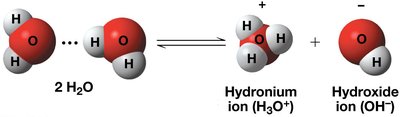
Biological processes often occur in aqueous environments where the concentration of hydrogen ions (H+) is critical. Acids increase H+ concentration, while bases decrease it.
Acids dissociate to release H+.
Bases accept H+ or provide OH– ions.
Free H+ in water is usually associated with water molecules as hydronium ions (H3O+).
The pH Scale
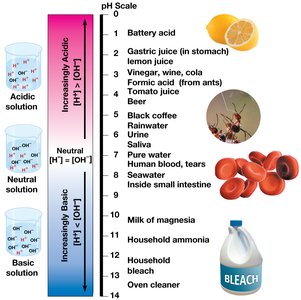
The pH scale measures the concentration of H+ in a solution, indicating its acidity or basicity.
pH < 7: Acidic
pH = 7: Neutral
pH > 7: Basic
Most biological fluids have pH values between 6 and 8.
The pH is calculated as:
Buffers
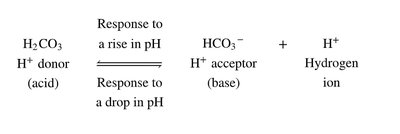
Buffers are substances that minimize changes in pH by reversibly binding or releasing H+. They are essential for maintaining stable conditions in cells and biological fluids.
Example: The carbonic acid-bicarbonate buffer system in blood.
Functional Groups
Key Functional Groups in Biological Molecules
Functional groups are specific groupings of atoms that confer distinct chemical properties to molecules. They influence acidity, reactivity, and interactions with water.
Chemical Group | Compound Name | Examples |
|---|---|---|
Hydroxyl (–OH) | Alcohol | Ethanol |
Carbonyl (C=O) | Ketone, Aldehyde | Acetone, Propanal |
Carboxyl (–COOH) | Carboxylic acid | Acetic acid |
Amino (–NH2) | Amine | Glycine |

Macromolecules
Polymers and Monomers
Most biological macromolecules are polymers, long chains built from repeating monomer units. The four major classes are carbohydrates, proteins, nucleic acids, and lipids (which are not true polymers).
Polymer: Long molecule of similar or identical building blocks (monomers).
Monomer: Small molecule that serves as a building block for polymers.
Carbohydrates
Monosaccharides
Monosaccharides are the simplest carbohydrates, serving as energy sources and building blocks for more complex sugars.
General formula: (CH2O)n
Classified by carbon number (triose, pentose, hexose) and carbonyl group position (aldose or ketose).
Examples: Glucose (main energy source), ribose (RNA, ATP), glyceraldehyde (glycolysis intermediate).
Disaccharides
Disaccharides are formed by joining two monosaccharides via a glycosidic linkage. The orientation (α or β) affects their properties.
Examples: Sucrose (glucose + fructose), lactose (glucose + galactose), maltose (glucose + glucose).
Polysaccharides
Polysaccharides are long chains of monosaccharides joined by glycosidic linkages. Their structure and function depend on the type of linkage and branching.
Starch: Plant energy storage; composed of α-1,4 and α-1,6 linkages (amylose and amylopectin).
Glycogen: Animal energy storage; highly branched for rapid glucose release.
Cellulose: Structural component of plant cell walls; β-1,4 linkages create strong fibers.
Chitin: Structural polysaccharide in arthropod exoskeletons and fungal cell walls.
Lipids
Structure and Function
Lipids are hydrophobic molecules that do not form true polymers. They serve as energy storage, membrane components, and signaling molecules.
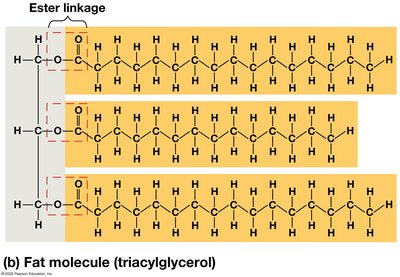
Fats (triglycerides): Glycerol + three fatty acids; energy storage, insulation, cushioning.
Phospholipids: Glycerol + two fatty acids + phosphate group; major component of cell membranes.
Steroids: Four fused carbon rings; include cholesterol and hormones.
Proteins
Amino Acids and Polypeptides
Proteins are polymers of amino acids, linked by peptide bonds. Their structure determines their function.
Amino acids: Contain amino (–NH2) and carboxyl (–COOH) groups, with variable R groups.
Polypeptide: Linear chain of amino acids with an amino (N) terminus and a carboxyl (C) terminus.
Levels of Protein Structure
Primary: Sequence of amino acids.
Secondary: Coils and folds (α helix, β sheet) due to hydrogen bonding.
Tertiary: Overall 3D shape from side chain interactions (hydrophobic, ionic, disulfide bonds).
Quaternary: Association of multiple polypeptide chains.
Nucleic Acids
Structure and Function
Nucleic acids (DNA and RNA) are polymers of nucleotides. They store, transmit, and express hereditary information.
Nucleotide: Nitrogenous base + pentose sugar + phosphate group.
Nucleoside: Nitrogenous base + sugar (no phosphate).
Phosphodiester linkage: Joins nucleotides in a polynucleotide chain.
DNA contains deoxyribose; RNA contains ribose.
Nitrogenous bases: Pyrimidines (C, T, U) and purines (A, G).
Summary: The molecular diversity of life is based on the versatile chemistry of carbon, which forms the backbone of carbohydrates, lipids, proteins, and nucleic acids. Understanding the structure and function of these biomolecules is essential for studying biology at the molecular level.
