 Back
Carbon and the Molecular Diversity of Life: Structure, Function, and Biological Importance
Study Guide - Smart Notes
 Tailored notes based on your materials, expanded with key definitions, examples, and context.
Carbon and the Molecular Diversity of Life
Overview: Carbon Compounds and Life
Living organisms are primarily composed of water and carbon-based compounds. Carbon's unique ability to form large, complex, and diverse molecules makes it the foundation of organic chemistry and life. Organic compounds are defined as molecules containing carbon, and the most critical classes of biological molecules are carbohydrates, lipids, proteins, and nucleic acids. The first three classes can form large macromolecules essential for cellular structure and function.
Carbon Atom Structure and Bonding
Electron Configuration and Bonding Versatility
Carbon atoms have four valence electrons, allowing them to form four covalent bonds with a variety of atoms. This versatility enables the creation of large, complex molecules. The electron configuration determines the types and numbers of bonds carbon can form, which is the basis for its chemical diversity.
Tetrahedral Shape: When carbon forms four single bonds, the molecule adopts a tetrahedral geometry.
Double Bonds: When two carbons are joined by a double bond, the atoms attached to them lie in the same plane.
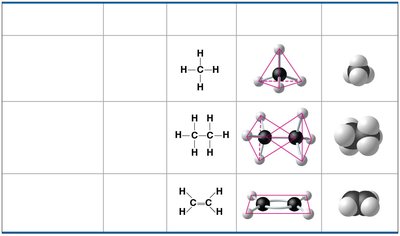
Valences of Carbon and Its Partners
The valences of carbon and its frequent partners—hydrogen, oxygen, and nitrogen—form the "building code" for living molecules. These elements combine in specific ways to create the architecture of biological macromolecules.

Molecular Diversity from Carbon Skeletons
Variation in Carbon Skeletons
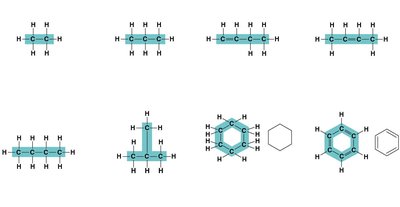
Carbon chains form the backbone of most organic molecules. These chains can vary in length, branching, double bond position, and the presence of rings, contributing to molecular diversity.
Length: Chains can be short or long.
Branching: Chains may be straight or branched.
Double Bond Position: Double bonds can occur at different locations.
Rings: Some carbon skeletons form rings.
Isomers: Structural Diversity
Types of Isomers
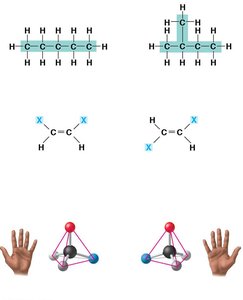
Isomers are compounds with the same molecular formula but different structures and properties. There are three main types:
Structural Isomers: Differ in covalent arrangement of atoms.
Cis-Trans Isomers: Differ in spatial arrangement due to double bonds.
Enantiomers: Mirror images due to asymmetric carbon; often only one is biologically active.
Functional Groups and Their Importance
Chemical Groups Most Important to Life
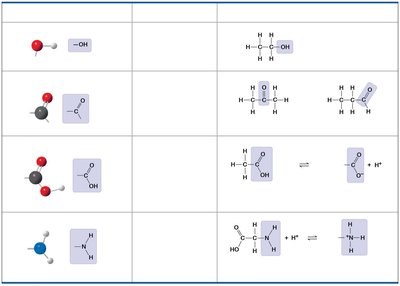
Functional groups are specific groups of atoms within molecules that are responsible for the characteristic chemical reactions of those molecules. Seven functional groups are most important in biological chemistry:
Hydroxyl (–OH): Found in alcohols; increases solubility in water.
Carbonyl (C=O): Found in ketones and aldehydes; important in sugars.
Carboxyl (–COOH): Found in acids; can donate H+.
Amino (–NH2): Found in amines; acts as a base.
Sulfhydryl (–SH): Found in thiols; forms disulfide bonds in proteins.
Phosphate (–OPO32–): Found in organic phosphates; involved in energy transfer.
Methyl (–CH3): Found in methylated compounds; affects gene expression.
Functional Group | Compound Name | Example |
|---|---|---|
Hydroxyl (–OH) | Alcohol | Ethanol |
Carbonyl (C=O) | Ketone/Aldehyde | Acetone/Propanal |
Carboxyl (–COOH) | Carboxylic acid | Acetic acid |
Amino (–NH2) | Amine | Glycine |
Sulfhydryl (–SH) | Thiol | Cysteine |
Phosphate (–OPO32–) | Organic phosphate | Glycerol phosphate |
Methyl (–CH3) | Methylated compound | 5-Methyl cytosine |
Macromolecules: Polymers and Monomers
Polymer Synthesis and Breakdown
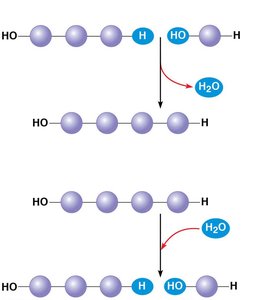
Macromolecules are polymers built from monomers. The synthesis of polymers occurs via dehydration reactions, where water is removed to join monomers. Breakdown occurs via hydrolysis, where water is added to split polymers into monomers. Enzymes facilitate these processes.
Dehydration Reaction: Joins monomers by removing water.
Hydrolysis: Breaks polymers into monomers by adding water.
Carbohydrates: Structure and Function
Monosaccharides and Disaccharides
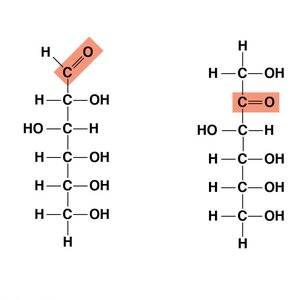
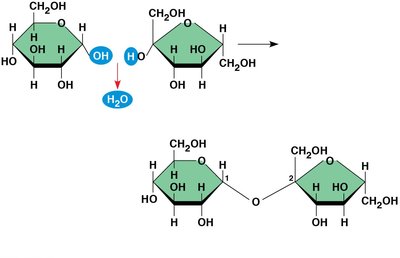
Carbohydrates include sugars and their polymers. Monosaccharides are simple sugars, classified by the number of carbons and the position of the carbonyl group. Glucose is the most common monosaccharide. Disaccharides are formed by joining two monosaccharides via a glycosidic linkage.
Monosaccharides: Triose (3C), Pentose (5C), Hexose (6C)
Disaccharides: Sucrose, lactose, maltose
Polysaccharides: Storage and Structural Roles
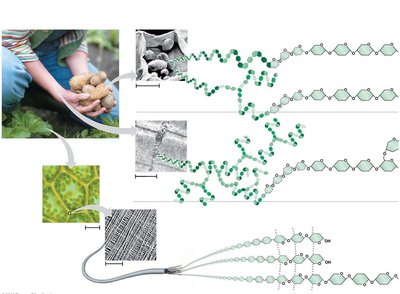
Polysaccharides are polymers of sugars with storage or structural functions. Starch (plants) and glycogen (animals) are storage polysaccharides. Cellulose (plants) and chitin (fungi and arthropods) are structural polysaccharides.
Starch: Composed of glucose monomers; stored in plastids.
Glycogen: Extensively branched; stored in liver and muscle cells.
Cellulose: Unbranched; forms plant cell walls.
Additional Info
These notes cover the molecular diversity of life, focusing on carbon's role in forming organic molecules, functional groups, macromolecule synthesis, and carbohydrate structure and function. The included images directly reinforce the structural concepts and biological relevance discussed in each section.
