 Back
Carbon and the Molecular Diversity of Life: Structure, Function, and Macromolecules
Study Guide - Smart Notes
 Tailored notes based on your materials, expanded with key definitions, examples, and context.
Carbon: The Backbone of Life
Properties of Carbon and Its Partners
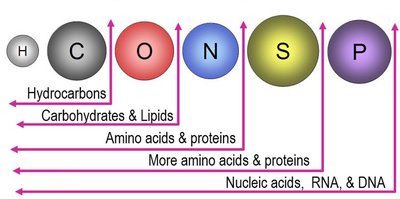
Carbon is unparalleled in its ability to form large, complex, and diverse molecules, making it the backbone of life. Its tetravalence (ability to form four covalent bonds) allows for the creation of a wide variety of molecular architectures. The valences of carbon and its most frequent partners—hydrogen, oxygen, and nitrogen—govern the structure of living molecules.
Organic compounds: Molecules containing carbon, typically bonded to hydrogen, oxygen, or nitrogen.
Tetravalence: Carbon always forms four covalent bonds, enabling complex molecular structures.
Valence: The number of bonds an atom can form; hydrogen (1), oxygen (2), nitrogen (3), carbon (4).
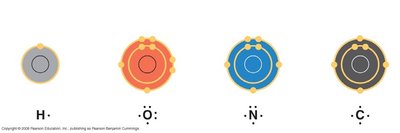
Example: Carbon's ability to bond with itself and other elements is fundamental to the diversity of organic molecules found in living organisms.
Chemistry Shorthand and Organic Chemistry Shorthand
Representing Molecules
Chemists use shorthand notation to represent molecules, simplifying complex structures. Covalent bonds are shown as lines, and hydrogens attached to carbons are often implied rather than explicitly drawn.
Chemistry shorthand: Carbon-carbon bonds are represented by lines; hydrogens are assumed.
Organic chemistry shorthand: All other atoms and bonds are fully drawn out for clarity.


Example: Methanol and propanol are depicted using shorthand to highlight their carbon skeletons.
Nomenclature and Structure of Hydrocarbons
Hydrocarbon Naming and Structural Variations
Hydrocarbons are named based on the number of carbon atoms in their chain. The structure of carbon skeletons can vary in length, branching, double bonds, and ring formation, contributing to molecular diversity.
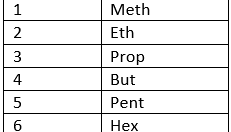
Nomenclature prefixes: Meth-, Eth-, Prop-, But-, Pent-, Hex- correspond to 1-6 carbons.
Structural variations:
Length: Number of carbons in the chain
Branching: Presence of side chains
Double bonds: Location and number of C=C bonds
Rings: Formation of cyclic structures

Number of Carbons | Prefix |
|---|---|
1 | Meth |
2 | Eth |
3 | Prop |
4 | But |
5 | Pent |
6 | Hex |
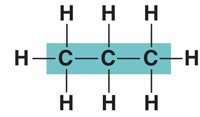
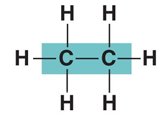
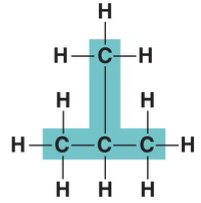
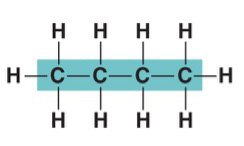
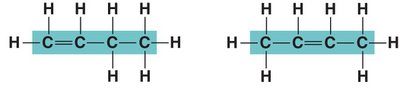
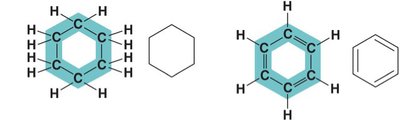
Example: Butane and isobutane are structural isomers with different branching.
Shapes of Organic Molecules
Molecular Shape and Representation
The shape of organic molecules is determined by the arrangement of atoms and the types of bonds formed. Models such as ball-and-stick and space-filling are used to visualize molecular geometry.
Methane (CH4): Tetrahedral shape
Ethane (C2H6): Extended tetrahedral
Ethene (C2H4): Planar due to double bond
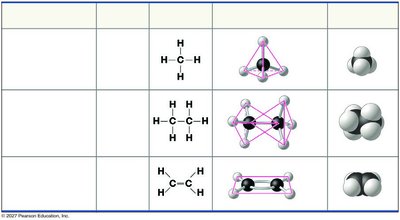
Example: The three-dimensional shape of methane is crucial for its chemical properties.
Isomers and Hydrocarbon Saturation
Structural Isomers and Saturation
Isomers are molecules with the same molecular formula but different structural arrangements. Hydrocarbons can be saturated (single bonds only) or unsaturated (one or more double bonds).
Structural isomers: Same formula, different structure; e.g., n-butane and isobutane.
Saturated hydrocarbons: Maximum number of hydrogens, only single bonds.
Unsaturated hydrocarbons: One or more double bonds.
Polyunsaturated hydrocarbons: Multiple double bonds.
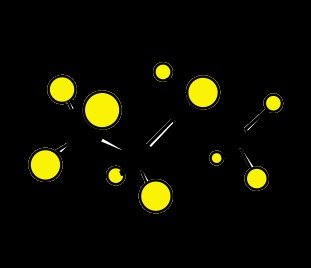
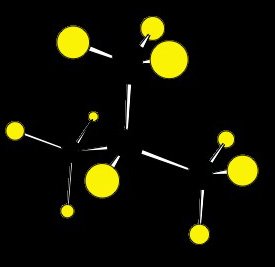


Example: Saturated fats contain only single bonds, while polyunsaturated fats have multiple double bonds.
Functional Groups in Organic Molecules
Key Functional Groups and Their Properties
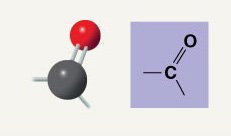
Functional groups are specific groups of atoms within molecules that are responsible for the characteristic chemical reactions of those molecules. They determine the shape, reactivity, and properties of organic molecules.
Hydroxyl group (-OH): Polar, found in alcohols
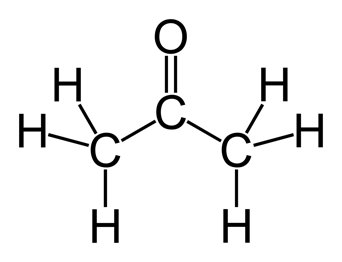
Carbonyl group (C=O): Polar, found in ketones and aldehydes
Carboxyl group (-COOH): Polar, acidic, found in organic acids
Amino group (-NH2): Polar, acts as a base, found in amino acids
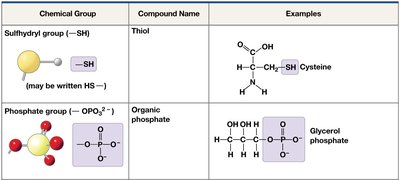
Sulfhydryl group (-SH): Polar, found in thiols
Phosphate group (-OPO32-): Polar, found in nucleic acids
Methyl group (-CH3): Nonpolar, found in methylated compounds
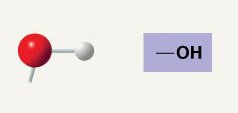
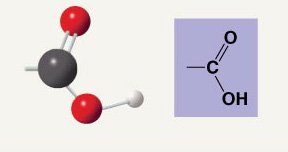
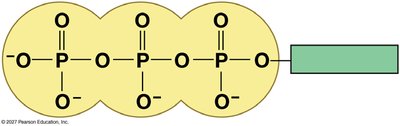
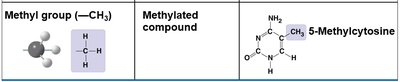
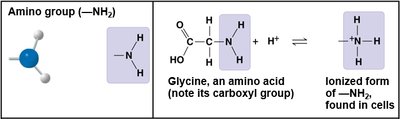
Example: The carboxyl group is acidic and forms ions, making it important in amino acids and fatty acids.
Carbon Skeletons and Molecular Diversity
Variation in Carbon Skeletons
The diversity of organic molecules arises from variations in the carbon skeleton, including chain length, branching, double bonds, and ring structures. Functional groups attached to these skeletons further increase diversity.
Chains: Linear arrangements of carbon atoms
Branching: Side chains off the main carbon chain
Rings: Cyclic structures
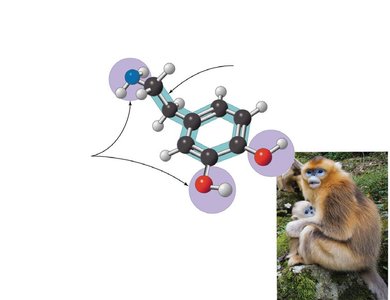
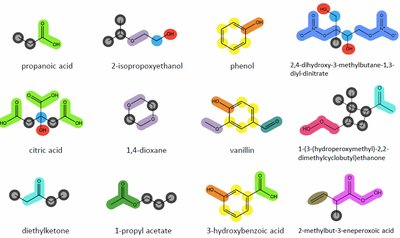
Example: Dopamine, a signaling molecule, contains multiple functional groups that determine its biological activity.
Macromolecules: The Molecules of Life
Classes and Structure of Macromolecules
All living things are composed of four classes of large biological molecules: carbohydrates, lipids, nucleic acids, and proteins. These macromolecules are polymers, made by linking together smaller units called monomers.
Carbohydrates: Monomer is monosaccharide
Lipids: Monomer is triglyceride (not a true polymer)
Nucleic acids: Monomer is nucleotide
Proteins: Monomer is amino acid
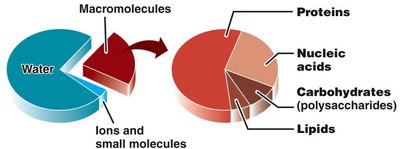
Example: Proteins are polymers made from amino acid monomers.
Synthesis and Breakdown of Polymers
Dehydration and Hydrolysis Reactions
Polymers are synthesized by dehydration (condensation) reactions, which remove a water molecule to form a new bond. They are broken down by hydrolysis, which adds a water molecule to break a bond. Enzymes catalyze these reactions.
Dehydration reaction: Joins monomers by removing water
Hydrolysis: Breaks polymers by adding water
Enzymes: Biological catalysts for these reactions
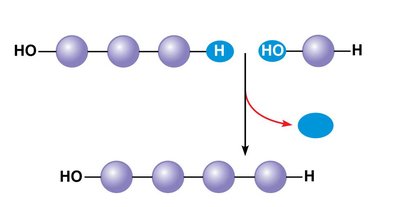
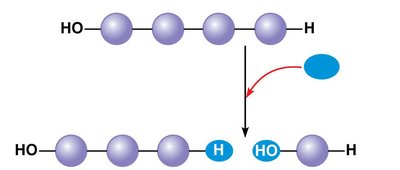
Example: The formation of starch from glucose monomers is a dehydration reaction; digestion of starch is hydrolysis.
Key Vocabulary and Study Guide
Essential Terms and Concepts
Isomers: Molecules with the same formula but different structures
Saturated: Hydrocarbons with only single bonds
Polyunsaturated: Hydrocarbons with multiple double bonds
Functional group: Specific group of atoms responsible for chemical properties
Macromolecule: Large molecule composed of many monomers
Polymer: Chain of monomers
Monomer: Building block of polymers
Hydrolysis: Breaking polymers by adding water
Dehydration reaction: Forming polymers by removing water
Enzymes: Catalysts for biochemical reactions
Additional info: Understanding the structure and function of carbon-based molecules is foundational for studying biomolecules, cell components, and metabolism in biology.
