 Back
Carbon and the Molecular Diversity of Life: Study Notes
Study Guide - Smart Notes
 Tailored notes based on your materials, expanded with key definitions, examples, and context.
Carbon and the Molecular Diversity of Life
Organic Chemistry and the Origin of Life
Organic chemistry is the study of compounds containing carbon, which are fundamental to all living organisms. The diversity of organic molecules is central to the origin and complexity of life on Earth. Experiments, such as Stanley Miller's, have demonstrated that organic molecules can form under abiotic conditions, supporting theories about the chemical origins of life.
Organic compounds range from simple molecules to large, complex structures.
Major elements of life include carbon (C), hydrogen (H), oxygen (O), nitrogen (N), sulfur (S), and phosphorus (P).
Carbon's ability to form four bonds allows for a vast variety of molecular structures.
Abiotic synthesis of organic compounds may have occurred near volcanoes or other early Earth environments.
Stanley Miller's experiment simulated early Earth conditions and produced organic molecules from inorganic precursors.
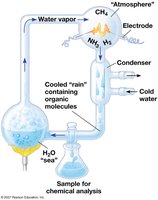
Example: Miller's experiment used water vapor, methane, ammonia, and hydrogen, with electrical sparks to simulate lightning, resulting in the formation of amino acids and other organic molecules.
Carbon Atom Structure and Bonding
Carbon's electron configuration enables it to form four covalent bonds, making it uniquely suited to create large and complex molecules. The shape and bonding of carbon atoms are essential for understanding molecular diversity.
Carbon has four valence electrons, allowing it to form four covalent bonds.
In molecules with multiple carbons, each carbon bonded to four other atoms has a tetrahedral shape.
Double bonds between carbon atoms result in a planar structure.
The number of unpaired electrons in the valence shell determines the atom's valence.
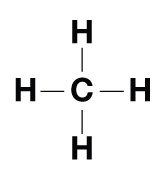
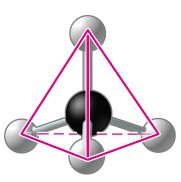
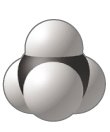
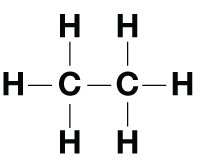
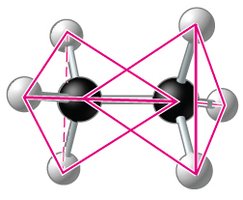
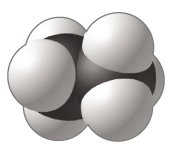
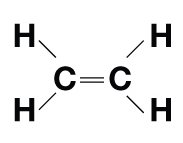
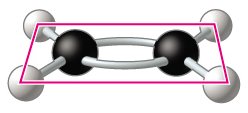
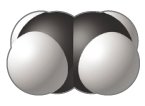
Example: Methane (CH4) is a simple organic molecule with a tetrahedral shape, while ethene (C2H4) has a planar structure due to its double bond.
Valence of Major Elements in Organic Molecules
The valence of an atom is the number of covalent bonds it can form, determined by the number of unpaired electrons in its valence shell. Carbon, hydrogen, oxygen, and nitrogen are the most frequent bonding partners in organic molecules.
Hydrogen: Valence of 1
Oxygen: Valence of 2
Nitrogen: Valence of 3
Carbon: Valence of 4




Example: The compatibility of carbon with hydrogen, oxygen, and nitrogen allows for the formation of diverse organic molecules.
Molecular Diversity from Carbon Skeletons
Carbon skeletons form the backbone of most organic molecules. These skeletons can vary in length, branching, double bond position, and the presence of rings, contributing to molecular diversity.
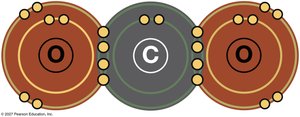
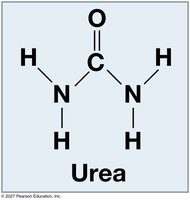
Carbon can bond with atoms other than hydrogen, such as oxygen and nitrogen.
Carbon dioxide (CO2) and urea are examples of molecules with carbon bonded to other elements.
Carbon chains can be straight, branched, or arranged in rings.
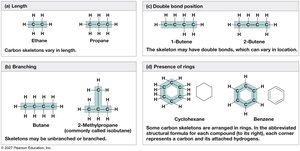
Example: Butane and 2-methylpropane are structural isomers with different carbon skeletons.
Hydrocarbons
Hydrocarbons are organic molecules composed only of carbon and hydrogen. They are found in many biological molecules, such as fats, and can undergo reactions that release significant energy.
Hydrocarbons are nonpolar and hydrophobic.
They serve as energy storage molecules in living organisms.
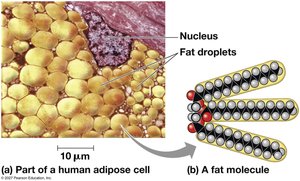
Example: Fat molecules contain long hydrocarbon chains that store energy.
Isomers
Isomers are compounds with the same molecular formula but different structures and properties. There are three main types: structural isomers, cis-trans (geometric) isomers, and enantiomers.
Structural isomers: Different covalent arrangements of atoms.
Cis-trans isomers: Same covalent bonds, different spatial arrangements.
Enantiomers: Mirror images of each other, often with different biological activity.
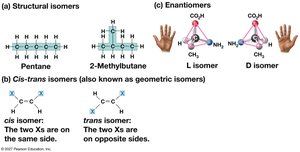
Example: Enantiomers of drugs can have different effects in the body; often only one is biologically active.
Pharmacological Importance of Enantiomers
Enantiomers are crucial in pharmaceuticals, as organisms are sensitive to subtle molecular variations. Two enantiomers of a drug may have different effects, with only one being biologically active.
Enantiomers can differ in their interaction with biological systems.
Examples include S-ibuprofen and R-ibuprofen, as well as R-albuterol and S-albuterol.
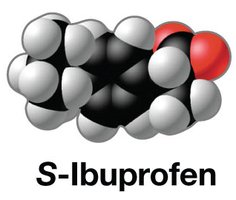
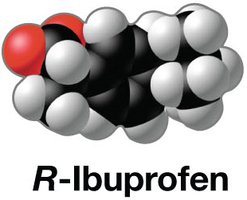
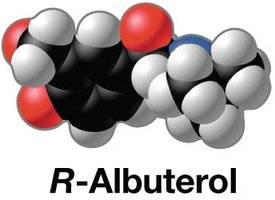
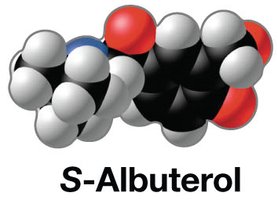
Example: S-ibuprofen is effective as a pain reliever, while R-ibuprofen is not.
Chemical Groups and Molecular Function
The properties of organic molecules depend on their carbon skeleton and the chemical groups attached. Functional groups are the components most commonly involved in chemical reactions, giving molecules their unique properties.
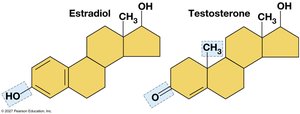
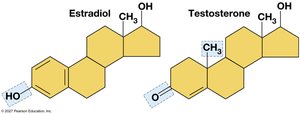
Estradiol and testosterone are steroids with a common carbon skeleton but different functional groups.
Seven functional groups are most important in biological chemistry: hydroxyl, carbonyl, carboxyl, amino, sulfhydryl, phosphate, and methyl.
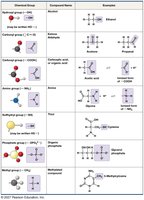
Functional Group | Compound Name | Example |
|---|---|---|
Hydroxyl (-OH) | Alcohol | Ethanol |
Carbonyl (>C=O) | Ketone/Aldehyde | Acetone, Propanal |
Carboxyl (-COOH) | Carboxylic acid | Acetic acid |
Amino (-NH2) | Amine | Glycine |
Sulfhydryl (-SH) | Thiol | Cysteine |
Phosphate (-OPO32-) | Organic phosphate | Glycerol phosphate |
Methyl (-CH3) | Methylated compound | 5-Methylcytosine |
Example: The presence and arrangement of functional groups determine the chemical reactivity and biological function of molecules.
ATP: An Important Source of Energy
Adenosine triphosphate (ATP) is a key organic phosphate that stores energy for cellular processes. ATP consists of adenosine attached to three phosphate groups and releases energy when it reacts with water.
ATP hydrolysis releases energy used by cells.
ATP is essential for metabolism and cellular work.
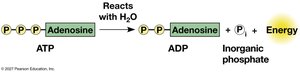
Equation:
Example: ATP hydrolysis powers muscle contraction, active transport, and biosynthetic reactions.
----------------------------------------
