 Back
Carbon and the Molecular Diversity of Life: Study Notes
Study Guide - Smart Notes
 Tailored notes based on your materials, expanded with key definitions, examples, and context.
Carbon and the Molecular Diversity of Life
Introduction to Carbon in Biology
Carbon is a fundamental element in biological molecules, forming the backbone of organic compounds essential for life. Its unique properties allow it to create diverse molecular structures, which underpin the complexity of living organisms.
Organic chemistry: The study of compounds containing covalently bonded carbon.
Organic compounds: Molecules that contain both carbon and hydrogen.
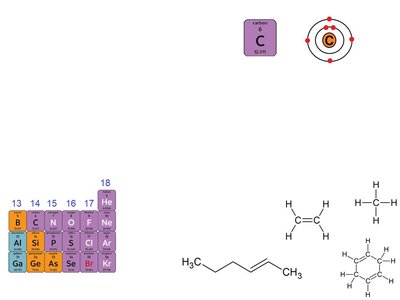
Valence electrons: Carbon has four valence electrons, enabling it to form up to four covalent bonds.
Carbon Bonding and Molecular Structure
Carbon's ability to form single, double, or triple covalent bonds allows for a wide variety of molecular shapes and sizes. This versatility is crucial for the formation of complex biological molecules.
Single, double, triple bonds: Carbon can form different types of covalent bonds, affecting molecular structure.
Long chains: Carbon atoms can link together, forming long chains or rings.
Common bonding partners: Hydrogen, oxygen, and nitrogen are frequently bonded to carbon in biological molecules.
Hydrocarbons are organic molecules consisting only of carbon and hydrogen, serving as the basic framework for more complex molecules.
Carbon chains form the skeletons of most organic molecules, which can vary in length, branching, double bond position, and presence of rings.
Isomers: Structural Diversity in Organic Molecules
Isomers are compounds with the same molecular formula but different structural arrangements, resulting in distinct properties. There are several types of isomers important in biology:
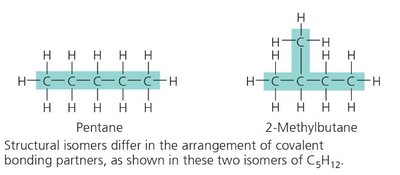
Structural isomers: Differ in the arrangement of covalent bonds.
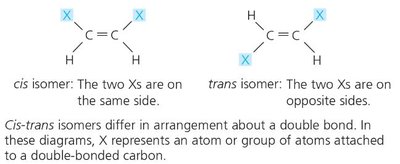
Cis-trans isomers: Differ in spatial arrangement around a double bond.
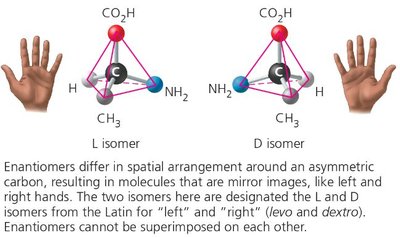
Enantiomers: Mirror-image isomers, important in biological activity.
Type of Isomer | Description | Example |
|---|---|---|
Structural Isomer | Different covalent arrangement of atoms | Pentane vs. 2-Methylbutane |
Cis-trans Isomer | Different arrangement around a double bond | Cis and trans forms of C=C |
Enantiomer | Mirror images, not superimposable | L and D isomers of amino acids |
Functional Groups: Chemical Diversity in Organic Molecules
Functional groups are specific chemical groups attached to the carbon skeleton of organic molecules. They participate in chemical reactions and confer distinct properties to molecules.
Hydroxyl group (–OH): Found in alcohols, increases solubility in water.
Carbonyl group (C=O): Found in ketones and aldehydes, affects reactivity.
Carboxyl group (–COOH): Found in acids, acts as a proton donor.
Amino group (–NH2): Found in amino acids, acts as a base.
Sulfhydryl group (–SH): Found in proteins, forms disulfide bonds.
Phosphate group (–PO4): Found in nucleic acids, involved in energy transfer.
Methyl group (–CH3): Affects gene expression and molecular shape.
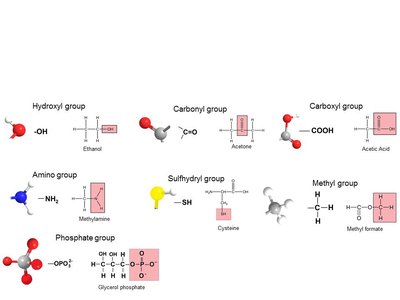
Summary Table: Functional Groups and Their Properties
Functional Group | Structure | Properties | Example |
|---|---|---|---|
Hydroxyl | –OH | Polar, forms hydrogen bonds | Ethanol |
Carbonyl | C=O | Polar, reactive | Acetone |
Carboxyl | –COOH | Acidic, donates H+ | Acetic acid |
Amino | –NH2 | Basic, accepts H+ | Methylamine |
Sulfhydryl | –SH | Forms disulfide bonds | Cysteine |
Phosphate | –PO4 | Negative charge, energy transfer | Glycerol phosphate |
Methyl | –CH3 | Nonpolar, affects expression | Methyl formate |
Key Equations and Concepts
Covalent bonding: (Methane formation)
Isomerism: can be arranged as pentane or 2-methylbutane
Example: The presence of different functional groups in amino acids determines their chemical behavior and role in protein structure.
