 Back
Carbon and the Molecular Diversity of Life
Study Guide - Smart Notes
 Tailored notes based on your materials, expanded with key definitions, examples, and context.
Chapter 4: Carbon and the Molecular Diversity of Life
Introduction to Organic Chemistry
Organic chemistry is the study of compounds containing covalently bonded carbon. The unique properties of carbon atoms allow them to form a wide variety of complex molecules essential for life. Organic compounds are defined as molecules that contain both carbon and hydrogen atoms.
Organic Compounds: Molecules containing carbon and hydrogen, often with other elements such as oxygen and nitrogen.
Valence Electrons: Carbon has four valence electrons, enabling it to form up to four covalent bonds with other atoms.
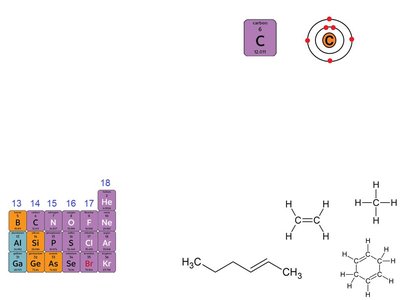
Bonding Properties of Carbon
Carbon atoms can form single, double, or triple covalent bonds, allowing for a diversity of molecular structures. The ability to form four covalent bonds makes carbon uniquely suited to serve as the backbone of large, complex molecules.
Single, Double, Triple Bonds: Carbon can share one, two, or three pairs of electrons with other atoms.
Common Bonding Partners: Hydrogen, oxygen, and nitrogen are the most frequent elements bonded to carbon in biological molecules.
Structural Diversity: The number and type of bonds affect the length and shape of carbon chains, influencing molecular function.
Carbon Chains and Hydrocarbons
Carbon atoms can bond to each other, forming chains that serve as the skeletons of most organic molecules. These chains can vary in length, branching, double bond position, and the presence of rings. Hydrocarbons are the simplest organic molecules, consisting only of carbon and hydrogen.
Hydrocarbons: Molecules made exclusively of carbon and hydrogen; serve as frameworks for more complex molecules.
Skeleton Variability: Carbon skeletons can be straight, branched, or arranged in rings, and may include double bonds at various positions.
Biological Relevance: Many regions of cellular organic molecules contain hydrocarbon components.
Isomers
Isomers are compounds with the same molecular formula but different structures, resulting in distinct properties. There are three main types of isomers: structural isomers, cis-trans (geometric) isomers, and enantiomers.
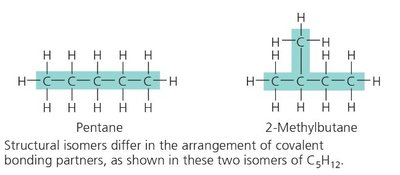
Structural Isomers: Differ in the covalent arrangement of their atoms.
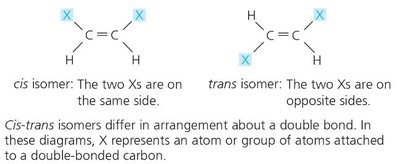
Cis-Trans Isomers: Differ in spatial arrangement around a double bond.
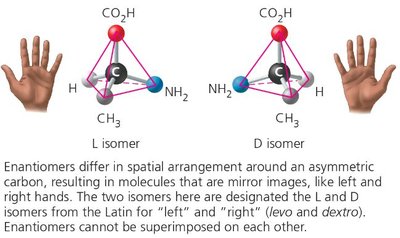
Enantiomers: Mirror images of each other, differing in spatial arrangement around an asymmetric carbon.
Type of Isomer | Description | Example |
|---|---|---|
Structural | Different covalent arrangements | Pentane vs. 2-Methylbutane |
Cis-Trans | Different arrangement around double bond | Cis-2-butene vs. Trans-2-butene |
Enantiomers | Mirror images, not superimposable | L- and D- isomers of amino acids |
Functional Groups
Functional groups are specific chemical groups attached to the carbon skeleton that participate in chemical reactions. These groups confer distinct chemical properties to organic molecules and are critical for the structure and function of biomolecules.
Hydroxyl Group (-OH): Found in alcohols; makes molecules polar and soluble in water.
Carbonyl Group (C=O): Found in aldehydes and ketones; increases reactivity.
Carboxyl Group (-COOH): Acts as an acid; found in amino acids and fatty acids.
Amino Group (-NH2): Acts as a base; found in amino acids.
Sulfhydryl Group (-SH): Found in some amino acids; forms disulfide bonds in proteins.
Phosphate Group (-OPO32-): Found in nucleotides; involved in energy transfer (e.g., ATP).
Methyl Group (-CH3): Affects gene expression and molecular recognition.
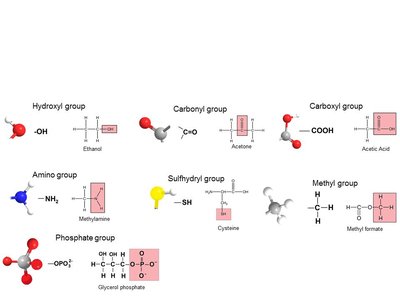
Summary Table: Major Functional Groups in Biological Molecules
Functional Group | Structure | Properties | Example |
|---|---|---|---|
Hydroxyl | -OH | Polar, forms hydrogen bonds | Ethanol |
Carbonyl | C=O | Increases reactivity | Acetone |
Carboxyl | -COOH | Acidic, donates H+ | Acetic acid |
Amino | -NH2 | Basic, accepts H+ | Methylamine |
Sulfhydryl | -SH | Forms disulfide bonds | Cysteine |
Phosphate | -OPO32- | Energy transfer | Glycerol phosphate |
Methyl | -CH3 | Gene expression | Methyl formate |
Additional info: The diversity of organic molecules is the foundation for the complexity of life. The structure and function of biological macromolecules depend on the arrangement of carbon skeletons and the presence of functional groups.
