 Back
Carbon and the Molecular Diversity of Life – Study Notes
Study Guide - Smart Notes
 Tailored notes based on your materials, expanded with key definitions, examples, and context.
Carbon and the Molecular Diversity of Life
Introduction to Carbon in Biology
Carbon is the foundational element for all biological molecules, making up the chemical basis of life. Its unique properties allow for the formation of a vast diversity of organic compounds, which are essential for the structure and function of living organisms.

Organic Chemistry and the Origin of Life
Organic chemistry is the study of carbon-containing compounds, regardless of their origin.
Organic compounds range from simple molecules (like methane) to complex macromolecules (like proteins and DNA).
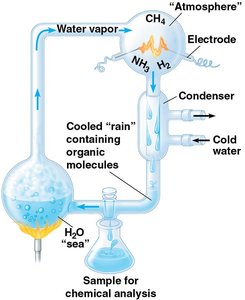
Experiments, such as Stanley Miller's classic simulation of early Earth conditions, demonstrated that organic molecules can form abiotically, supporting hypotheses about the chemical origins of life.
Why Is Carbon Special?
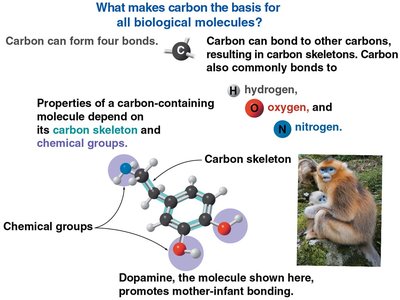
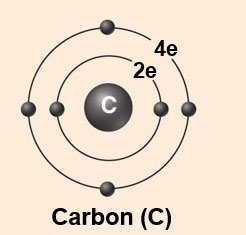
Carbon has four valence electrons, allowing it to form up to four covalent bonds with other atoms.
This bonding versatility enables carbon to create large, complex, and diverse molecules, including chains, rings, and branched structures.
Carbon commonly bonds with hydrogen, oxygen, and nitrogen, forming the backbone of biological macromolecules.
Structure and Bonding of Carbon
Electron Configuration and Bonding
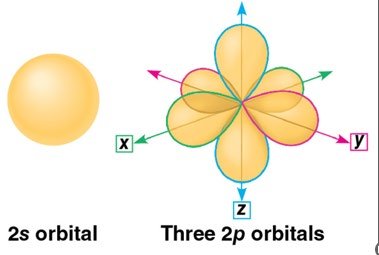
The electron configuration of carbon (1s2 2s2 2p2) determines its chemical behavior and bonding capacity.
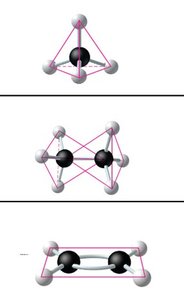
With four unpaired electrons in its outer shell, carbon forms four covalent bonds, resulting in a tetrahedral geometry when bonded to four other atoms.
When two carbons are joined by a double bond, the molecule is planar around the double bond.
Shapes of Simple Organic Molecules
The shape of organic molecules is determined by the bonding patterns of carbon:
Methane (CH4): Tetrahedral geometry.
Ethane (C2H6): Two tetrahedral carbons joined together.
Ethene (C2H4): Planar structure due to the double bond.
Valence and Bonding Partners
The number of unpaired electrons in the valence shell (valence) determines how many bonds an atom can form:
Element | Valence | Common Bonds |
|---|---|---|
Hydrogen | 1 | 1 |
Oxygen | 2 | 2 |
Nitrogen | 3 | 3 |
Carbon | 4 | 4 |
Molecular Diversity from Carbon Skeletons
Variation in Carbon Skeletons
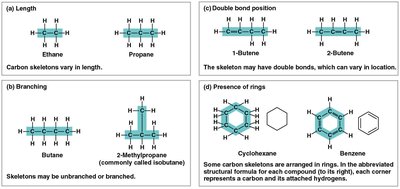
Carbon skeletons form the backbone of organic molecules and can vary in several ways:
Length (e.g., ethane vs. propane)
Branching (e.g., butane vs. isobutane)
Double bond position (e.g., 1-butene vs. 2-butene)
Presence of rings (e.g., cyclohexane, benzene)
Hydrocarbons
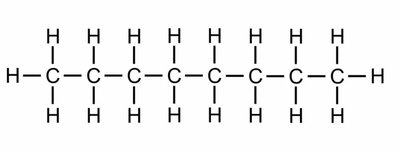
Hydrocarbons are organic molecules consisting only of carbon and hydrogen.
They are major components of fats and can store large amounts of energy.
Isomers: Structural Diversity in Organic Molecules
Types of Isomers
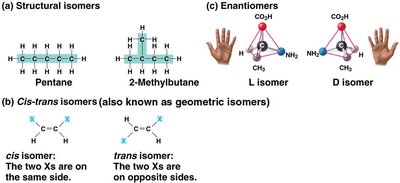
Isomers are compounds with the same molecular formula but different structures and properties.
Structural isomers: Differ in covalent arrangement of atoms.
Cis-trans (geometric) isomers: Same covalent bonds, different spatial arrangements due to inflexible double bonds.
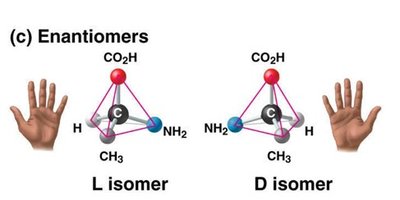
Enantiomers: Mirror images of each other, not superimposable.
Biological Importance of Enantiomers
Enantiomers can have dramatically different biological effects.
For example, only one enantiomer of a drug may be effective, while the other is inactive or harmful.
Drug | Effect | Effective Enantiomer | Ineffective Enantiomer |
|---|---|---|---|
Ibuprofen | Reduces inflammation and pain | S-ibuprofen | R-ibuprofen |
Albuterol | Relaxes bronchial muscles | R-albuterol | S-albuterol |
Chemical Groups and Molecular Function
Functional Groups
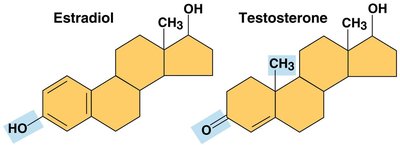
Distinctive properties of organic molecules depend on the carbon skeleton and the chemical groups attached to it. Functional groups are the most reactive parts of molecules and determine their chemical behavior.
Estradiol and testosterone are both steroids with a common carbon skeleton but differ in the functional groups attached, leading to different biological activities.
The Seven Most Important Functional Groups in Biology
Hydroxyl group (–OH): Found in alcohols; makes molecules polar and can form hydrogen bonds.
Carbonyl group (C=O): Found in aldehydes and ketones; increases reactivity.
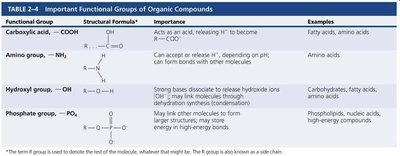
Carboxyl group (–COOH): Acts as an acid; found in amino acids and fatty acids.
Amino group (–NH2): Acts as a base; found in amino acids.
Sulfhydryl group (–SH): Found in some amino acids; forms disulfide bonds in proteins.
Phosphate group (–PO4): Found in nucleic acids and ATP; involved in energy transfer.
Methyl group (–CH3): Affects gene expression and molecular shape.
Functional Group | Structural Formula | Importance | Examples |
|---|---|---|---|
Carboxyl | –COOH | Acts as an acid | Fatty acids, amino acids |
Amino | –NH2 | Acts as a base | Amino acids |
Hydroxyl | –OH | Makes molecules polar | Carbohydrates, alcohols |
Phosphate | –PO4 | Energy transfer | ATP, nucleic acids |
Key Points on Functional Groups
Functional groups are joined to the carbon skeleton by covalent bonds.
The carboxyl group behaves as an acid in organic molecules.
Summary
Carbon's unique bonding properties allow for the molecular diversity essential to life.
Variation in carbon skeletons and functional groups leads to the vast array of biological molecules.
Understanding the structure and function of these molecules is fundamental to biology.
