 Back
BackCarbon and the Molecular Diversity of Life: Study Notes
Study Guide - Smart Notes
 Tailored notes based on your materials, expanded with key definitions, examples, and context.
Chapter 4: Carbon and the Molecular Diversity of Life
Concept 4.1: Organic Chemistry is Key to the Origin of Life
Organic chemistry is the study of compounds containing carbon, which forms the foundation of all known life. Organic compounds can range from simple molecules to complex macromolecules, and the versatility of carbon is central to biological diversity.
Organic Compounds: Molecules containing carbon, regardless of their origin.
Abiotic Synthesis: Stanley Miller's experiment demonstrated that organic molecules could form under conditions simulating early Earth, supporting the hypothesis that life could originate from non-living matter.
Major Elements of Life: Carbon (C), Hydrogen (H), Oxygen (O), Nitrogen (N), Sulfur (S), and Phosphorus (P) are consistently found in living organisms.
Carbon's Versatility: Carbon's ability to form four covalent bonds allows for a vast diversity of organic molecules.
Example: The diversity of life on Earth is largely due to the chemical versatility of carbon.
Concept 4.2: Carbon Atoms Can Form Diverse Molecules by Bonding to Four Other Atoms
Carbon's electron configuration enables it to form stable covalent bonds with a variety of elements, resulting in complex and diverse molecular structures.
Electron Configuration: Determines the number and types of bonds an atom can form.
Valence: The number of unpaired electrons in the valence shell equals the number of covalent bonds an atom can form.
Tetrahedral Shape: When carbon forms four single bonds, the molecule adopts a tetrahedral geometry.
Double Bonds: When two carbons are joined by a double bond, the atoms bonded to them lie in the same plane.
Frequent Bonding Partners: Hydrogen, oxygen, and nitrogen are the most common elements bonded to carbon.
Example: Carbon chains form the backbone of most organic molecules and can vary in length and shape.
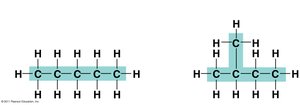
Molecular Diversity Arising from Variation in Carbon Skeletons
Carbon skeletons can vary in several ways, contributing to the diversity of organic molecules.
Length: Carbon chains can be short or long.
Branching: Chains may be unbranched or branched.
Double Bonds: The position and number of double bonds can vary.
Rings: Carbon chains can form rings.
Example: Hydrocarbons are organic molecules consisting only of carbon and hydrogen, and they can store significant energy.
Hydrocarbons
Hydrocarbons are composed solely of carbon and hydrogen atoms. They are found in many biological molecules, such as fats, and can undergo reactions that release energy.
Definition: Organic molecules containing only carbon and hydrogen.
Role in Biology: Hydrocarbon components are present in fats and other energy-rich molecules.
Energy Release: Hydrocarbons can undergo combustion reactions, releasing energy.
Isomers
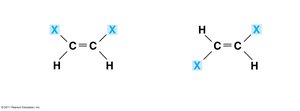
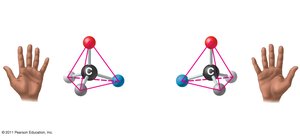
Isomers are compounds with the same molecular formula but different structures and properties. There are three main types of isomers: structural, cis-trans (geometric), and enantiomers.
Structural Isomers: Differ in the covalent arrangement of atoms.
Cis-Trans Isomers: Have the same covalent bonds but differ in spatial arrangement around a double bond.
Enantiomers: Are mirror images of each other and differ in their biological activity.
Pharmaceutical Importance: Often, only one enantiomer of a drug is biologically active, highlighting the importance of molecular shape.
Example: The differing effects of enantiomers in drugs demonstrate the sensitivity of biological systems to molecular structure.
Concept 4.3: A Few Chemical Groups Are Key to Molecular Function
The properties of organic molecules depend on both the carbon skeleton and the chemical groups attached to it. Functional groups are specific groups of atoms within molecules that are responsible for the characteristic chemical reactions of those molecules.
Functional Groups: Components of organic molecules most commonly involved in chemical reactions.
Seven Key Functional Groups:
Hydroxyl group (-OH)
Carbonyl group (C=O)
Carboxyl group (-COOH)
Amino group (-NH2)
Sulfhydryl group (-SH)
Phosphate group (-OPO32-)
Methyl group (-CH3)
Example: Estradiol and testosterone are steroids with similar carbon skeletons but different functional groups, resulting in distinct biological functions.
ATP: An Important Source of Energy for Cellular Processes
Adenosine triphosphate (ATP) is a key organic molecule that stores and releases energy for cellular processes.
Structure: ATP consists of adenosine attached to three phosphate groups.
Energy Release: The hydrolysis of ATP to ADP releases energy that can be used by cells.
Equation:
Example: ATP is the primary energy currency in biological systems.
The Chemical Elements of Life: A Review
The versatility of carbon enables the vast diversity of organic molecules, which underpins the molecular foundation of biological diversity.
Key Point: Variation at the molecular level is fundamental to the diversity of life.
