 Back
BackCarbon and the Molecular Diversity of Life: Study Notes
Study Guide - Smart Notes
 Tailored notes based on your materials, expanded with key definitions, examples, and context.
Carbon and the Molecular Diversity of Life
Introduction to Carbon in Biology
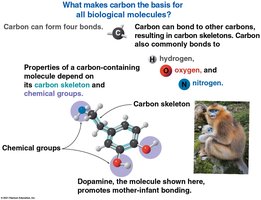
Carbon is the foundational element in biological molecules, forming the backbone of proteins, DNA, carbohydrates, and other compounds essential to life. Its unique ability to form four covalent bonds allows for the creation of large, complex, and diverse molecules.
Key Point: Living organisms are primarily composed of carbon-based compounds.
Key Point: Carbon's versatility enables the formation of a vast array of molecular structures.
Example: Proteins and nucleic acids are built from carbon skeletons with various functional groups attached.
Organic Chemistry: The Study of Carbon Compounds
Definition and Scope
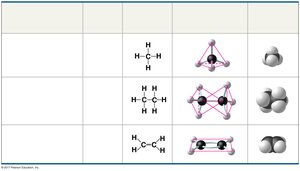
Organic chemistry focuses on compounds containing carbon, regardless of their origin. These compounds range from simple molecules like methane to complex macromolecules such as DNA.
Key Point: Organic compounds are defined by the presence of carbon atoms.
Key Point: Carbon's ability to form four bonds leads to molecular diversity.
Example: Methane (CH4), ethane (C2H6), and ethene (C2H4) are simple organic molecules.
Formation of Bonds with Carbon
Electron Configuration and Valence
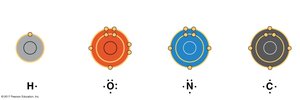
The electron configuration of carbon determines its bonding properties. Carbon has four unpaired electrons in its valence shell, allowing it to form four covalent bonds with other atoms, including hydrogen, oxygen, and nitrogen.
Key Point: The number of unpaired electrons equals the number of covalent bonds an atom can form (its valence).
Key Point: Carbon commonly bonds with H, O, and N, forming the basis of biological molecules.
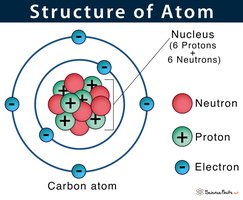
Example: The structure of a carbon atom includes 6 protons, 6 neutrons, and 6 electrons.
Molecular Diversity from Carbon Skeletons
Variation in Carbon Chains
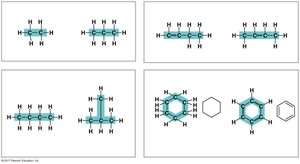
Carbon chains form the skeletons of most organic molecules, varying in length, branching, double bond position, and the presence of rings. This diversity underlies the complexity of organic chemistry.
Key Point: Carbon skeletons can be straight, branched, or form rings.
Key Point: The position of double bonds and branching affects molecular properties.
Example: Butane and isobutane (2-methylpropane) are structural isomers with different properties.
Hydrocarbons
Structure and Properties
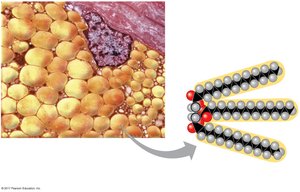
Hydrocarbons are organic molecules consisting only of carbon and hydrogen. They are found in many biological molecules, such as fats, and can undergo reactions that release significant energy.
Key Point: Hydrocarbons are nonpolar and hydrophobic.
Key Point: They serve as energy storage molecules in living organisms.
Example: Fat molecules contain long hydrocarbon chains.
Isomers: Structural Diversity in Organic Molecules
Types of Isomers
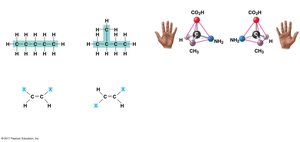
Isomers are compounds with the same molecular formula but different structures and properties. The main types are structural isomers, cis-trans isomers, and enantiomers.
Structural Isomers: Differ in the covalent arrangement of atoms.
Cis-Trans Isomers: Differ in spatial arrangement around double bonds.
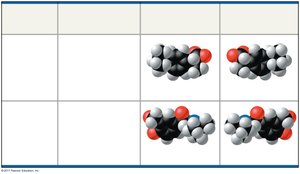
Enantiomers: Mirror images of each other, differing in spatial arrangement around an asymmetric carbon.
Example: Ibuprofen and albuterol have enantiomers with different biological effects.
Functional Groups: Key to Molecular Function
Overview of Functional Groups
Functional groups are specific groups of atoms within molecules that are responsible for the characteristic chemical reactions of those molecules. The number and arrangement of functional groups give each molecule its unique properties.
Key Point: Functional groups are the most reactive parts of organic molecules.
Key Point: They determine the physical and chemical properties of molecules.
Example: Alcohols, ketones, carboxylic acids, amines, thiols, phosphates, and methylated compounds.
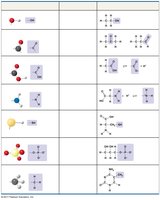
Major Functional Groups in Biological Molecules
Descriptions and Examples
Each functional group has distinct properties and roles in biological molecules. Below is a summary of the major functional groups:
Functional Group | Structure | Properties | Example |
|---|---|---|---|
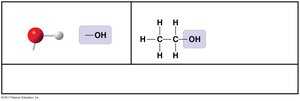
Hydroxyl (–OH) |
| Polar, forms hydrogen bonds with water | Ethanol |
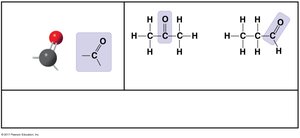
Carbonyl (C=O) |
| Found in ketones and aldehydes | Acetone, Propanal |
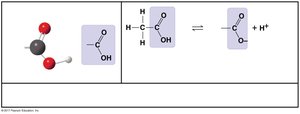
Carboxyl (–COOH) |
| Acts as an acid | Acetic acid |
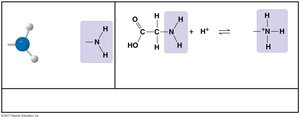
Amino (–NH2) |
| Acts as a base | Glycine |
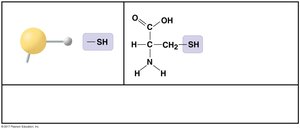
Sulfhydryl (–SH) |
| Forms disulfide bonds | Cysteine |
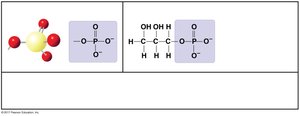
Phosphate (–OPO32–) |
| Contributes negative charge, energy transfer | Glycerol phosphate |
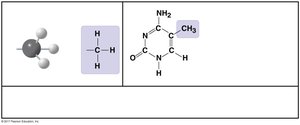
Methyl (–CH3) |
| Affects gene expression and hormone function | 5-Methylcytosine |
Classification of Functional Groups
Polar/Ionic vs. Non-Polar Groups
Functional groups can be classified based on their polarity and charge:
Polar/Ionic: Hydroxyl, Carbonyl, Carboxyl, Amino, Phosphate, Sulfhydryl
Non-Polar: Methyl
Summary Table: Functional Groups and Their Properties
Group | Polarity | Example | Function |
|---|---|---|---|
Hydroxyl | Polar | Ethanol | Hydrogen bonding, increases solubility |
Carbonyl | Polar | Acetone | Reactivity in sugars and metabolic intermediates |
Carboxyl | Polar, acidic | Acetic acid | Proton donor, acid-base reactions |
Amino | Polar, basic | Glycine | Proton acceptor, forms amides |
Sulfhydryl | Polar | Cysteine | Disulfide bond formation |
Phosphate | Polar, ionic | Glycerol phosphate | Energy transfer, signaling |
Methyl | Non-polar | 5-Methylcytosine | Gene regulation, hydrophobic interactions |
Key Equations and Concepts
Covalent Bond Formation
The number of covalent bonds formed by an atom is determined by its valence electrons:
Carbon: 4 bonds
Hydrogen: 1 bond
Oxygen: 2 bonds
Nitrogen: 3 bonds
General formula for hydrocarbons:
(alkanes)
Isomerism:
Isomers have the same molecular formula but different structures:
Conclusion
Carbon's unique chemical properties make it the central element in biological molecules. Its ability to form diverse structures, combined with the presence of functional groups, underlies the complexity and diversity of life. Understanding these principles is essential for further study in biochemistry and molecular biology.
