 Back
BackCarbon and the Molecular Diversity of Life: Study Notes
Study Guide - Smart Notes
 Tailored notes based on your materials, expanded with key definitions, examples, and context.
Carbon and the Molecular Diversity of Life
Organic Chemistry Overview
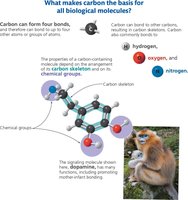
Organic chemistry is the study of carbon-containing compounds, which are fundamental to all living organisms. Carbon's unique properties make it the backbone of biological molecules, enabling the formation of a vast array of structures and functions essential for life.
Carbon's Versatility: Carbon can form four covalent bonds, allowing it to bond with many elements, including hydrogen, oxygen, and nitrogen.
Organic Molecules: Found in living organisms, ranging from simple to complex structures.
Carbon Backbone: Carbon chains form the structural foundation of organic molecules, often covalently bonded to H, O, N, S, and P.
Four Major Types:
Carbohydrates
Lipids
Proteins
Nucleic acids

Organic Molecules and the Origin of Life
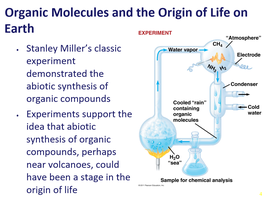
Organic molecules are believed to have played a crucial role in the origin of life. Experiments, such as Stanley Miller's, demonstrated that organic compounds could be synthesized abiotically, supporting theories about life's emergence from non-living matter.
Abiotic Synthesis: Formation of organic compounds without biological intervention.
Stanley Miller Experiment: Simulated early Earth conditions, producing amino acids and other organic molecules.
Implications: Suggests that organic molecules could have formed near volcanoes or other natural environments, providing a foundation for life.
Electron Configuration of Carbon
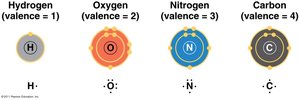
Carbon's electron configuration gives it four valence electrons, allowing it to form stable covalent bonds with a variety of elements. This compatibility is key to the diversity of organic molecules.
Valence Electrons: Carbon has four, enabling multiple bonding possibilities.
Covalent Compatibility: Bonds with hydrogen, oxygen, nitrogen, and other elements.
Hydrocarbons: Molecules containing only carbon and hydrogen, capable of storing and releasing energy.
Example: Urea (CO(NH2)2) is a simple organic molecule formed by carbon bonding with nitrogen and oxygen.
Hydrocarbons and Carbon Skeleton Variability
Hydrocarbons are organic molecules composed solely of carbon and hydrogen. The carbon skeleton can vary in length, branching, and ring formation, contributing to molecular diversity.
Hydrocarbons: Only carbon and hydrogen; can be linear, branched, or cyclic.
Energy Storage: Hydrocarbons can undergo reactions that release significant energy.
Carbon Skeleton Variability: Four ways: length, branching, double bond position, and ring formation.
Valences of Major Elements in Organic Molecules
The valence of an element determines how many bonds it can form, influencing the structure and function of organic molecules.
Hydrogen: Valence = 1
Oxygen: Valence = 2
Nitrogen: Valence = 3
Carbon: Valence = 4
Isomers
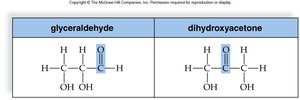
Isomers are compounds with the same molecular formula but different structures, resulting in distinct properties. Structural isomers differ in the arrangement of atoms, while enantiomers are mirror images of each other.
Structural Isomers: Different covalent arrangements of atoms.
Enantiomers: Mirror images; important in biological systems due to their different effects.
Example: Glyceraldehyde and dihydroxyacetone are structural isomers.
Functional Groups
Functional groups are specific chemical groups attached to carbon skeletons, directly involved in chemical reactions. They confer distinct properties, shapes, and charges, influencing molecular behavior.
Seven Major Functional Groups:
Hydroxyl
Carboxyl
Carbonyl
Amino
Sulfhydryl
Phosphate
Methyl
Chemical Reactivity: First six groups are chemically reactive; all except sulfhydryl are hydrophilic, increasing solubility in water.
Biologically Important Functional Groups
Functional groups play critical roles in biological processes. For example, the phosphate group is essential in energy transfer, as seen in ATP (adenosine triphosphate).
Organic Phosphate: Key component of ATP, the primary energy molecule in cells.
ATP: Stores and releases energy for cellular processes.
Summary Table: Structural Isomers Example
Compound | Structure |
|---|---|
Glyceraldehyde | Contains an aldehyde group |
Dihydroxyacetone | Contains a ketone group |
Additional info:
Functional groups are often used to classify organic molecules and predict their reactivity.
Enantiomers can have drastically different biological effects, such as in pharmaceuticals.
