 Back
BackCarbon Chemistry and the Diversity of Biological Polymers
Study Guide - Smart Notes
 Tailored notes based on your materials, expanded with key definitions, examples, and context.
Carbon Chemistry
Hydrocarbons
Hydrocarbons are a fundamental class of organic molecules consisting solely of carbon and hydrogen atoms. These molecules are important in biology due to their energy-rich bonds and their role as building blocks for more complex molecules.
Definition: Hydrocarbons are organic molecules made up of only carbon (C) and hydrogen (H).
Chemical Properties: Hydrocarbons can undergo reactions that release a large amount of energy, making them important for cellular energy storage and metabolism.
Example Structure: The simplest hydrocarbon is methane, with the chemical formula CH4:
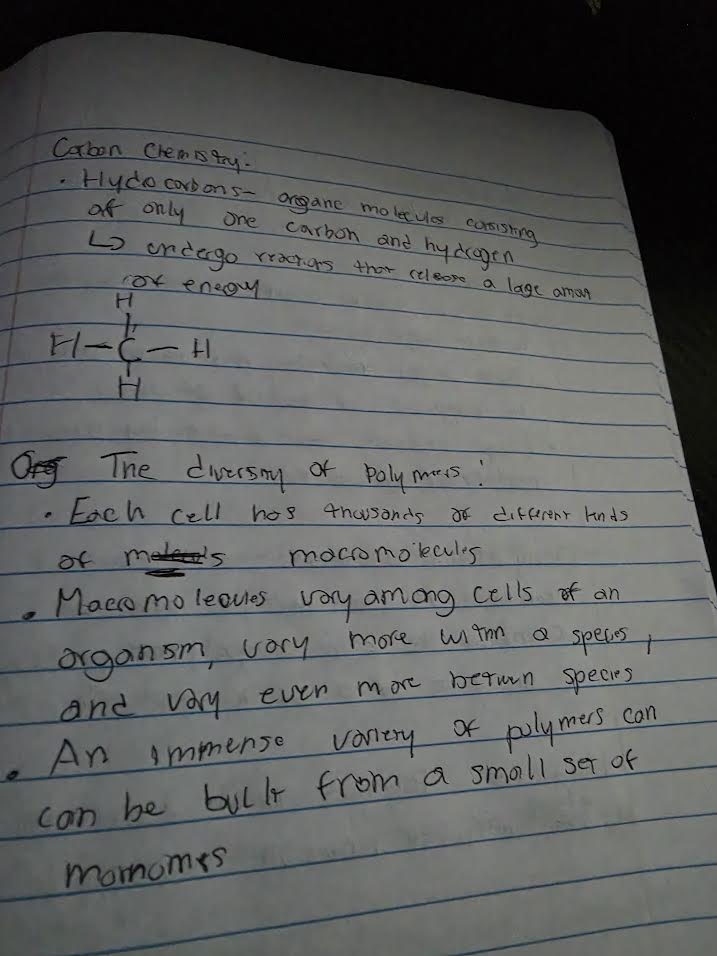
Biological Relevance: Hydrocarbons form the backbone of many biological molecules, including lipids and some amino acid side chains.
The Diversity of Polymers
Macromolecules and Cellular Diversity
Polymers are large molecules composed of repeating subunits called monomers. In biological systems, polymers such as proteins, nucleic acids, and polysaccharides are essential for structure and function.
Cellular Variety: Each cell contains thousands of different kinds of macromolecules, each with specific functions.
Variation: The types and sequences of macromolecules vary among cells of an organism, vary more within a species, and vary even more between species. This molecular diversity underlies the complexity of life.
Polymer Construction: An immense variety of polymers can be constructed from a relatively small set of monomers. For example, proteins are made from 20 different amino acids, and nucleic acids from 4 types of nucleotides.
Example: DNA is a polymer built from four types of nucleotide monomers (adenine, thymine, cytosine, guanine), yet the sequence of these monomers encodes the genetic information for all living organisms.
Additional info: The ability to generate diverse macromolecules from a limited set of monomers is a key principle in molecular biology, enabling the vast complexity observed in living systems.
