 Back
Carbon: The Backbone of Life – Structure, Isomerism, and Functional Groups
Study Guide - Smart Notes
 Tailored notes based on your materials, expanded with key definitions, examples, and context.
Carbon: The Backbone of Life
The Significance of Organic Chemistry and Carbon's Unique Properties
Organic chemistry is the study of carbon-based compounds, which are fundamental to all living organisms. Carbon's atomic structure allows it to form a wide variety of stable molecules, making it the central element in biological macromolecules.
Ubiquity of Carbon in Life: The main elements in living organisms are carbon (C), hydrogen (H), oxygen (O), nitrogen (N), sulfur (S), and phosphorus (P). Carbon acts as the primary building block due to its bonding versatility.
Bonding Versatility: Carbon has four valence electrons, enabling it to form up to four covalent bonds. These can be single, double, or triple bonds, allowing for a diverse range of molecular structures.
Stability: Carbon's valence shell is close to the nucleus, resulting in stable bonds and the ability to form complex molecules.
The Shapes and Structures of Carbon Molecules
The bonding patterns of carbon atoms determine the three-dimensional shapes of molecules, which are crucial for their biological functions.
Electron Configuration: Carbon's electron arrangement favors the formation of four strong covalent bonds.
Tetrahedral Shape: Four single bonds around a carbon atom create a tetrahedral geometry with bond angles of approximately 109.5°.
Planar Shape: Double bonds between carbons restrict rotation, resulting in a planar (flat) structure.
Molecular Representations: Biologists use various models to depict molecules, including ball-and-stick, space-filling, Lewis dot, and line diagrams.
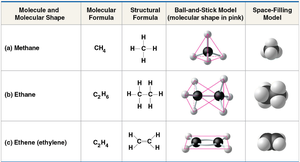
Carbon Skeletons: Chains, Branches, and Rings
Carbon atoms can bond in different arrangements, forming the skeletons of organic molecules. These skeletons can be straight, branched, or ring-shaped, and their structure influences molecular properties.
Common Bonding Partners: Hydrogen, oxygen, and nitrogen are the most frequent partners for carbon in biological molecules.
Variations: Carbon skeletons can differ in length, branching, double bond position, and ring formation.
Hydrocarbons: Molecules made only of carbon and hydrogen. They are nonpolar, hydrophobic, and serve as energy storage molecules due to high-energy C-H bonds.
Isomers: Same Formula, Different Structures
Types of Isomers
Isomers are compounds with the same molecular formula but different structural arrangements, resulting in distinct properties.
Structural Isomers: Differ in the covalent arrangement of atoms (e.g., pentane vs. 2-methylbutane).
Cis-Trans Isomers (Geometric Isomers): Differ in spatial arrangement around a double bond. Cis isomers have similar groups on the same side; trans isomers have them on opposite sides.
Enantiomers: Mirror-image isomers that are non-superimposable, typically due to a chiral center (carbon bonded to four different groups). Enantiomers can have drastically different biological effects.
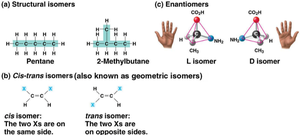
Functional Groups: Modifying Carbon Skeletons
Key Functional Groups and Their Properties
Functional groups are specific clusters of atoms attached to carbon skeletons that determine the chemical reactivity and properties of organic molecules.
Hydroxyl Group (-OH): Found in alcohols; polar and hydrophilic.
Carbonyl Group (C=O): Found in ketones and aldehydes; present in sugars.
Carboxyl Group (-COOH): Found in carboxylic acids; acts as a weak acid.
Amino Group (-NH2): Found in amines; acts as a weak base.
Sulfhydryl Group (-SH): Found in thiols; important for protein structure (disulfide bridges).
Phosphate Group (-PO42−): Found in organic phosphates; crucial for energy transfer (e.g., ATP).
Methyl Group (-CH3): Nonpolar; involved in gene regulation.
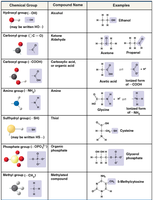
Adenosine Triphosphate (ATP): The Cell's Energy Currency
Structure and Function of ATP
ATP is a vital organic molecule that stores and transfers energy within cells. Its structure includes an adenosine group and three phosphate groups.
Energy Storage: The bonds between phosphate groups in ATP contain significant chemical energy.
ATP Hydrolysis: Breaking the terminal phosphate bond releases energy for cellular processes:
ATP to ADP and AMP: Removal of one phosphate forms ADP; removal of another forms AMP.
Central Role: ATP is constantly cycled in cells to provide energy for metabolism, movement, and biosynthesis.
