 Back
Carbon: The Backbone of Life – Structure, Isomerism, and Functional Groups
Study Guide - Smart Notes
 Tailored notes based on your materials, expanded with key definitions, examples, and context.
Carbon: The Backbone of Life
Significance of Organic Chemistry and Carbon's Unique Properties
Organic chemistry is the study of carbon-based compounds, which are fundamental to all living organisms. Carbon's atomic structure allows it to form a wide variety of stable and complex molecules, making it the central element in biological chemistry.
Ubiquity of Carbon: The main elements in living organisms are carbon (C), hydrogen (H), oxygen (O), nitrogen (N), sulfur (S), and phosphorus (P). Carbon acts as the primary building block for organic molecules.
Bonding Versatility: Carbon has four valence electrons, enabling it to form up to four covalent bonds in various combinations (single, double, triple bonds).
Stability: Carbon's valence shell is close to the nucleus, resulting in stable bonds and the ability to create large, complex molecules.
The Shapes and Structures of Carbon Molecules
Electron Configuration and Molecular Geometry
The arrangement of electrons in carbon's orbitals determines its bonding behavior and the three-dimensional shapes of molecules, which are crucial for biological function.
Tetrahedral Shape: When carbon forms four single bonds, the molecule adopts a tetrahedral geometry with bond angles of approximately 109.5°.
Planar Shape: Double bonds between carbons create planar, rigid structures, restricting rotation and influencing molecular function.
Structural Representations: Biologists use ball-and-stick models, space-filling models, Lewis dot structures, and line diagrams to represent molecular structure.
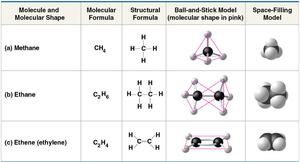
Carbon Skeletons: Chains, Branches, and Rings
Diversity of Carbon Structures
Carbon atoms can bond in various ways, forming the skeletons of organic molecules. These skeletons can be straight, branched, or arranged in rings, and their structure determines the properties of the molecule.
Common Bonding Partners: Hydrogen, oxygen, and nitrogen are the most frequent partners for carbon in biological molecules.
Variations: Carbon skeletons can differ in length, branching, double bond position, and ring formation.
Hydrocarbons: Molecules made only of carbon and hydrogen; they are nonpolar, hydrophobic, and serve as energy storage molecules (e.g., fats and oils).
Isomers: Same Formula, Different Structures
Types of Isomers
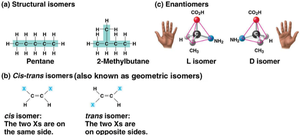
Isomers are compounds with the same molecular formula but different structural arrangements, resulting in distinct properties.
Structural Isomers: Differ in the covalent arrangement of atoms (e.g., pentane vs. 2-methylbutane).
Cis-Trans (Geometric) Isomers: Differ in spatial arrangement around a double bond.
Cis Isomer: Similar groups are on the same side of the double bond.
Trans Isomer: Similar groups are on opposite sides.
Enantiomers: Mirror-image isomers that are non-superimposable, typically due to a chiral carbon bonded to four different groups. Enantiomers can have drastically different biological effects (e.g., thalidomide).
Functional Groups: Modifying Carbon Skeletons
Key Functional Groups and Their Biological Roles
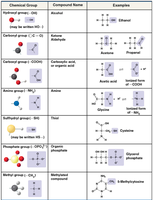
Functional groups are specific clusters of atoms attached to carbon skeletons that determine the chemical properties and reactivity of organic molecules. They are critical for the function and diversity of biomolecules.
Hydroxyl Group (-OH): Found in alcohols; polar and hydrophilic.
Carbonyl Group (C=O): Found in ketones and aldehydes; important in sugars.
Carboxyl Group (-COOH): Found in carboxylic acids; acts as a weak acid.
Amino Group (-NH2): Found in amines; acts as a weak base.
Sulfhydryl Group (-SH): Found in thiols; important for protein structure (disulfide bridges).
Phosphate Group (-PO42-): Found in organic phosphates; crucial for energy transfer (e.g., ATP).
Methyl Group (-CH3): Nonpolar; involved in gene regulation.
Adenosine Triphosphate (ATP): The Cell's Energy Currency
Structure and Function of ATP
ATP is a vital organic molecule that stores and transfers energy within cells. Its structure and the presence of phosphate functional groups are essential for its role in metabolism.
Structure: ATP consists of an adenosine group attached to three phosphate groups.
Energy Storage: The bonds between phosphate groups store significant chemical energy.
ATP Hydrolysis: Breaking the terminal phosphate bond releases energy for cellular processes:
ATP Cycle: ATP is continually broken down to ADP and regenerated, serving as the primary energy currency of the cell.
Additional info: The ATP cycle is fundamental to cellular metabolism, powering processes such as muscle contraction, active transport, and biosynthesis.
