 Back
Carbon: The Basis of Molecular Diversity – Study Notes
Study Guide - Smart Notes
 Tailored notes based on your materials, expanded with key definitions, examples, and context.
Carbon: The Basis of Molecular Diversity
Introduction to Organic Chemistry
Organic chemistry is the study of compounds containing carbon, which is fundamental to the origin and diversity of life. Carbon's unique ability to form four covalent bonds allows for the creation of a vast array of molecules, ranging from simple compounds like methane (CH4) to complex macromolecules such as proteins.
Major elements of life: Carbon (C), Hydrogen (H), Oxygen (O), Nitrogen (N), Sulfur (S), and Phosphorus (P).
Carbon's versatility: Its electron configuration enables it to bond in numerous ways, resulting in molecular diversity among organisms.
Species distinction: Variations in organic molecules contribute to the diversity of living organisms.
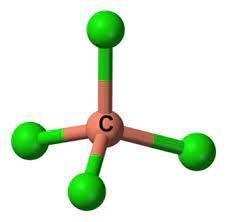
Carbon Atom Structure and Bonding
The chemical characteristics of an atom are determined by its electron configuration, specifically the number of valence electrons. Carbon can form up to four covalent bonds, allowing molecules to branch in multiple directions and enabling the formation of large, complex structures.
Tetrahedral geometry: Four single bonds create a tetrahedral shape.
Planar geometry: Double bonds result in a flat, planar shape.
Bonding diversity: Carbon can bond with a variety of atoms, including other carbons, forming chains and rings.
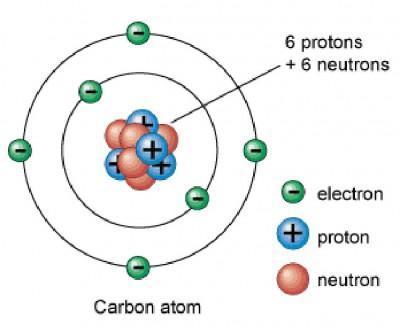
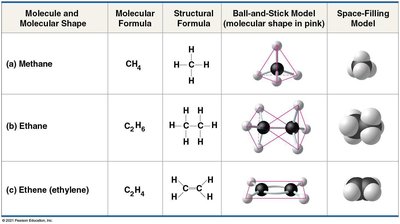
Valence and Bonding Capacity of Major Elements
The number of valence electrons determines how many bonds an element can form. This is crucial for understanding molecular structure and reactivity.
Element | Valence Electrons | Electrons Needed | Valence (Bonds Formed) |
|---|---|---|---|
Hydrogen | 1 | 1 | 1 |
Oxygen | 6 | 2 | 2 |
Nitrogen | 5 | 3 | 3 |
Carbon | 4 | 4 | 4 |
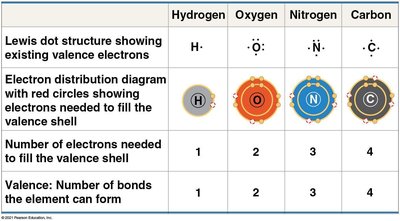
Examples of Carbon Compounds
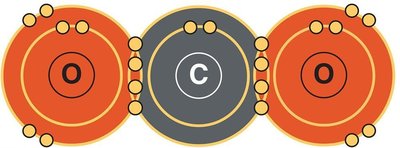
Carbon forms a variety of compounds by bonding with different elements. For example, carbon dioxide (CO2) and urea (CO(NH2)2) demonstrate carbon's ability to form both single and double bonds.
Carbon dioxide: One carbon atom forms double bonds with two oxygen atoms.
Urea: Carbon forms single and double bonds with nitrogen and oxygen.
Molecular Diversity from Carbon Skeletons
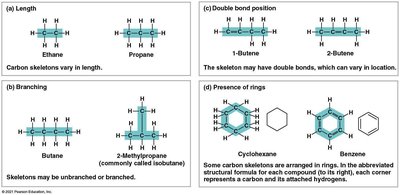
Carbon atoms can bond to other carbons, forming chains of varying length, branching, and ring structures. This variation is a key factor in the complexity and diversity of organic molecules.
Chain length: Molecules can have short or long carbon chains.
Branching: Chains may be branched or unbranched.
Rings: Some carbon skeletons form rings, such as benzene.
Hydrocarbons
Hydrocarbons are organic molecules composed entirely of carbon and hydrogen. They are hydrophobic and their reactions release significant amounts of energy.
Hydrophobic nature: Hydrocarbons do not mix well with water.
Energy release: Combustion of hydrocarbons releases energy, making them important fuel sources.
Isomers: Structural Diversity in Molecules
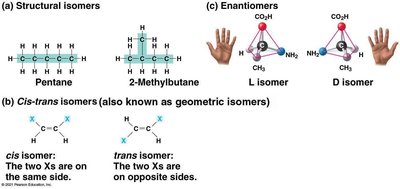
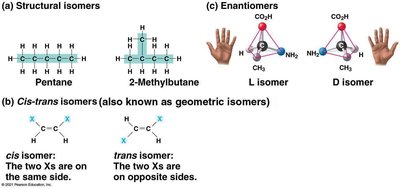
Isomers are compounds with the same molecular formula but different structures, resulting in distinct properties. There are three main types of isomers:
Structural isomers: Differ in the covalent arrangement of atoms.
Cis-trans (geometric) isomers: Same covalent bonds, different spatial arrangements.
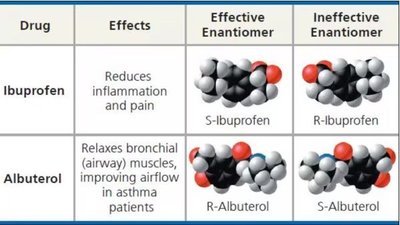
Enantiomers: Mirror images of each other, often with different biological activity.
Biological Importance of Enantiomers
Enantiomers can have dramatically different effects in biological systems. For example, one enantiomer of a drug may be effective, while the other is not.
Drug | Effects | Effective Enantiomer | Ineffective Enantiomer |
|---|---|---|---|
Ibuprofen | Reduces inflammation and pain | S-Ibuprofen | R-Ibuprofen |
Albuterol | Relaxes bronchial muscles in asthma | R-Albuterol | S-Albuterol |
Functional Groups: Key to Molecular Function
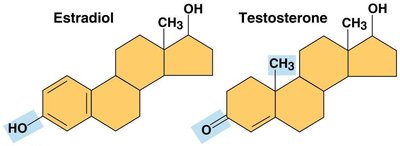
The distinctive properties of organic molecules depend on both the carbon skeleton and the chemical groups attached to it. Functional groups are specific groups of atoms that participate directly in chemical reactions and determine the reactivity and properties of molecules.
Hydroxyl (-OH)
Carbonyl (>C=O)
Carboxyl (-COOH)
Amino (-NH2)
Sulfhydryl (-SH)
Phosphate (-OPO32-)
Methyl (-CH3)
ATP: The Energy Currency of the Cell
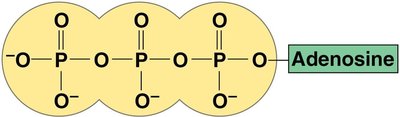
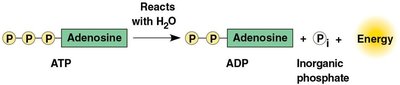
ATP (adenosine triphosphate) is a complex organic phosphate that stores energy for cellular processes. ATP consists of adenosine attached to three phosphate groups. When ATP reacts with water, it loses a phosphate group, forming ADP (adenosine diphosphate) and releasing energy.
ATP structure: Adenosine + 3 phosphate groups
Energy release: Hydrolysis of ATP releases energy used by cells
Summary and Review
Carbon's versatility: Its electron configuration allows for four covalent bonds, enabling structural diversity.
Carbon skeletons: Provide enormous structural diversity in organic molecules.
Isomers: Same molecular formula, different structure or spatial arrangement.
Functional groups: Determine the properties and reactivity of organic molecules.
Review Questions:
Why is carbon unusually versatile?
Name the three types of isomers.
What are the functional groups?
How can structure affect function?
