 Back
BackCell-Cell Interactions and Signaling Pathways (Ch. 11.3–11.4)
Study Guide - Smart Notes
 Tailored notes based on your materials, expanded with key definitions, examples, and context.
Cell-Cell Interactions
Overview of Cell Communication
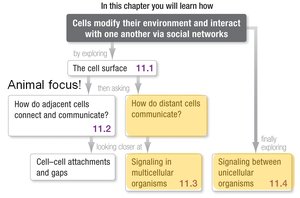
Cells interact with their environment and each other through a variety of mechanisms, forming complex social networks. These interactions are essential for multicellular life, enabling coordination of activities such as growth, development, and response to external stimuli.
Cell surface: The interface where cells connect and communicate.
Adjacent cell communication: Involves cell-cell attachments and gaps.
Distant cell communication: Utilizes signaling molecules that travel through connective tissues.
Unicellular signaling: Involves environmental sensing and population density responses.
How Distant Cells Communicate (Ch. 11.3)
Signaling Molecules and Pathways
Distant cell communication is mediated by signaling molecules that travel through connective tissues (e.g., blood in mammals). Cells must be able to receive, process, and respond to these signals.
Signal reception: Cells detect signaling molecules using specific receptors.
Signal processing: The signal is interpreted within the cell, leading to a response.
Signal response: The cell changes its activity, such as gene expression or protein function.
Signal Reception
Signal molecules can be lipid-soluble or lipid-insoluble. The location of the receptor depends on the solubility of the signal:
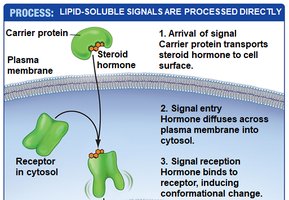
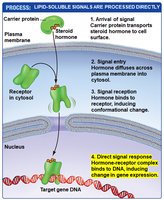
Lipid-soluble signals: Receptors are located inside the cell (cytosol).
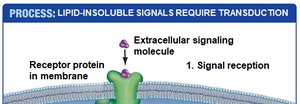
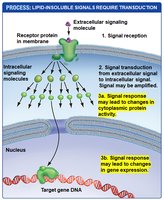
Lipid-insoluble signals: Receptors are bound to the plasma membrane.
Signal Processing
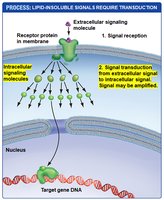
Lipid-soluble signals are processed directly, often resulting in immediate changes in gene expression. Lipid-insoluble signals require signal transduction, converting the extracellular signal into an intracellular response.
Lipid-soluble: Direct response, no additional processing required.
Lipid-insoluble: Signal transduction is necessary; the signal cannot cross the membrane and must be converted.
Signal Response
The cellular response depends on the nature of the signal:
Lipid-soluble signals: Usually result in changes in gene expression.
Lipid-insoluble signals: May lead to changes in cytoplasmic protein activity or gene expression.
Types of Signal Transduction Pathways
Two common types of signal transduction pathways for lipid-insoluble signals are:
G-protein-coupled receptors (GPCRs)
Enzyme-linked receptors
G-Protein-Coupled Receptors (GPCRs)
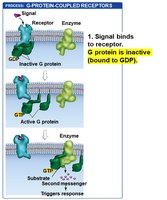
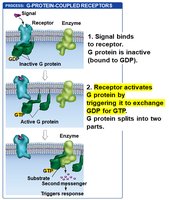
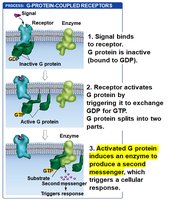
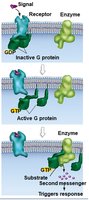
GPCRs are membrane-bound receptors that activate G proteins upon signal binding. The G protein exchanges GDP for GTP, splits into two parts, and activates an enzyme to produce a second messenger, triggering a cellular response.
Inactive G protein: Bound to GDP.
Active G protein: Exchanges GDP for GTP.
Second messenger: Produced by activated enzyme, amplifies the signal.
Enzyme-Linked Receptors
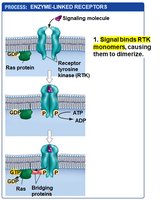
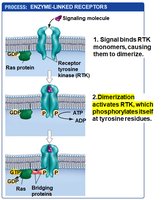
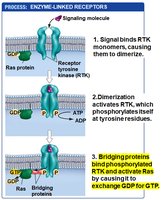
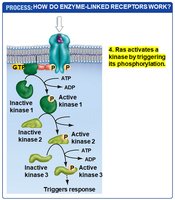
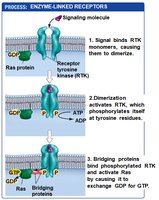
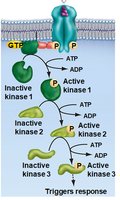
Enzyme-linked receptors, such as receptor tyrosine kinases (RTKs), dimerize upon signal binding, phosphorylate themselves, and activate downstream proteins (e.g., Ras). This triggers a phosphorylation cascade, leading to a cellular response.
RTK dimerization: Signal binding causes two RTK monomers to join.
Autophosphorylation: RTKs phosphorylate their own tyrosine residues.
Activation of Ras: Bridging proteins activate Ras by exchanging GDP for GTP.
Phosphorylation cascade: Series of kinases are activated, amplifying the signal.
Signal Deactivation
Signaling pathways are sensitive to changes in signal and receptor molecules, allowing rapid activation and deactivation. For example:
GPCR pathway: G protein is deactivated by hydrolyzing GTP to GDP, shutting down the pathway.
RTK pathway: Phosphatases remove phosphate groups, deactivating kinases and shutting down the pathway.
Crosstalk Between Signaling Pathways
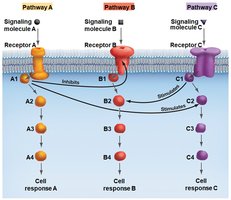
Cells often receive multiple signals simultaneously. Crosstalk refers to the interaction between different signaling pathways, allowing cells to integrate and fine-tune their responses.
Pathway integration: Components of different pathways interact.
Fine-tuning: Ensures appropriate cellular responses to complex stimuli.
Signaling Between Unicellular Organisms (Ch. 11.4)
Quorum Sensing
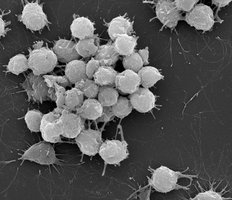
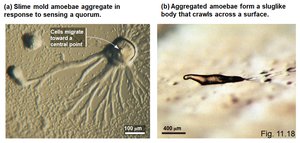
Unicellular organisms, such as bacteria and slime molds, use quorum sensing to detect population density and coordinate group behaviors. All individuals secrete signaling molecules, and when a threshold concentration is reached, all cells respond.
Quorum sensing: Response to population density.
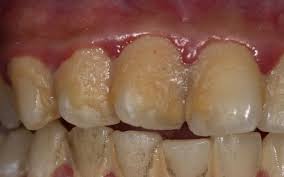
Biofilm formation: Bacteria secrete proteins to adhere to surfaces (e.g., dental plaque).
Mating cues: Slime molds aggregate and form multicellular structures in response to signals.
Comparison Table: Lipid-Soluble vs. Lipid-Insoluble Signaling
Property | Lipid-Soluble Signal | Lipid-Insoluble Signal |
|---|---|---|
Receptor Location | Inside cell (cytosol) | Plasma membrane |
Signal Processing | Direct (no transduction) | Requires signal transduction |
Typical Response | Change in gene expression | Change in protein activity or gene expression |
Example | Steroid hormones | Peptide hormones |
Key Equations
GTP hydrolysis (G-protein deactivation):
Phosphorylation cascade (kinase activation):
Additional info: Academic context was added to clarify the mechanisms of cell signaling, the role of signal transduction, and the importance of crosstalk and quorum sensing in both multicellular and unicellular organisms.
