 Back
Cell-Cell Interactions: Structure, Function, and Communication
Study Guide - Smart Notes
 Tailored notes based on your materials, expanded with key definitions, examples, and context.
Cell-Cell Interactions
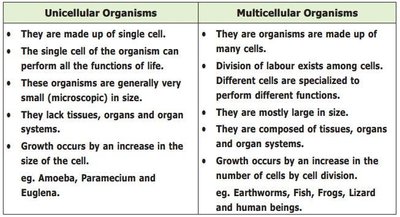
Unicellular vs. Multicellular Organisms
Cells must adapt to their environment and communicate with each other, especially in multicellular organisms. The distinction between unicellular and multicellular life forms is fundamental to understanding cell-cell interactions.
Unicellular organisms: Consist of a single cell capable of performing all life functions. Examples include Amoeba, Paramecium, and Euglena.
Multicellular organisms: Composed of many cells with division of labor. Cells are specialized for different functions and form tissues, organs, and organ systems. Examples include earthworms, fish, frogs, lizards, and humans.
The Cell Surface
Plasma Membrane Structure and Function
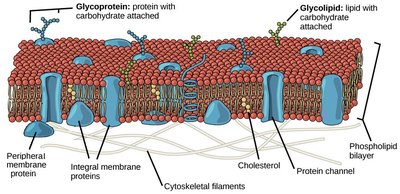
The plasma membrane is a dynamic structure composed of a phospholipid bilayer embedded with proteins. It regulates transport and maintains distinct internal and external environments.
Integral membrane proteins: Span the membrane and are involved in transport and signaling.
Peripheral membrane proteins: Attach to the membrane surface and cytoskeletal elements.
Membrane proteins: Attach to extracellular structures and regulate cell shape and communication.
Protective Layers Beyond the Membrane
Most cells possess a protective layer or wall beyond the plasma membrane. This extracellular layer helps define cell shape, attaches cells to one another, and acts as a first defense.
Structure and Function of Extracellular Layers
Prokaryotic Cell Walls
Prokaryotes have distinct cell wall structures:
Bacteria: Cell walls are primarily composed of peptidoglycan polymers connected by peptide bonds.
Archaea: Lack peptidoglycan; cell walls form a dense protein coat called the S-layer.
Eukaryotic Extracellular Layers
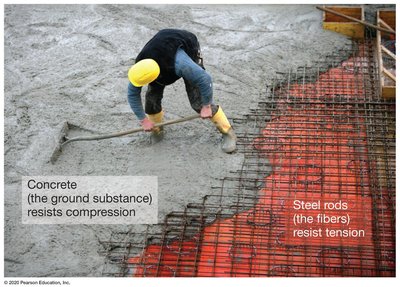
Eukaryotic cells, including plants and animals, have extracellular layers with a fiber composite organization. These layers consist of a network of filaments that resist tension and a ground substance that protects against compression.
Plant Cell Walls
Primary Cell Wall
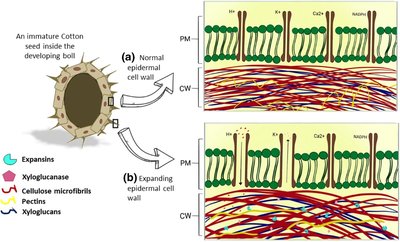
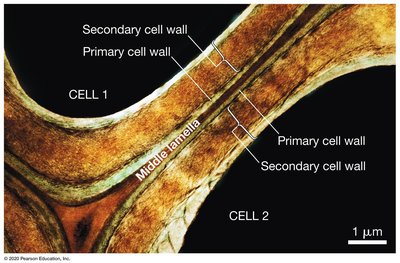
Most plant cells are surrounded by a primary cell wall, which is a fiber composite of cellulose microfibrils and gelatinous polysaccharides like pectin. The primary cell wall defines cell shape and counteracts turgor pressure from water entering the cell by osmosis.
Cellulose microfibrils: Provide structural support.
Pectin: Maintains cell wall moisture.
Turgor pressure: Essential for young, growing cells; proteins called expansins disrupt microfibril cross-linking, allowing cell growth.

Secondary Cell Wall
Mature plant cells secrete a secondary cell wall between the plasma membrane and primary cell wall. Its composition varies by cell type: leaf cells contain waxes, while wood-forming cells contain lignin.
Animal Extracellular Matrix (ECM)
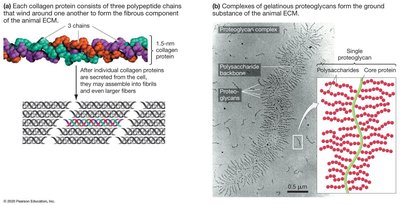
Most animal cells secrete a fiber composite called the extracellular matrix (ECM), which provides structural support. The fibrous component is mainly collagen, while the ground substance is made of proteoglycans.
Collagen: Forms structural fibrils from triple helix proteins.
Proteoglycans: Proteins with attached polysaccharides, giving cartilage its rubber-like consistency.
ECM Variability and Integrins
The amount and composition of ECM varies among tissues. Integrins are membrane proteins that bind to ECM cross-linking proteins (e.g., laminins), anchoring the cytoskeleton to the ECM and connecting the plasma membrane to extracellular structures.
How Do Adjacent Cells Connect and Communicate?
Cell-Cell Attachments in Multicellular Organisms
Direct physical connections between cells are essential for maintaining tissue structure and function. Cell-cell attachments are especially important in epithelia, which line surfaces.
Indirect Cell-Cell Attachments in Plants
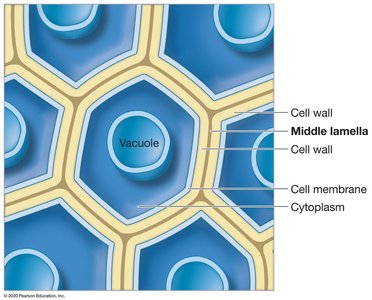
Plant cells are glued together by the middle lamella, a gelatinous layer rich in pectins, which is continuous with adjacent cells' primary cell walls.
Tight Junctions in Animals
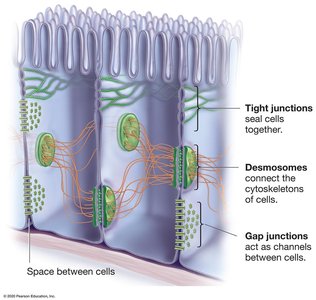
Tight junctions are cell-cell attachments composed of membrane proteins in adjacent animal cells. They form watertight seals, especially in epithelial tissues, and can dynamically open or close in response to environmental changes.
Desmosomes in Animals
Desmosomes are strong cell-cell attachments common in epithelial and muscle cells. They consist of linking proteins and cytosolic anchoring proteins, reinforced by cytoskeletal intermediate filaments.
Selective Cell-Cell Adhesion
Animal cells adhere selectively via specific adhesion proteins. Experiments with sponges showed that dissociated cells can re-aggregate and adhere to cells of the same tissue type, reforming functional organisms.
Discovery of Adhesion Proteins
Researchers identified several classes of adhesion proteins using antibodies. Cadherins are linking proteins in desmosomes, binding only to cadherins of the same type, enabling specific cell-type attachment.
Cell Communication via Cell-Cell Gaps
Direct connections between cells allow ions and small molecules to pass, regulating gene expression and protein activity.
Gap Junctions in Animals
Gap junctions connect adjacent animal cells by forming channels, allowing rapid passage of regulatory ions and small molecules, and coordinating cellular activities.
Plasmodesmata in Plants
Plant cells are connected by plasmodesmata, membrane-lined channels that link plasma membranes, cytoplasm, and smooth ER of adjacent cells. The plasma membrane separates plant tissues into the symplast (shared cytoplasm) and apoplast (extracellular space).
Summary Table: Cell-Cell Connections
Structure | Organism | Function |
|---|---|---|
Tight Junctions | Animals | Seal cells together, prevent leakage |
Desmosomes | Animals | Strong adhesion, connect cytoskeletons |
Gap Junctions | Animals | Channels for communication |
Plasmodesmata | Plants | Channels for communication |
Middle Lamella | Plants | Glues cells together |
