 Back
BackCh. 11 part 1
Study Guide - Smart Notes
 Tailored notes based on your materials, expanded with key definitions, examples, and context.
Cell-Cell Interactions
Overview
Cell-cell interactions are essential for the structure, function, and communication of multicellular organisms. Animal cells modify their environment and interact with one another via specialized structures at the cell surface, enabling them to form tissues, maintain integrity, and coordinate activities.
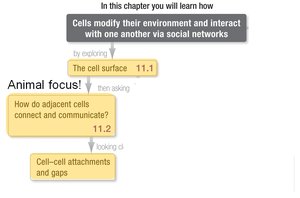
The Cell Surface (Section 11.1)
Structure and Function of the Extracellular Layer
The extracellular layer in eukaryotes is a fiber composite, analogous to reinforced concrete. This structure provides both strength and flexibility to tissues.
Ground substance: Functions like concrete, resisting compression.
Fibers/filaments: Act like steel rods, resisting tension.
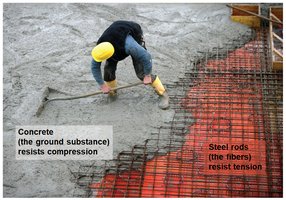
Key Point: The combination of a stiff ground substance and a network of fibers allows tissues to withstand both compressive and tensile forces.
Extracellular Matrix (ECM) in Animals
The extracellular matrix (ECM) is a complex network outside animal cells, providing structural support and mediating cell signaling.
Ground substance: Mainly composed of proteoglycans, which are gel-forming molecules that resist compression.
Fibers: Primarily collagen, which provides tensile strength.
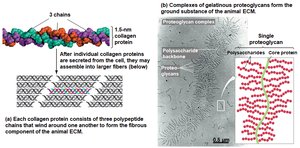
Example: Collagen fibers are made of three polypeptide chains wound together, forming strong, rope-like structures. Proteoglycans consist of a core protein with many carbohydrate chains, forming a gel that fills the space between fibers.
Anchoring Cells to the ECM
Cells are anchored to the ECM through multiple components:
Integrin proteins (transmembrane proteins) connect the cell membrane to the ECM.
Laminin and other crosslinked proteins connect integrins to the ECM outside the cell.
Actin filaments (part of the cytoskeleton) connect to integrins inside the cell.
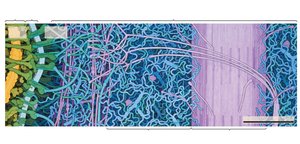
Key Point: This anchoring system allows cells to sense and respond to changes in their environment, transmitting signals from the ECM to the cell interior.
How Adjacent Cells Connect and Communicate (Section 11.2)
Cell-Cell Attachments in Animals
Animal cells in tissues are connected by specialized junctions that provide structural support and regulate communication.
Tight Junctions
Tight junctions are formed by membrane proteins that bind adjacent cells together, creating a water-tight seal. These are especially important in epithelial tissues, such as those lining the digestive tract and bladder.
Prevent leakage of fluids between cells.
The "tightness" can vary depending on the tissue and physiological needs.
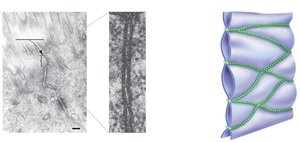
Example: Tight junctions are looser in the small intestine (to facilitate nutrient absorption) and tighter in the bladder (to prevent urine leakage).
Desmosomes
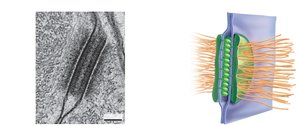
Desmosomes provide strong adhesion between cells, linking the cytoskeletons of adjacent cells via anchoring and linking proteins. They are reinforced by intermediate filaments, giving tissues mechanical strength.
Found in tissues subject to mechanical stress, such as skin and heart muscle.
Composed of cadherin proteins and other components.
Selective Adhesion
Cells exhibit selective adhesion, binding only to cells of the same tissue type. This specificity is due to differences in adhesion proteins expressed by different cell types.
Ensures proper tissue formation and maintenance.
Prevents inappropriate cell mixing.
Gap Junctions
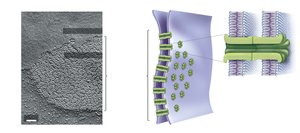
Gap junctions are specialized channels that connect the cytoplasm of adjacent animal cells, allowing ions and small molecules to pass directly between cells. This facilitates rapid communication and coordination, especially in tissues like the heart and smooth muscle.
Formed by channel proteins aligning between neighboring cells.
Enable electrical and chemical signaling.
Summary of Cell-Cell Connections
The three main types of cell-cell junctions in animal tissues are:
Junction Type | Main Function | Key Components |
|---|---|---|
Tight Junction | Seals cells together, prevents leakage | Claudins, occludins (membrane proteins) |
Desmosome | Provides strong adhesion, mechanical strength | Cadherins, intermediate filaments |
Gap Junction | Allows communication via small molecules/ions | Connexins (channel proteins) |
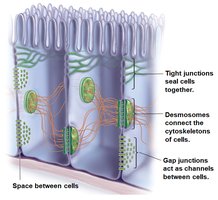
Additional info: Cell-cell interactions are crucial for tissue integrity, signaling, and coordinated function in multicellular organisms. Disruption of these connections can lead to diseases such as cancer and heart disease.
