 Back
Cell Communication and G Protein-Coupled Receptors (GPCRs): Mechanisms and Biological Significance
Study Guide - Smart Notes
 Tailored notes based on your materials, expanded with key definitions, examples, and context.
Cell Communication: Core Concepts and Overview
Introduction to Cell Communication
Cell communication is a fundamental process in biology, enabling cells to detect and respond to signals from their environment and from other cells. This process is essential for development, homeostasis, and coordinated function in multicellular organisms.
Signal Transduction: The process by which a cell converts one kind of signal or stimulus into another, often resulting in a specific cellular response.
Key Players: Ligands (signaling molecules) and receptor proteins are central to initiating cell communication.
Biological Importance: Cell communication underlies processes such as growth, immune responses, and sensory perception.
Mechanisms of Cell Communication
Signal Reception, Transduction, and Response
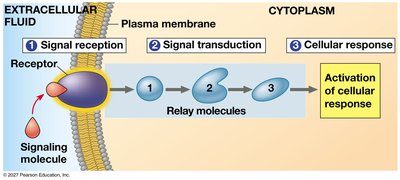
Cell signaling typically involves three main stages: reception, transduction, and response.
Reception: A signaling molecule (ligand) binds to a specific receptor protein, usually located on the cell surface or inside the cell.
Transduction: The receptor activates a series of intracellular events, often involving relay molecules, to transmit the signal.
Response: The cell executes a specific response, such as altering gene expression, enzyme activity, or cell behavior.
Analogy: Signal Conversion
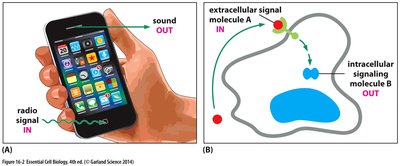
Just as a cell phone converts radio signals into sound, cells convert extracellular signals into intracellular responses.
Ligands and Receptors
Ligand: A molecule that binds specifically to a receptor, initiating the signaling process. Ligands can be proteins, peptides, hormones, or other small molecules.
Receptor: A protein that recognizes and binds to a ligand, triggering a cellular response. Receptors can be located on the cell surface (e.g., for hydrophilic ligands) or inside the cell (e.g., for hydrophobic ligands like steroid hormones).
Types of Cell Signaling in Animals
Modes of Signaling
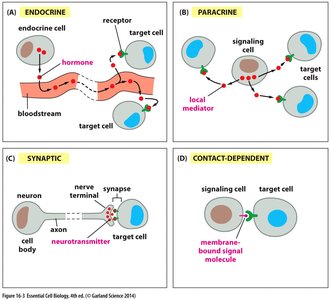
Animal cells use several distinct signaling mechanisms, classified by the distance over which the signal acts:
Endocrine signaling: Hormones are released into the bloodstream and act on distant target cells.
Paracrine signaling: Local mediators affect nearby cells.
Synaptic signaling: Neurotransmitters are released at synapses between neurons and target cells.
Contact-dependent signaling: Direct contact between signaling and target cells via membrane-bound molecules.
G Protein-Coupled Receptors (GPCRs)
Overview and Biological Significance
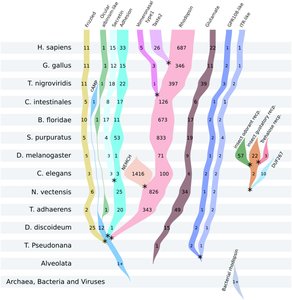
G protein-coupled receptors (GPCRs) are the largest family of cell surface receptors in animals. They play critical roles in sensory perception, physiological regulation, and are major targets for pharmaceuticals.
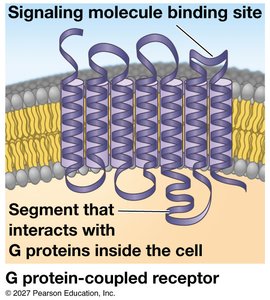
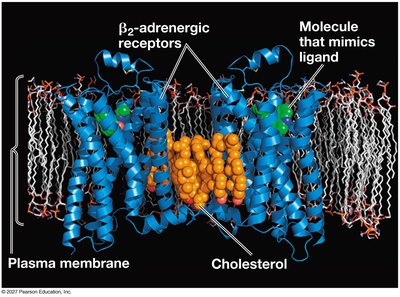
Structure: GPCRs span the plasma membrane seven times (seven transmembrane domains).
Function: They transmit signals from a wide variety of ligands, including hormones, neurotransmitters, and sensory stimuli (e.g., taste, smell).
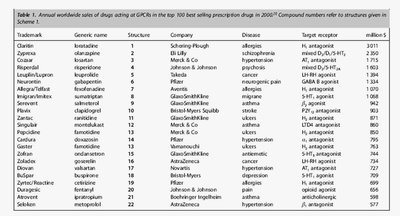
Medical Relevance: Approximately 40% of prescription drugs target GPCRs.
Discovery and Study of GPCRs
The discovery of GPCRs was a major milestone in cell biology and pharmacology, recognized by the Nobel Prize in Chemistry in 2012. Key scientists contributed to understanding their structure and function, including their role in disease and therapeutic targeting.
GPCR Structure
GPCRs have a characteristic structure with seven alpha-helical transmembrane domains.
The extracellular region binds the ligand, while the intracellular region interacts with G proteins.
G Proteins: Molecular Switches
Mechanism of G Protein Activation
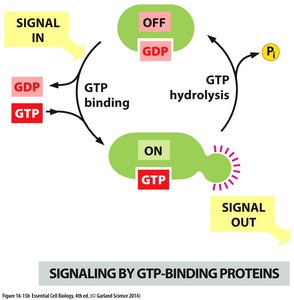
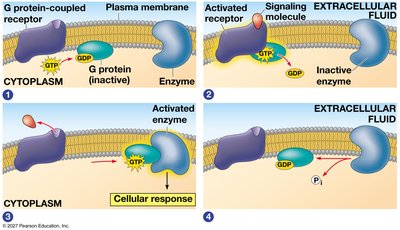
G proteins are intracellular proteins that act as molecular switches, cycling between active (GTP-bound) and inactive (GDP-bound) states.
Activation: Ligand binding to a GPCR causes the receptor to activate a G protein by promoting the exchange of GDP for GTP.
Inactivation: The G protein hydrolyzes GTP to GDP, returning to the inactive state.
Equation:
Example: GPCRs in Taste Sensation
Bitter Taste Reception
Many taste receptors, especially those detecting bitter compounds, are GPCRs. Genetic variation in these receptors can lead to differences in taste sensitivity among individuals.
Specificity: Mutations in genes encoding bitter taste receptors can increase or decrease sensitivity to bitter compounds without affecting other taste modalities.
Mechanism: Bitter compounds bind to specific GPCRs on taste receptor cells, initiating a signal transduction pathway that ultimately sends a signal to the brain.
Example: Variation in the TAS2R gene family affects perception of bitterness in foods like kale or brussels sprouts.
Summary Table: Types of Cell Signaling
Type | Distance | Example Signal | Target |
|---|---|---|---|
Endocrine | Long | Hormones (e.g., insulin) | Distant cells via bloodstream |
Paracrine | Medium/Short | Local mediators | Nearby cells |
Synaptic | Very short | Neurotransmitters | Adjacent neurons or muscle cells |
Contact-dependent | Direct contact | Membrane-bound signals | Touching cells |
Key Terms and Concepts
Ligand: A molecule that binds to a receptor to initiate signaling.
Receptor: A protein that detects a signal molecule and initiates a response.
GPCR: G protein-coupled receptor, a large family of cell surface receptors.
G protein: Intracellular protein that transduces signals from GPCRs.
Signal transduction: The process of converting an extracellular signal into a cellular response.
Hydrolysis: Chemical breakdown of a compound due to reaction with water (e.g., GTP to GDP).
Additional info:
Alterations in cell communication pathways are frequently implicated in diseases, including cancer and metabolic disorders.
GPCRs are involved in many sensory systems, including vision, smell, and taste.
Pharmaceutical targeting of GPCRs is a major strategy in drug development due to their central role in physiology and disease.
