 Back
BackCell Communication and Signal Transduction
Study Guide - Smart Notes
 Tailored notes based on your materials, expanded with key definitions, examples, and context.
Cell Communication and Signal Transduction
Evolution of Cell Signaling
Cell signaling mechanisms are fundamental to life and evolved early in the history of prokaryotes and single-celled eukaryotes. These mechanisms were later adapted for use in multicellular organisms, allowing cells to coordinate complex behaviors.
Quorum Sensing: Bacteria use signaling molecules to sense local population density, coordinating activities such as biofilm formation and virulence.
Pathogenic Signaling: Some bacteria secrete toxins that can inhibit neurotransmitter release in host organisms.
Conservation: The molecular details of signal transduction are remarkably similar in yeasts and mammals, highlighting evolutionary conservation.
Types of Cell Communication
Cells communicate through direct contact or by secreting signaling molecules that affect nearby or distant cells. The main types of signaling include:
Cell-Cell Recognition: Direct contact between cell surface molecules.
Paracrine Signaling: Local signaling where secreted molecules affect nearby target cells. Growth factors are common paracrine signals that stimulate cell growth and division.
Synaptic Signaling: In the nervous system, neurotransmitters are released in response to electrical signals and diffuse across synapses to target cells. Many drugs for depression, anxiety, and PTSD affect this process.
Endocrine (Hormonal) Signaling: Specialized cells release hormones into the bloodstream, allowing long-distance communication. In animals, hormones are produced by glands; in plants, phytohormones are used but without specialized glands.
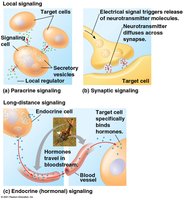
The ability of a cell to respond to a signal depends on the presence of a specific receptor for that signal.
The Three Stages of Cell Signaling
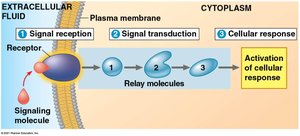
Cell signaling involves three main stages that convert external signals into cellular responses:
Reception: The target cell detects a signaling molecule (ligand) that binds to a receptor protein on the cell surface or inside the cell.
Transduction: The binding of the ligand alters the receptor, initiating a cascade of molecular events (signal transduction pathway).
Response: The transduced signal triggers a specific cellular response, such as gene expression, enzyme activation, or cell division.
Signal Reception: Types of Receptors
Membrane Receptors
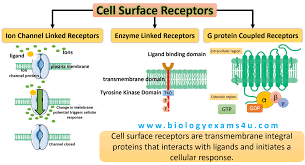
Most signaling molecules bind to receptors embedded in the plasma membrane. There are three main classes of membrane receptors:
G Protein-Coupled Receptors (GPCRs): Transmembrane receptors that activate G proteins, which then bind GTP and relay signals to other proteins.
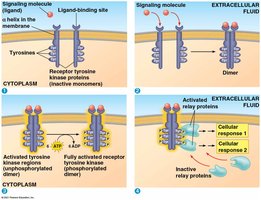
Receptor Tyrosine Kinases (RTKs): Enzyme-linked receptors that transfer phosphate groups from ATP to tyrosine residues on target proteins, often triggering multiple signaling pathways.
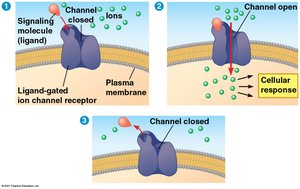
Ion Channel Receptors: Ligand-gated channels that open or close in response to ligand binding, allowing specific ions to flow across the membrane and alter cell activity.
G Protein-Coupled Receptors (GPCRs)
GPCRs are the largest family of cell-surface receptors.
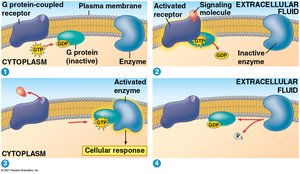
They work with the help of G proteins, which are molecular switches that bind GTP.
Activation of a GPCR leads to the exchange of GDP for GTP on the G protein, which then activates downstream enzymes or ion channels.
Receptor Tyrosine Kinases (RTKs)
RTKs are membrane receptors with intrinsic enzyme activity.
Ligand binding causes dimerization and autophosphorylation of tyrosine residues, creating docking sites for relay proteins.
RTKs can activate multiple signaling pathways simultaneously.
Abnormal RTK signaling is linked to various cancers.
Ion Channel Receptors
These receptors act as gates for ions such as Na+ or Ca2+.
Ligand binding opens the channel, allowing ions to flow and change the cell's membrane potential or trigger other responses.
Intracellular Receptors
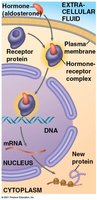
Some signaling molecules are small or hydrophobic enough to cross the plasma membrane and bind to receptors inside the cell (cytoplasm or nucleus).
Examples include steroid and thyroid hormones.
The hormone-receptor complex can act as a transcription factor, turning specific genes on or off.
Cellular Responses and Apoptosis
Cellular Response
The final stage of cell signaling is the cellular response, which can involve changes in gene expression, metabolism, cell shape, or cell division. The specificity of the response depends on the cell type and the signaling pathway activated.
Apoptosis: Programmed Cell Death
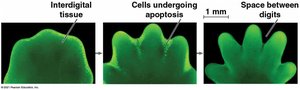
Apoptosis is a controlled process of cell death that is essential for development and maintenance in multicellular organisms.
Cells that are damaged, infected, or no longer needed undergo apoptosis to prevent harm to neighboring cells.
During apoptosis, cellular components are packaged into vesicles and digested by scavenger cells.
Apoptosis prevents the leakage of harmful enzymes and is crucial for processes such as the development of fingers and toes in humans.
It is triggered by signals that activate a cascade of proteases (mainly caspases) and nucleases, which dismantle the cell.
Dysregulation of apoptosis is implicated in diseases such as cancer (insufficient apoptosis) and neurodegenerative disorders (excessive apoptosis).
Type of Receptor | Location | Ligand Type | Example |
|---|---|---|---|
G Protein-Coupled Receptor (GPCR) | Plasma membrane | Peptides, neurotransmitters | Adrenaline receptor |
Receptor Tyrosine Kinase (RTK) | Plasma membrane | Growth factors | Insulin receptor |
Ion Channel Receptor | Plasma membrane | Ions, neurotransmitters | Acetylcholine receptor |
Intracellular Receptor | Cytoplasm or nucleus | Steroid hormones | Estrogen receptor |
