 Back
Cell Communication and Signal Transduction
Study Guide - Smart Notes
 Tailored notes based on your materials, expanded with key definitions, examples, and context.
Cell Communication and Signal Transduction
Overview of Cell Signaling
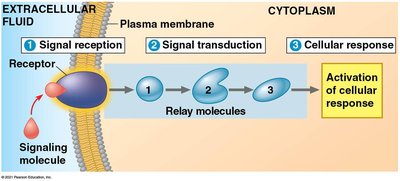
Cell signaling is a fundamental process that enables cells to perceive and correctly respond to their microenvironment. It is essential for the coordination of cellular activities and responses to external stimuli. Cell signaling typically involves three main stages: reception, transduction, and response.
Signal Reception: A signaling molecule (ligand) binds to a specific receptor protein on the cell surface or inside the cell.
Signal Transduction: The receptor initiates a cascade of intracellular events, often involving relay molecules, that transmit the signal.
Cellular Response: The transduced signal triggers a specific cellular activity, such as gene expression, enzyme activation, or changes in cell behavior.
Types of Cell Signaling
Cells communicate through different signaling mechanisms, classified based on the distance the signal travels and the nature of the target cell.
Paracrine Signaling: Signals are released by a cell and affect nearby target cells. Example: Growth factors acting locally.
Synaptic Signaling: Specialized form of paracrine signaling in neurons where neurotransmitters cross synapses to target cells.
Endocrine Signaling: Hormones are released into the bloodstream and act on distant target cells throughout the body.
Cell Surface vs. Intracellular Receptors
Receptors are proteins that recognize and bind signaling molecules. Their location determines the type of signaling molecule they interact with:
Cell Surface Receptors: Located on the plasma membrane; bind hydrophilic or large signaling molecules that cannot cross the membrane (e.g., peptide hormones, neurotransmitters).
Intracellular Receptors: Located in the cytoplasm or nucleus; bind small or hydrophobic molecules that can diffuse through the membrane (e.g., steroid hormones).
Major Classes of Cell Surface Receptors
G Protein-Coupled Receptors (GPCRs)
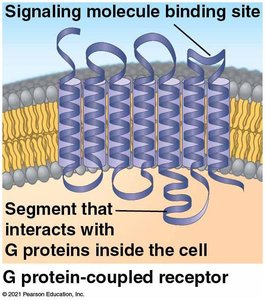
GPCRs are a large family of membrane receptors that interact with G proteins to transmit signals inside the cell. They are involved in many physiological processes.
Structure: Characterized by seven transmembrane α-helices.
Activation Steps:
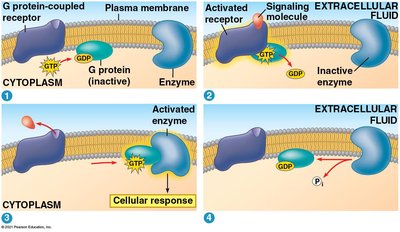
A signaling molecule binds to the GPCR, causing a conformational change.
The activated GPCR interacts with a G protein, causing GDP to be replaced by GTP on the G protein.
The activated G protein dissociates and interacts with an effector enzyme, leading to a cellular response.
The G protein hydrolyzes GTP to GDP, returning to its inactive state.
Receptor Tyrosine Kinases (RTKs)
RTKs are membrane receptors that attach phosphates to tyrosines. They are crucial for regulating cell growth, differentiation, and metabolism.
Activation Steps:
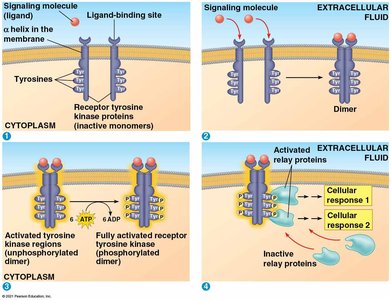
Ligand binding causes two RTK monomers to dimerize.
Dimerization activates the kinase domains, leading to autophosphorylation of tyrosine residues.
Phosphorylated tyrosines serve as docking sites for relay proteins, initiating multiple signaling pathways.
Intracellular Receptors
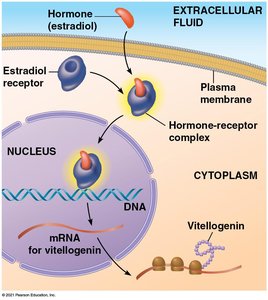
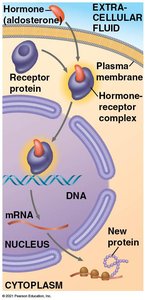
Intracellular receptors are found in the cytoplasm or nucleus. They typically bind lipid-soluble signaling molecules, such as steroid hormones, which can cross the plasma membrane.
Activation Steps:
The signaling molecule diffuses through the plasma membrane and binds to the receptor.
The hormone-receptor complex enters the nucleus and binds to specific DNA sequences.
This binding regulates gene expression, leading to the synthesis of new proteins.
Signal Transduction Pathways
Phosphorylation Cascades
Many signal transduction pathways involve a series of protein phosphorylations, known as a phosphorylation cascade. Protein kinases transfer phosphate groups from ATP to target proteins, while protein phosphatases remove them.
Protein Kinase: Enzyme that adds phosphate groups to proteins, often activating them.
Protein Phosphatase: Enzyme that removes phosphate groups, generally inactivating the protein.
Function: Amplifies the signal and allows for tight regulation of cellular responses.
Second Messengers
Second messengers are small, non-protein molecules that relay signals from receptors to target molecules inside the cell. They play a key role in amplifying and distributing signals.
Common Second Messengers: cAMP (cyclic AMP), Ca2+, IP3.
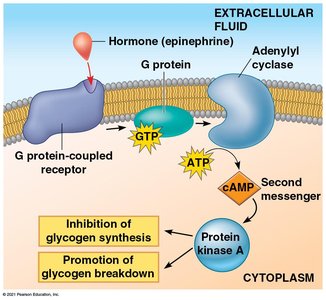
cAMP Production: Generated from ATP by the enzyme adenylyl cyclase, which is activated by G proteins.

cAMP as a Second Messenger in GPCR Pathways
cAMP is a widely used second messenger in GPCR signaling pathways. It activates protein kinase A (PKA), which then phosphorylates various target proteins to elicit cellular responses.
Pathway Steps:
Ligand binds to GPCR, activating the G protein.
G protein activates adenylyl cyclase, which converts ATP to cAMP.
cAMP activates protein kinase A (PKA).
PKA phosphorylates target proteins, leading to specific cellular responses (e.g., regulation of glycogen metabolism).
Summary Table: Comparison of Receptor Types
Receptor Type | Location | Ligand Type | Example | Mechanism |
|---|---|---|---|---|
GPCR | Plasma membrane | Hydrophilic (e.g., epinephrine) | Adrenergic receptor | Activates G protein, second messengers |
RTK | Plasma membrane | Hydrophilic (e.g., growth factors) | Insulin receptor | Dimerization, autophosphorylation |
Intracellular | Cytoplasm/Nucleus | Hydrophobic (e.g., steroid hormones) | Estrogen receptor | Direct gene regulation |
Key Terms and Concepts
Ligand: A molecule that specifically binds to another (usually larger) molecule, such as a receptor.
Signal Amplification: The process by which a single signaling event leads to a large number of cellular responses.
Termination of Signal: Mechanisms such as ligand dissociation, GTP hydrolysis, or degradation of second messengers ensure that signaling is transient and reversible.
