 Back
BackCell Communication and Signal Transduction
Study Guide - Smart Notes
 Tailored notes based on your materials, expanded with key definitions, examples, and context.
Cell Communication and Signal Transduction
Overview of Cell Signaling
Cell signaling is a fundamental process that enables cells to perceive and correctly respond to their microenvironment. This process is essential for the survival, development, and function of all living organisms. Signals can be chemical, physical, or electrical, and the mechanisms of signaling are highly conserved across species.
Quorum Sensing: A process in prokaryotes where the concentration of signaling molecules allows bacteria to sense local population density.
Yeast Mating: Saccharomyces cerevisiae uses secreted factors to locate cells of the opposite mating type, initiating a signal transduction pathway.
Types of Signaling in Multicellular Eukaryotes: Includes direct contact, paracrine, synaptic, and endocrine (hormonal) signaling.
Types of Cell Signaling
Local Signaling: Involves direct contact or short-range signals (e.g., paracrine and synaptic signaling).
Long-Distance Signaling: Utilizes hormones that travel through the circulatory system to reach target cells.
Direct Contact: Includes cell junctions and cell-surface molecule interactions, important in development and immune responses.
The Three Stages of Cell Signaling
Stages and Their Functions
Cell signaling typically involves three main stages: reception, transduction, and response. Each stage is crucial for the accurate transmission and execution of cellular instructions.
Reception: The target cell detects a signaling molecule (ligand) that binds to a receptor protein on the cell surface or inside the cell.
Transduction: The binding of the ligand alters the receptor, initiating a cascade of molecular interactions (signal transduction pathway).
Response: The transduced signal triggers a specific cellular response, such as gene expression or enzyme activation.
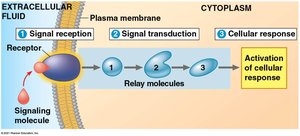
Reception: Signal Detection by Receptors
Receptor Types and Mechanisms
Receptors are proteins that specifically bind signaling molecules and initiate the signaling process. They can be located on the plasma membrane or within the cell.
Plasma Membrane Receptors: Most water-soluble signals bind to these receptors.
Intracellular Receptors: Found in the cytoplasm or nucleus; bind small or hydrophobic molecules (e.g., steroid hormones).
G Protein-Coupled Receptors (GPCRs)
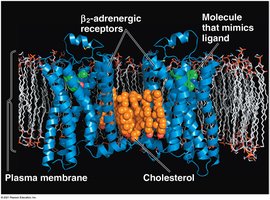
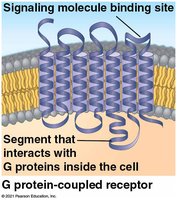
GPCRs are the largest family of cell-surface receptors. They work with G proteins, which bind GTP and relay signals inside the cell.
Receptor Tyrosine Kinases (RTKs)
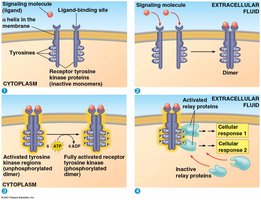
RTKs are membrane receptors that catalyze the transfer of phosphate groups from ATP to tyrosine residues on proteins. They can activate multiple pathways simultaneously.
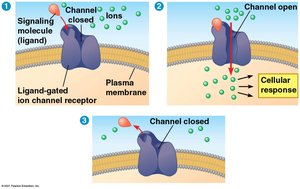
Ligand-Gated Ion Channel Receptors
These receptors act as gates that open or close in response to ligand binding, allowing specific ions to pass through the membrane and alter cell activity.
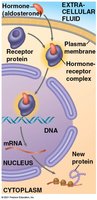
Intracellular Receptors
These receptors bind hydrophobic signaling molecules that cross the plasma membrane. The hormone-receptor complex often acts as a transcription factor, regulating gene expression.
Transduction: Signal Relay and Amplification
Signal Transduction Pathways
Transduction involves a cascade of molecular interactions, often amplifying the signal and providing opportunities for regulation. Each step typically involves a conformational change in a protein.
Protein Phosphorylation: Addition of phosphate groups by kinases; removal by phosphatases.
Second Messengers: Small, nonprotein, water-soluble molecules or ions that spread the signal within the cell.
Cyclic AMP (cAMP) as a Second Messenger
cAMP is produced from ATP by adenylyl cyclase and is a common second messenger in GPCR pathways. It activates protein kinase A, which phosphorylates target proteins.

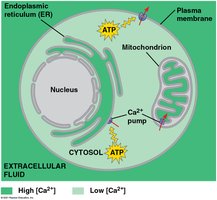
Calcium Ions and Inositol Triphosphate (IP3)
Calcium ions (Ca2+) are widely used as second messengers. Their concentration is tightly regulated by pumps and channels in the plasma membrane and organelles.
Cellular Response: Output of the Signal
Types of Cellular Responses
The final outcome of cell signaling is a specific cellular response, which may involve changes in gene expression, enzyme activity, or cell behavior. The response can occur in the nucleus or cytoplasm.
Gene Expression: Activation or repression of specific genes by transcription factors.
Enzyme Activity: Activation or inhibition of metabolic pathways.
Cell Division: Regulation of the cell cycle and proliferation.
Regulation of the Response
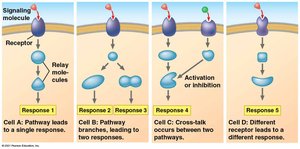
Cell signaling is tightly regulated to ensure appropriate responses. Four key aspects of regulation include:
Amplification: Enzyme cascades increase the magnitude of the response.
Specificity: Different cells can respond differently to the same signal, depending on their proteins and pathways.
Efficiency: Scaffolding proteins organize components for faster signaling.
Termination: Inactivation mechanisms ensure signals are not perpetuated unnecessarily.
Apoptosis: Programmed Cell Death
Mechanisms and Importance
Apoptosis is a form of programmed cell death essential for development and homeostasis. It involves the orderly dismantling of cellular components, preventing damage to neighboring cells.
Triggers: Can be initiated by internal signals (e.g., DNA damage) or external signals (e.g., death ligands).
Caspases: A family of proteases that execute apoptosis by cleaving specific cellular substrates.
Biological Roles: Shapes tissues during development, removes damaged or dangerous cells, and prevents cancer.
Example: Apoptosis sculpts fingers and toes during embryonic development and removes cells with irreparable DNA damage.
Additional info: Dysregulation of apoptosis is implicated in diseases such as cancer (insufficient apoptosis) and neurodegenerative disorders (excessive apoptosis).
