 Back
Cell Communication and Signal Transduction: AP Biology Unit 4 Study Guide
Study Guide - Smart Notes
 Tailored notes based on your materials, expanded with key definitions, examples, and context.
Cell Communication
Introduction to Cellular Communication
Cellular communication is essential for the coordination of activities within unicellular and multicellular organisms. Cells use signaling molecules to transmit information, allowing them to respond to environmental changes, coordinate development, and maintain homeostasis.
Why do cells communicate? To regulate growth, respond to stimuli, coordinate immune responses, and maintain tissue integrity.
Cellular communication in unicellular life: Enables behaviors like quorum sensing and mating.
Cellular communication in multicellular life: Coordinates complex processes such as development, immune response, and tissue repair.
Phases of Signal Transduction
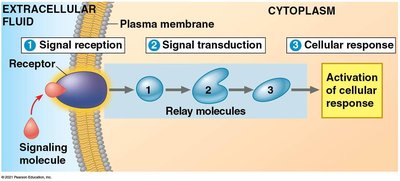
Signal transduction is the process by which a cell converts an external signal into a functional response. It consists of three main phases:
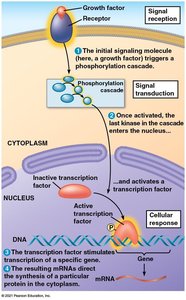
Signal Reception: The cell detects a signaling molecule (ligand) via a receptor.
Signal Transduction: The signal is relayed and amplified through a series of intracellular molecules.
Cellular Response: The cell executes a specific response, such as gene expression or metabolic change.
Types of Cellular Signaling
Local Signaling
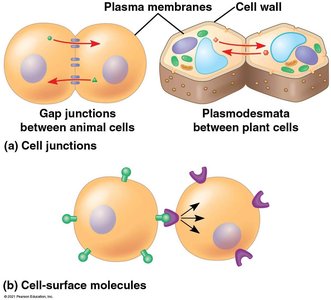
Local signaling occurs between cells that are in close proximity. It is crucial for processes such as embryonic development and immune responses.
Cell Junctions: Direct connections between cells (gap junctions in animals, plasmodesmata in plants) allow molecules to pass directly between cytoplasms.
Cell-Surface Molecules: Cells communicate via direct contact between membrane-bound molecules.
Paracrine Signaling: Messenger molecules (e.g., growth factors) are secreted and affect nearby cells.
Synaptic Signaling: Neurotransmitters are released in response to electrical signals in the nervous system.
Long-Distance Signaling
Long-distance signaling involves hormones that travel through the circulatory system to reach target cells. The response depends on the presence of specific receptors.
Hormonal (Endocrine) Signaling: Specialized cells release hormones that affect distant cells.
Receptor Specificity: Only cells with the appropriate receptor can respond to a given hormone.
Chemistry and Reception of Signals
Types of Signaling Molecules
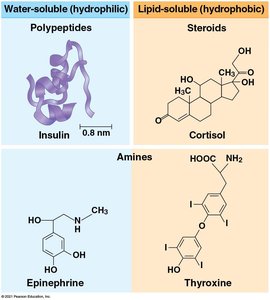
Signaling molecules can be classified based on their solubility:
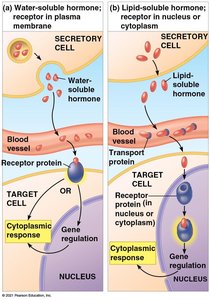
Water-soluble (hydrophilic): Polypeptides (e.g., insulin), amines (e.g., epinephrine) – generally do not enter the cell.
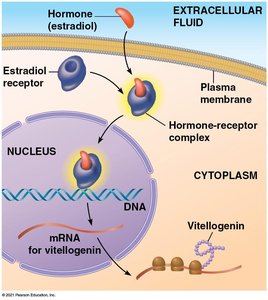
Lipid-soluble (hydrophobic): Steroids (e.g., cortisol), thyroid hormones – can pass through the cell membrane.
Receptor Location and Response
The location of the receptor determines the pathway and outcome of the signal:
Plasma Membrane Receptors: Bind water-soluble ligands; trigger cytoplasmic responses.
Intracellular Receptors: Bind lipid-soluble ligands; often regulate gene expression.
Signal Transduction Pathways
G Protein-Coupled Receptors (GPCRs)
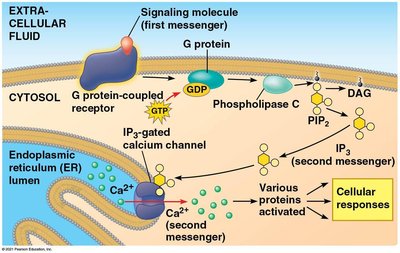
GPCRs are a large family of membrane receptors that activate G proteins upon ligand binding. G proteins are activated by GTP and initiate various intracellular signaling cascades.
Highly conserved: Found in all domains of life.
Function: Activate second messengers and downstream pathways.
Receptor Tyrosine Kinases
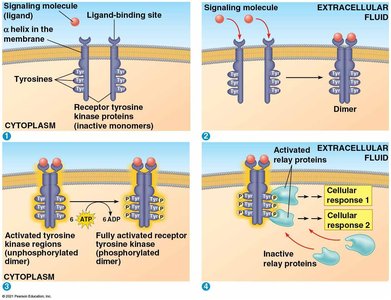
Tyrosine kinases are membrane receptors that phosphorylate tyrosine residues on themselves and relay proteins, forming dimers upon ligand binding.
Remain active: As long as the ligand is attached.
Phosphorylation: Transfers phosphate groups to relay proteins, activating multiple responses.
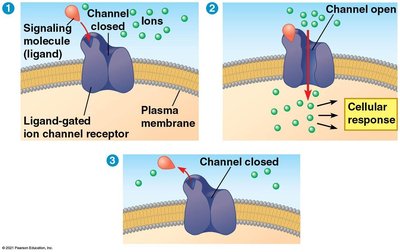
Ligand-Gated Ion Channels
Ligand-gated ion channels open in response to ligand binding, allowing ions to flow into the cell and trigger a cellular response.
Example: Neurotransmitter-gated channels in synaptic signaling.
Second Messengers
Cyclic AMP (cAMP)
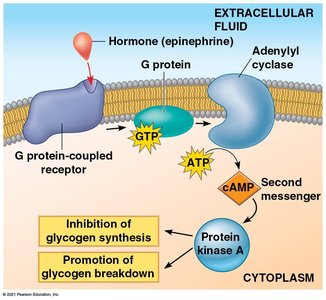
cAMP is a common second messenger produced from ATP by adenylyl cyclase. It activates protein kinase A and triggers various cellular responses.
Pathway: First messenger binds GPCR → G protein activates adenylyl cyclase → ATP converted to cAMP → cAMP activates protein kinase A.

Calcium Ions (Ca2+)
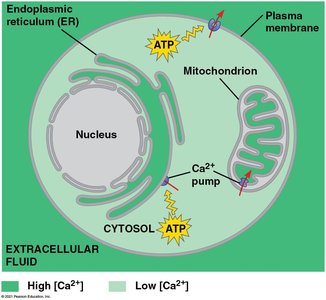
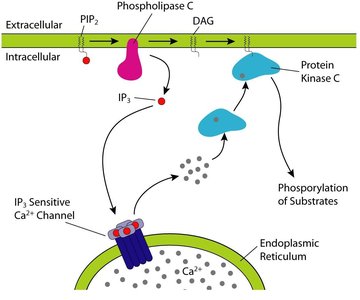
Calcium ions are widely used as second messengers in both animal and plant cells. Their concentration is tightly regulated by pumps and channels.
Functions: Muscle contraction, exocytosis, cell division, and plant responses.
Pathways: Often involve IP3 and DAG as additional second messengers.
Examples of Signal Transduction
Epinephrine (Adrenaline) Signaling
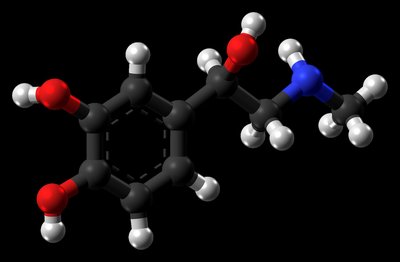
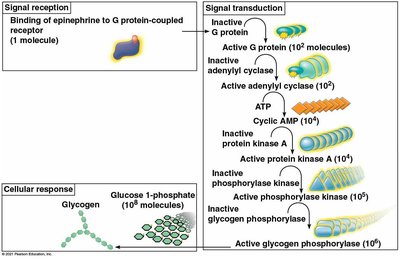
Epinephrine is a polar amine hormone involved in the fight-or-flight response. It binds to GPCRs, triggering cAMP production and metabolic changes such as glycogen breakdown.
Cannot pass through membrane: Binds to membrane receptors.
Amplification: One molecule can trigger a cascade resulting in millions of responding molecules.
Complexity in Signal Transduction
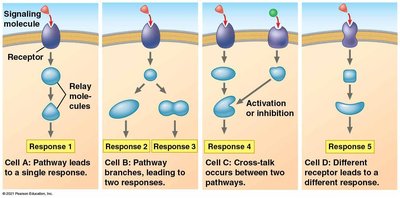
Pathway Branching and Cross-Talk
Cells can integrate multiple signals through pathway branching and cross-talk, allowing for coordinated responses to complex stimuli.
Different proteins: Allow cells to detect and respond to different signals.
Emergence: Complex behaviors arise from simple signaling networks.
Applications of Cell Communication
Quorum Sensing
Quorum sensing is a form of communication among microbes that triggers group responses at certain population densities. For example, Vibrio fischeri produces bioluminescence when population density is high.
Biofilms: Aggregations of bacterial cells on surfaces, maintained by quorum sensing.
Medical importance: Interfering with quorum sensing may offer alternatives to antibiotics.
Yeast Mating
Yeast cells communicate via signaling molecules to initiate mating. Two mating types (a and alpha) produce and respond to specific factors, leading to cell fusion and diploid formation.
Apoptosis (Programmed Cell Death)
Apoptosis is a controlled process by which cells die, preventing damage to neighboring cells. It is triggered by signals that activate a cascade of proteins, such as Ced-9 in C. elegans.
Importance: Essential for development, maintenance, and disease prevention.
Example: Loss of cells during digit formation in mammals.
Summary Table: Types of Cell Signaling
Type | Distance | Example | Mechanism |
|---|---|---|---|
Paracrine | Local | Growth factors | Secreted molecules affect nearby cells |
Synaptic | Local | Neurotransmitters | Released in response to electrical signals |
Hormonal (Endocrine) | Long-distance | Insulin, epinephrine | Hormones travel via circulatory system |
Direct Contact | Local | Gap junctions, plasmodesmata | Direct cytoplasmic exchange |
Key Terms and Concepts
Ligand: A molecule that binds to a receptor to initiate a signal.
Receptor: Protein that detects a signaling molecule.
Second Messenger: Intracellular molecule that amplifies the signal (e.g., cAMP, Ca2+).
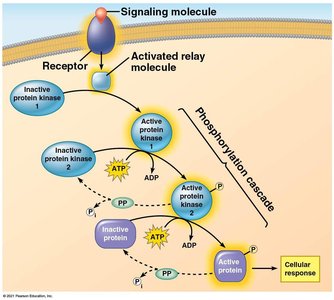
Phosphorylation Cascade: Series of events where proteins are phosphorylated to amplify the signal.
Apoptosis: Programmed cell death, essential for development and disease prevention.
Equations and Pathways
cAMP Formation:
Phosphorylation Cascade:
Additional info: This guide expands on brief notes with academic context, definitions, and examples to ensure completeness and clarity for exam preparation.
