 Back
Cell Communication and Signal Transduction: Chapter 11 Study Guide
Study Guide - Smart Notes
 Tailored notes based on your materials, expanded with key definitions, examples, and context.
Cell Communication
Introduction to Cell Signaling
Cell communication is essential for the coordination and regulation of biological processes in multicellular organisms. Cells use signaling molecules to convey information, enabling responses to environmental cues and internal states. - Cell signaling involves the transmission of signals from the environment or other cells to trigger specific cellular responses. - Signaling molecules include hormones, neurotransmitters, and local regulators. 
Types of Cell Signaling
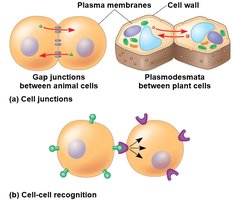
Cells communicate through various mechanisms, which can be classified based on the distance over which the signal acts. Local signaling occurs between cells in close proximity, while long-distance signaling involves signals traveling through the organism.
Direct contact: Animal cells use gap junctions; plant cells use plasmodesmata.
Paracrine signaling: Local regulators affect nearby cells.
Synaptic signaling: Neurotransmitters cross synapses in nervous tissue.
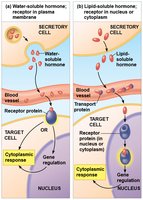
Endocrine signaling: Hormones travel via the bloodstream to distant target cells.
The Three Stages of Cell Signaling
Overview of Signal Transduction
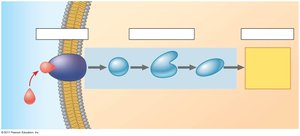
Cell signaling typically follows three stages: Reception, Transduction, and Response.
Reception: The cell detects a signaling molecule via a receptor protein.
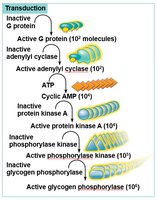
Transduction: The signal is relayed and amplified through a cascade of molecular events.
Response: The cell executes a specific action, such as gene expression or metabolic change.
Signal Reception: Membrane and Intracellular Receptors
Membrane Receptors
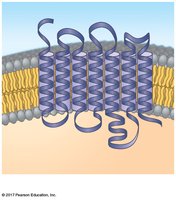
Most signal receptors are proteins embedded in the plasma membrane. There are three main types:
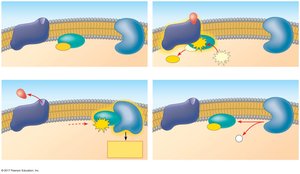
G protein-coupled receptors (GPCRs): Activate G proteins upon ligand binding.
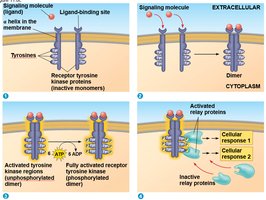
Receptor tyrosine kinases (RTKs): Transfer phosphate groups to proteins, triggering multiple pathways.
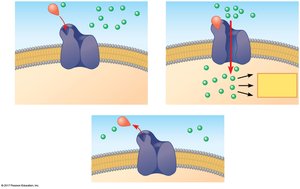
Ion channel receptors: Open or close in response to ligand binding, allowing ion flow.
Intracellular Receptors
Some signaling molecules, such as steroid hormones, cross the plasma membrane and bind to receptors inside the cell. - Intracellular receptors are found in the cytoplasm or nucleus. - The hormone-receptor complex often acts as a transcription factor, regulating gene expression. 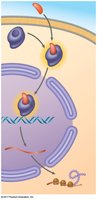
Signal Transduction Pathways
Protein Phosphorylation and Dephosphorylation
Signal transduction often involves cascades of protein phosphorylation, which regulate protein activity. - Protein kinases transfer phosphate groups from ATP to proteins (phosphorylation). - Protein phosphatases remove phosphate groups (dephosphorylation). - This system acts as a molecular switch, controlling cellular activities. 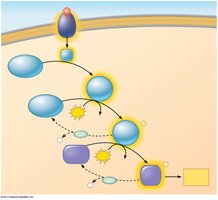
Second Messengers
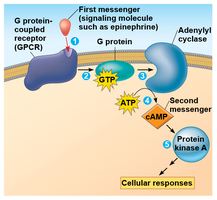
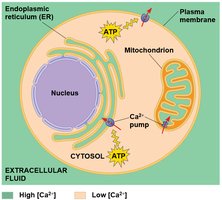
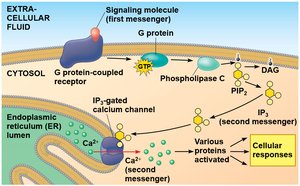
Many pathways use small, nonprotein molecules called second messengers to relay signals. Common examples include cyclic AMP (cAMP) and calcium ions (Ca2+).
Cyclic AMP (cAMP): Produced by adenylyl cyclase from ATP; activates protein kinase A.
Calcium ions: Concentration changes trigger various cellular responses; often released via IP3 signaling.

Cellular Responses to Signals
Regulation of Transcription and Cytoplasmic Activities
The final outcome of cell signaling is a specific cellular response, which may involve changes in gene expression or enzyme activity. - Transcription factors are often activated, leading to synthesis of new proteins. - Other pathways regulate enzyme activity directly, affecting metabolism. 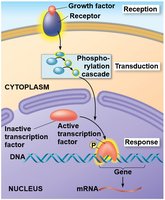
Regulation of the Response
Signal regulation ensures appropriate cellular outcomes. Four key aspects are:
Amplification: Enzyme cascades increase the magnitude of the response.
Specificity: Different cell types respond differently to the same signal.
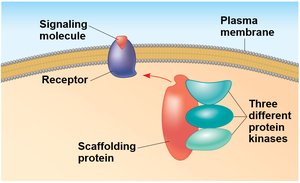
Efficiency: Scaffolding proteins organize signaling components for rapid response.
Termination: Inactivation mechanisms ensure signals are not perpetuated indefinitely.
Summary Table: Types of Cell Signaling
Type | Distance | Example |
|---|---|---|
Direct contact | Adjacent cells | Gap junctions, plasmodesmata |
Paracrine | Local | Growth factors |
Synaptic | Local | Neurotransmitters |
Endocrine | Long-distance | Hormones |
Equations and Key Concepts
Protein Phosphorylation
cAMP Formation
Signal Amplification
Review: The Three Stages of Cell Signaling
Reception: Detection of signaling molecule by receptor.
Transduction: Relay and amplification of signal via molecular cascades.
Response: Execution of cellular action (gene expression, metabolism, etc.).
Example: Cell Signaling in Animal Behavior
Fight-or-Flight Response in Impala
When an impala senses a predator, its brain signals the adrenal glands to release epinephrine, triggering a cascade that mobilizes glucose for rapid muscle activity. 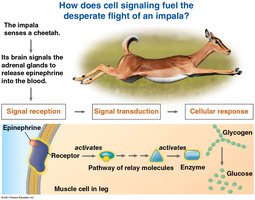 Key Point: Cell signaling enables organisms to respond rapidly and specifically to environmental challenges.
Additional info:
- The notes expand on brief points with academic context, definitions, and examples. - Images are included only when directly relevant to the explanation. - All equations are provided in LaTeX format as required.
